
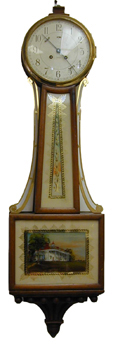
Clock maker: Chelsea Clock Company
Location: University Hall 301, Registrar Counter
Catalogue number: Historical Property #2319
Height: 37 1/4 in.
Width: 10 1/4 in.
Depth: 4 in.
Country: Boston, USA Date: 1938
Marks:
Maker's Mark: Chelsea (brass plaque in base)
Donor's plaque:
To Frederick Taft Guild of the class of 1890 Assistant Secretary of the Corporation for many years. Following forty-eight years of Continuous Service with the University June 1890-June 1938 From Members of the Corporation of Brown University Inside note: "Please make sure to stop at the 1/2 hour and hour and let the clock chime before changing the clock time (each 1/2 hour and hour)."
| Clock | Low Resolution | Medium Resolution | High Resolution |
| Detail | Low Resolution | Medium Resolution | High Resolution |
Provenance: On June 30, 1938, the registrar of Brown University for 47 years, Frederick Taft Guild, retired. Members of the Corporation honored Guild by presenting him a Chelsea clock. This act carries great meaning, for from the very beginning in 1897, when the first Chelsea clocks were made, it has became a tradition for U.S. Presidents to present these distinguished timepieces to visiting heads of state. The presentation, an expression of Mr. Guild's long service to Brown was made by Dr. Hermon C. Bumpus, a senior Fellow.
Frederick Taft Guild was born Providence, Aug. 13, 1868, son of Clarence H. Guild and Sophie (Howland) Guild; and died in Providence, May 9, 1941. He received his A.B. degree from Brown in 1890 and a M.A. in chemistry the following year and was made honorary member of Delta Phi fraternity. He served as instructor in chemistry at Brown in 1890.
When Frederick Guild assumed the office of registrar and secretary of the faculty in 1891, he constituted one-half of Brown University's administrative staff; the other half was President Benjamin. Guild also served under Presidents William H.P. Faunce, Clarence A. Barbour and Henry M. Wriston. Officials estimated Guild had arranged some 11,320 diplomas for presentation by four presidents since 1891.
In 1937, Guild was elected Honorary Fellow of the American College of Dentists in recognition of four years of service in appraising scholastic credentials of candidates for admission to the dental school of the United States for the Dental Education Council of America.
On Oct. 10, 1894, he married Alice Elizabeth Drowne, who died in 1940. During his last few years, he had made his home at the University Club.
As to whether students have changed since the 1890s, Guild reported to the Providence Journal (Tuesday July 9, 1935), "There may be just one change in the student. When I first assumed my duties here a student registered for a college education with a definite idea in his mind. He wanted to be a teacher, or a lawyer or a minister. Now, many come here simply for a college education and half of them don't know what they will do after they graduated. So I suppose that does constitute a change although I attributed it to the fact that more parents are interested in seeing that their children are given the best educational advantages possible."
Clockmaker biography: The earliest clockmaker in Massachusetts was Simon Willard who, in 1802, invented his famous Willard Banjo Clock.
Edward Howard was an apprentice of Aaron Willard Jr., nephew of Simon Willard. Howard started in business for himself in 1840. One of Howard's apprentices was a Joseph Eastman. In 1886 Eastman built a factory on Everett Avenue in Chelsea, MA, and called it the Eastman Clock Company.
Chelsea's production began in 1897 with the introduction of the "Ship's Bell" clock containing a specially designed clock works that replaced the pendulum. Patented in the United States and England, Chelsea rapidly expanded its offering of Ship's clocks to include a wide variety of clocks for home and office. It was Eastman's idea to put the watch escapement in a high-quality striking clock for home use. He argued that it could make an excellent timekeeper, that it would run in any position, and that it would not have to be set plumb on the mantle as pendulum clocks did. It would be small and compact and lend itself to small cases. After experiencing operating difficulties, the name of the company became the Boston Clock Company and Charles H. Pearson of Brookline bought the business in 1897. At this time Pearson changed the name yet again to what it is now known today as the Chelsea Clock Company.
Chelsea clocks are used in a great variety of instruments for recording purposes, in particular the measurement of water supply and in hydroelectric development over a period of ten years, such as that in the Tennessee Valley. They also measure the amount of water taken out of the Great Lakes for the sewage disposal of the City of Chicago. Those that were built to customers' specifications include the measurement of electricity generated by Niagara Falls and the countdown to electrocutions at Atlanta Penitentiary.
Chelsea has done major projects with the U.S. Navy, Williamsburg Reproductions, Tiffany Studios, the Smithsonian, the Macmillan's Arctic Expedition of 1922 to record the magnetism at the North Pole and Admiral Byrd's South Pole expedition to record temperature, pressure and humidity. In these special expeditions, the clocks had to be specially oiled with low teperature oil before use. During the World Wars, Chelsea movements were used in connection with fire control mechanisms on battleships and dead reckoning tracers. [1]
Related information:
Advertisements printed by the Chelsea Company can be found at Chelsea Clock Museum
Chelsea Clock Museum. One proudly displayed the timetable (below) of how a Chelsea clock could chime every 30 minutes, instead of every hour. Ironically, this would become an annoyance to contemporary owners.
12.30 DING
1.00 DING, DING
1.30 DING, DING-DING
2.00 DING, DING-DING, DING-DING etc..
References:
[1] Source: History of the Chelsea Clock Company
History of the Chelsea Clock Company