
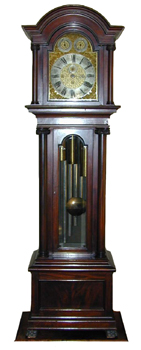
Clock maker: Works by J.J. Elliot, Tubular bells by Harrington, Case by Walter Durfee
Location: Admissions 109, "Socrates Room"
Catalogue number: Historic Property #343
Height: 90 in.
Width: 24 1/4 in.
Depth: 18 1/4 in.
Country: England Date: 1890-1900
Marks:
On face: Elliot, London
On works: J.J. Elliot 121 & 123 Rosebury Avenue London, England H+H 752
H + H marked on the tubes refers to Harris & Harrington. Many case for Elliot clocks were made by Walter Durfee of Providence
| Clock | Low Resolution | Medium Resolution | High Resolution |
| Side Detail | Low Resolution | Medium Resolution | High Resolution |
| Base Detail | Low Resolution | Medium Resolution | High Resolution |
The mass of its 8 chiming zinc tubes, molding strip panels and hefty base not only demands an extra wooden foundation board to steady the whole article on the soft carpeted floor, but can be read in the density of rose and sunflower relief cast on its face. Depending on the choice of the silence/strike and options dial placed within the dial's arch, a Westminster or Whittington melody might escape through the cloth panel in its back on the quarter-hour and on the hour.
Provenance: No donor's plaque visible.
Clockmaker biography: About Walter Durfee: Walter Durfee began selling antique furniture in Providence in 1877, and from the beginning he had specialized in tallcase clocks, taking full advantage of the interest revived in them by Longfellow's poem, "The Old Clock on the Stairs." Beginning in 1880, a year before he formed "Durfee & Enches" with Providence antique collector Charles Pendleton, they had traveled to England in search of antiques. Through this and subsequent trips of the early 1880s, Durfee came into contact with manufacturers of clocks and cases who would later ship the parts to the United States, which he would reassemble in Providence. When he added a bell chime, recently patented in England, he enhanced the demand for hall clocks in America to such an extent that he became known as "the father of the modern grandfather clock." Durfee so frequently visited England to check his suppliers that by 1902, he had made nineteen round trips. He also served as a scout for antiques for Charles Pendleton and several of his collecting friends. [1]
About John Harrington: In 1884, John Harrington, of Coventry, Warwick County, England patented the first clock-chime of tubular bells. It was an immediate success, winning gold medals at Paris in 1885 and at Liverpool in 1886. Within a few years, they were being used in England in both hall clocks and bell towers.
J.J. Elliot, from Clerkenwell, a clock maker till his death in 1904, was based in London and employed at Harris & Harrington (H & H) as its sales representative
In 1886, Walter H. Durfee, an antiques dealer from Providence, who had recently begun importing English longcase movements to America, met Harrington while on a business trip to England. They saw the possibility of using John Harrington's tubes as clock bells, with Elliot's clock movements in longcase clocks.
In 1887, Harrington's American patent #372,849 for a clock chime apparatus was assigned to Walter H. Durfee. With the protection of this patent, Durfee was the monopolist of American tallcase clocks with tubular chimes, which he assembled in high-quality cases. [2]
In ca. 1894, Durfee was able to stop importing Harrington's tubular tower bells and began manufacturing his own. James E. Treat of Methuen Organ Company in Boston had assigned his American patent for a tubular bell to United States Tubular Bell Company of which Walter H. Durfee was the president.
In 1900, Wallen W. Harrington, a U.S. citizen residing in New York, obtained American patent #656,603 and assigned it to Harris & Harrington's American office in the same city. The Harrington firm had bypassed Durfee to sell directly into the American market. [3]
Related information:
The tallcase clocks at Maddock 200, English Department and Pembroke Hall were also made by Walter Durfee.
References:
[1] Monkhouse, Christopher P. "Cabinetmakers and Collectors: Colonial Furniture and its Revival in Rhode Island." In Monkhouse, Christopher P. and Thomas S. Michie, ed., American Furniture in Pendleton House. Museum of Art, Rhode Island School of Design, Providence, Rhode Island, 1986. p. 17-18.
[2] Patent #568,816 was for a tubular bell reinforced by an annular ring inside an/or outside of the top edge. Treat was an organ builder, and at one time controlled the Methuen Organ Company, so it is possible that this patent was related to the use of tubular bells in pipe organs.
[3] Patent #656,603 was for a tubular bell for chiming clocks, a patent claim that was based on the addition of diaphragms at both ends of the rube, with a small axial perforation in the one at the top and a larger axial perforation in the one at the bottom.