
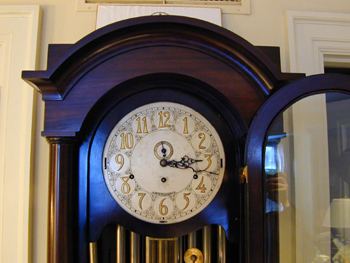
Clock maker: Charles Jacques
Location: John Hay Library 106
Catalogue number: Historic Property #1453
Height: 77 in.
Width: 25 7/8 in.
Depth: 16 ¼ in.
Country: New York City Date: ca. 1880
Marks:
Jacque Reg. U.S. pat. Off Baden 1965
Donor Plaque:
Presented to Brown University In Memory of Antonio Alfred Capotosto, Associate Justice Supreme Court of Rhode Island
Capotosto 1879-1962
| Face | Low Resolution | Medium Resolution | High Resolution |
| Side View | Low Resolution | Medium Resolution | High Resolution |
| Pendulum | Low Resolution | Medium Resolution | High Resolution |
Provenance: Presented to Brown University in memory of Antonio Alfred Capotosto, Associate Justics, Supreme Court of Rhode Island. Capotosto 1879-1962.
Clockmaker biography: Jacques Clock Co., operated from Cortland Street, New York City, ca. 1880.
In 1901, Charles A. Jacques obtained two American patents for various "improvements" on the tubular bell invented by John Harrington of England. Jacques' patents enabled American clockmakers to produce longcase clocks with tubular chimes of their own design. Before this, Walter H. Durfee, Providence, Rhode Island, was sole importer of the Harrington tubular bells from England. Consequently, Durfee's production of such clocks declined. [1]
References:
[1] Patent #685,045 for creating variations of a hammer mechanism for striking tubular bells. Patent #686,301 included a solid cap closing the top of the tube, a transverse tube enclosing the supporting cable, and tuning by means of cutting away part of the tube or perforating or notching it. Jacques' patent was assigned to Bawo & Dotter, a corporation of New Jersey.