
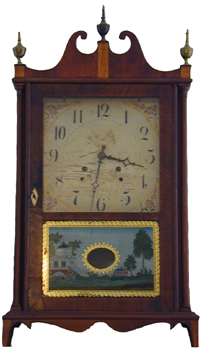
Clock maker: Eli Terry
Location: Maddock Alumni Center 201
Catalogue number: Historic Property #569
Height: 32 in.
Width: 17 5/8 in.
Depth: 4 1/2 in.
Country: USA Date: ca. 1824
Marks:
Paper label
Patent clocks, invented by Eli Terry, made and sold at Plymouth, Connecticut, by E. Terry & Sons, warranted if well used N.B. The public may be assured that this kind of clock will run as long without repairs and be as durable and accurate for keeping time as any kind of clock whatever.
Instructions for clock: when winding this clock, the left keyhole goes clockwise and the right goes counter clockwise. Do not wind too tight. The hands can be moved forward (only minute hand!) but never move it back beyond the 12. The clock can be made to go faster or slower by screwing the knob below the pendulum up or down.
| Clock | Low Resolution | Medium Resolution | High Resolution |
| Case (w/ door open) | Low Resolution | Medium Resolution | High Resolution |
| Painting Detail | Low Resolution | Medium Resolution | High Resolution |
Provenance: No donor's plaque visible.
Clockmaker biography: Eli Terry was born in East Windsor, Connecticut on April 13, 1772, the son of Samuel and Hildah Burnham. He was the first to manufacture clocks in large quantities in America and became known as the "father of American clockmaking." He is famous for his clocks, wooden clock movements, and patents, including the first U.S. Patent Office patent for a clock mechanism in 1797.
Terry made his first clock in 1792 using brass movements then wooden ones, which he perfected from 1809, after nine patents was issued to his company in Plymouth, Connecticut. In 1816, Eli Terry patented the shelf clock (or bracket clock). The clock's smaller size resulted in a selling priced that was "cheaper including the case." It was easily moved from one room to another and "with the weights in sight, the owner was more likely to remember to wind it." [1] His signature piece was the Pillar Scroll Top. In 1818, his sons Eli Jr. and Henry Terry joined the firm and they were known as E. Terr & Sons between 1824 and 1827.
Eli Terry retired with a fortune ca. 1834, and continued to make occasional brass movement clocks and tower clocks, turning his business into his hobby. Penrose Hoopes said of him, "His shop was one where pride of workmanship and high personal skill were combined to make fine clocks." Eli Terry died in Terryvile on February 24, 1852, aged 80. In ca. 1862, his son sold the company to Seth Thomas Clock Co. [2]
References:
[1] Zea, Philip and Cheney, Robert. Clock Making in New England 1725-1825. Old Sturbridge, Inc. 1992. p. 127.
[2] Palmer, Brooks. The Book of American Clocks. The Macmillan Company, New York. 1959.