
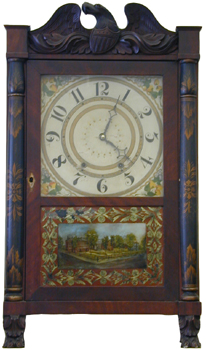
Clock maker: Seth Thomas
Location: Nicholson House 201
Catalogue number: No Historic Property number visible
Height: 29 3/4 in.
Width: 16 1/2 in.
Depth: 4 3/4 in.
Country: Plymouth, Connecticut Date: 1830-1870
Marks:
Seth Thomas
| Clock | Low Resolution | Medium Resolution | High Resolution |
| Interior | Low Resolution | Medium Resolution | High Resolution |
| Mantel Painting | Low Resolution | Medium Resolution | High Resolution |
| Mantel Painting, Reverse | Low Resolution | Medium Resolution | High Resolution |
| Eagle and Shield | Low Resolution | Medium Resolution | High Resolution |
Provenance: No donor's plaque visible.
Clockmaker biography: Seth Thomas, born on August 18, 1785 in Greystone, Plymouth, Conn. son of James and Martha Thomas, died January 29, 1859. He had learnt cabinet making in ca. 1818 and was licensed to manufacture some 4,000 clocks for Eli Terry, whose sons were still too young to enter the business then (1817 to 1823). Terry and Thomas were joined by Silas Hoadley and they made wooden 30-hour movements, tall clock cases, and was called Terry, Thomas & Hoadley. After Terry sold his share in 1809, Thomas & Hoadley continued successfully until 1813, when Thomas sold his interest and moved to Plymouth Hollow where he started Seth Thomas Clock Co., which employed more the 900 people in 1853. Seth Thomas eventually adapted the design to his advantage with an off-center pendulum which differed significantly with the patent. [1] Plymouth Hollow was named "Thomaston" in 1866 in his honor. [2]
The Pillar and Scroll clocks using wooden movement were successful until 1838, when the 30-hour brass movement was adopted. By ca. 1850, almost all clock weights had been replaced by springs.
References:
[1] Zea, Philip and Cheney, Robert. Clock Making in New England 1725-1825. Old Sturbridge Inc. 1992, p. 127.
[2] Palmer, Brooks. The Book of American Clocks. The Macmillan Company. New York, 1959.