
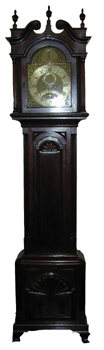
Clock maker: Samuel Toulmin
Location: University Hall 115, Provost's Office
Catalogue number: Historic Property #321
Height: 93 in.
Width: 22 3/4 in.
Depth: 12 in.
Country: Strand, London Date: 1720-1760
Marks:
Sam Toulmin, Strand London
Inside door: MAILS Post-Office Providence [Picture of horse carriage] Winter Arrangement of the Mails from Oct. 15, 1807 to April 15, 1808
A note: John Gano Benedict was named for the Rev. John Gano, his uncle. The Rev. Steven Gano wa also his uncle. His Grandfather was Rev. David Benedict. The pictures of these men are in the Historical Society with their histories and sermons. - Mary Benedict. A Picture with caption "This is John Gano Benedict."
Fragment of what could be a Calendar or Time equation table
| Clock | Low Resolution | Medium Resolution | High Resolution |
| Dial | Low Resolution | Medium Resolution | High Resolution |
| Interior | Low Resolution | Medium Resolution | High Resolution |
| Base Carving | Low Resolution | Medium Resolution | High Resolution |
| John Gano Benedict | Low Resolution | Medium Resolution | High Resolution |
The arched dial is decorated with cast brass spandrels. A strike, silent finger mechanism occupies the boss, while the chapter ring is engraved with Roman hour numerals, Arabic minute numerals and minute gradations.
In the style of this early period is a pair of non-matching hands, anchored between a second's dial and a calendar aperture showing the date of the month. The minute needle straight as an arrow appears indifferent to the trellis of its counterpart.
Provenance: Rev. David Benedict, grandfather of John Gano (left) was born in Norwalk, CT in 1779. Graduating from Brown in 1806, Benedict was pastor of the First Baptist Church of Pawtucket, postmaster of the town and was well-known as the author of several religious historical books, such as General History of the Baptist Denomination, The History of Pawtucket, Rhode Island and was working on The History of Donatists at the time of his death in 1874, at the age of 95. In 1808, he married Margaret Hubbel Gano, daughter of Rev. Stephen Gano, and Vornelia Vavasour. Maria M. Benedict, the youngest of Benedict's ten children, was the only one who outlived him. Upon her death in 1891, she bequeathed, "To John Gano Benedict, son of my brother Joseph Brown Benedict the old fashioned upright clock on my stairs ..." then valued at $50.00.
John Gano, uncle of the above owner of the clock depicted in the photograph, was born at Hopewell, N.J. on the 22nd of July 1727 and was a chaplain in the Revolutionary War. At the close of 1754 or early 1755 he married Sarah Stites, daughter of the highly respected John Stites of Elizabethtown, N.J. She was the sister of the wife of Dr. Manning, the first President of Rhode Island College (Brown University). They had a number of children, one of whom Stephen, the second son, became Pastor of a Baptist church in Providence. John Gano died in 1804, aged 77.
Clockmaker biography: Before the Revolution, the lack of artisans due to the close social and economic ties with England had resulted in clocks being imported from England in sufficient numbers to supply those of the gentry who desired time-keeping devices. [1] The clock in the Provost's Office is one such instance, and was imported from a large, respectable district of London better known for watch-making than clock-making. Strand, London was the place where David Hubert (1714-48) created one of the earliest specimens of silver case repeating watches that sounds the minutes, and an early work of bracket clock repeating the quarters on six bells by the pull of a cord. John Holmes, one of the experts appointed by the House of Commons in 1791 to report on Mudge's timekeepers, was also located at 156 Strand. Samuel Toulmin's shop at 27 Strand produced center-seconds watch with cylinder escapement, two of which were collected by the Guildhall Museum and the Science Museum of South Kensington, England. [2]
Related information:
[1] An extremely rare automation longcase clock depicting in the arch of the brass dial, two people playing tennis, knocking the ball to and fro with their rackets to the beat of the second, ca. 1770.
[2] Retrieved at Fine Antique Clocks
Fine Antique Clocks