
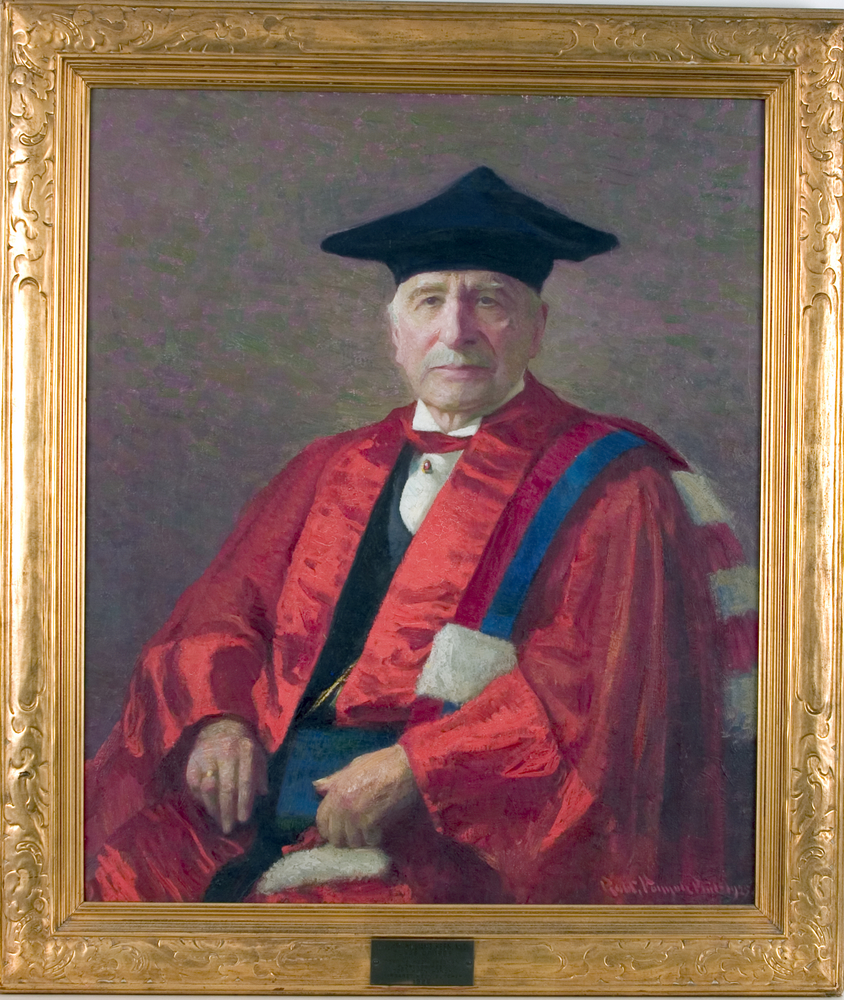
Keen, William Williams (1837-1932)
Role: Class of 1859Dates: 1859 - 1932
Portrait Location: Library Annex
Artist: Vonnoh, Robert (1858-1933)
Portrait Date: 1925
Medium: oil on canvas
Dimensions: 35 3/4" x 29 3/4"
Framed Dimensions: 43 3/4" x 37 3/4"
Brown Portrait Number: 120
Brown Historical Property Number: 1277
In the "Encyclopedia Brunoniana," University Archivist Martha Mitchell writes: William Williams Keen (1837-1932), eminent surgeon, member of the class of 1859 and long-term member of the Corporation, was born in Philadelphia on January 19, 1837. He was a descendant of Joran Kyn, an original settler of Chester, Pennsylvania. At Commencement in 1859 he was valedictorian of his class and delivered an oration on "The Scholar's Sentiment of Veneration for the Past." He remained at Brown for an extra year to prepare for his medical studies and entered Jefferson Medical College in Philadelphia in 1860. He supplemented his course of lectures and attendance at the medical clinics, where there was no personal contact between the students and the patients. The faculty, some of whom had never practiced medicine, took turns at clinical teaching. As a private office student of Jacob M. DaCosta and John H. Brinton, Keen took his practical training in surgery with Brinton, who recommended him as surgeon for the Fifth Massachusetts Regiment in July 1861. He cared for the wounded at the Battle of Bull Run and was discharged soon afterward when the enlistment of his regiment expired in September 1861. He finished his course at Jefferson Medical College and received the M.D. degree in March of 1862. Two months later he was commissioned as Acting Assistant Surgeon in the United States Army and was placed in charge of Eckington General Hospital near Washington, where his orders were to convert two churches into hospitals. Later he went with a supply train to Pope's army and witnessed the Second battle of Bull Run.
In May 1863 Keen was sent to Philadelphia to be resident surgeon in special wards in the Christian Street Hospital devoted to the treatment of injuries and diseases of the nerves. There he was associated with Dr. S. Weir Mitchell and Dr. George R. Morehouse, with whom he wrote "Gunshot Wounds and Other Injuries of Nerves," published in 1864. In 1864 he went to Europe and studied in Paris and Berlin. He returned in 1866 to lecture at Jefferson Medical College and to direct the Philadelphia School of Anatomy. His medical practice was slow in growing. Dr. Wilfred Pickles, in a biographical sketch in the Rhode Island Medical Journal in January 1927, when Keen was ninety, noted that after five years in practice, in the month of June, Keen saw a total of seven patients, of whom three were charity cases. Two disappeared without paying him, and the other two paid him one dollar each.
When Joseph Lister came to Philadelphia in 1876, Keen heard his views on antisepsis in surgery and was one of the first American surgeons to adopt Lister's system. Keen was professor of artistic anatomy at the Pennsylvania Academy of Fine Arts from 1876 to 1890, professor of surgery at the Women's Medical College from 1884 to 1889, and professor of surgery at Jefferson Medical College from 1889 to 1907. He was said to have performed the first successful operation for brain tumors in 1887, and in 1893 he assisted Dr. Joseph D. Bryant in operating on President Grover Cleveland. The knowledge that Cleveland had a malignant growth in his left jaw was, in the best interests of the country, kept secret, and the operation was performed in New York City on a yacht moving at half speed up the East River. When a second operation was performed, Cleveland was fitted with a rubber plate, with no one the wiser, and lived for fifteen more years. The story of the operation became known in 1917, after which Keen wrote a little book, "The Surgical Operations on President Cleveland in 1893." He also wrote many medical articles and, with Dr. J. William White, edited the first surgical textbook in the English language in 1892. He believed in evolution and supported animal experimentation. He published "Animal Experimentation and Medical Progress" in 1914, and "I Believe in God and in Evolution" in 1921. He began his monumental "Surgery," which contained articles by about a hundred American and British authors, in 1905 and issued the eighth and final volume in 1921.
Keen retired from the active practice of medicine in 1907. In that year he was the delegate of the American Philosophical Society to the celebration of the two hundredth anniversary of the birth of Carolus Linnaeus held at the University of Upsala in Sweden, and was the recipient of an honorary Ph.D. degree from that institution, which on that occasion awarded degrees to foreigners for the first time. In 1908 he became president of the American Philosophical Society. Among the other honors conferred upon him were honorary degrees from the Universities of Edinburgh and St. Andrews and honorary fellowship in the American College of Surgeons and the Royal College of Surgeons of Edinburgh. He was elected president of the International Surgical Congress, the first American so honored, and created an officer of the Order of the Crown of Belgium. He was a trustee of Brown University from 1873 to 1895 and a Fellow from 1895 to 1932. He was awarded the Susan Colver Rosenberger medal in 1925. He died on June 7, 1932.
A bronze plaque profile portrait of William Williams Keen by the sculptor R. Tait McKenzie hangs in the Champlin Memorial Library of the Alpert Medical School at Brown.
The Boston impressionist painter Robert Vonnoh studied in Paris at the Academy Julian, and with Gustave Boulanger and Jules-Joseph Lefebre. His own students included Robert Henri. Vonnoh specialized in portraits and landscapes. His portrait of William Williams Keen is signed and dated 1925.