
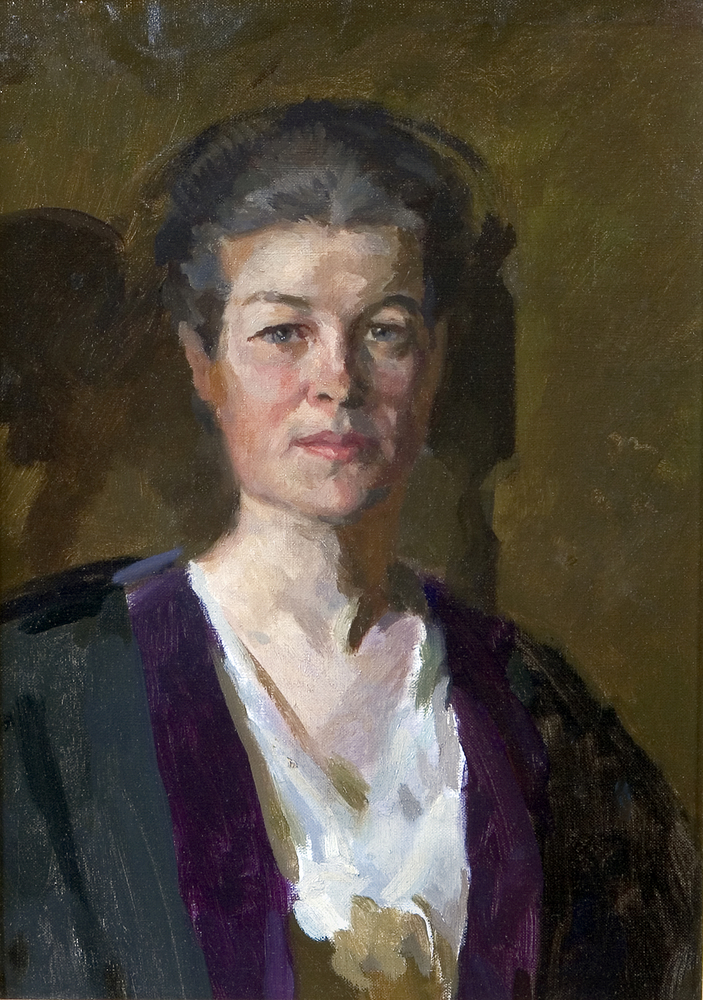
King, Lida Shaw (1868-1932)
Role: Third Dean of Pembroke CollegeDates: 1895-1920
Portrait Location: University Hall 311
Artist: Drury, Fritz ()
Portrait Date: 1999
Medium:
Dimensions:
Framed Dimensions:
Brown Portrait Number: 282
Brown Historical Property Number: 0
Lida Shaw King was a classical scholar and one of the pioneers in early 20th century women's higher education. Born to the family of a Baptist minister in Boston and descended from Mayflower pilgrim, John Alden, King fit in well at Brown University, where a stringent preference for New England Baptists remained the rule until 1926. The youngest of three daughters, her father was the pastor of the First Baptist Church in Providence from 1891-1906.
As an ambitious female scholar in an era when the vast majority of women were full-time homemakers, however, King was more often conspicuous on the academic landscape. In the pursuit of a higher education and an academic career at a time when such aspirations were rare and unconventional for women, she had to struggle against her father's opposition in realizing her plans. Indeed, her predecessor at Brown's Women's College stepped down upon marriage to remain at home (BP 109). King graduated from Vassar College in 1890, and then went on to earn a Master of Arts degree from Brown in 1894, the first year women were awarded degrees. King pursued graduate work in classics at both Vassar and Radcliffe Colleges until 1898, when she became a teacher in, and later director of, the Department of Greek and Latin at the Packer Collegiate Institute. In 1899 she was awarded the prestigious Bryn Mawr Fellowship to study at the American School of Archaeology in Athens. She returned to Athens again the following year as an Agnes Hoppin Memorial Fellow. King and former student Ida Thallon became the first women to conduct an archaeological dig on mainland Greece, and in 1903 King published an article in the Journal of the Archaeological Institute based on their excavations in a cave mythically associated with Pan and the nymphs.
In 1905, King was invited to Brown as the third dean?and second female dean?of the Women's College, and was offered an assistant professorship. She was named full professor of classical literature and archaeology in 1909, becoming the lone woman on a university faculty of over a hundred men. King excelled not only in scholarship and teaching, but in administration as well. During her fifteen years as Dean of the Women's College, she increased its funding five fold, and enrollments more than doubled. In addition, under her leadership, two new dormitories were built on campus, and the Rhode Island Society for the Collegiate Education of Women allotted her a discretionary fund for social and cultural events. Her work at the Women's College was consistent with her goals of bringing more women into higher education and improving the standards of women's education. King was awarded honorary degrees from Mount Holyoke College (Litt. D., 1912) and from Western Reserve University (LL.D., 1913).
In 1922, King retired and President Faunce reported that she planned "to return to Greece to pursue her favorite studies in classical archaeology." In fact, it was mental illness that had cast its shadow on a brilliant career, a shadow that grew deeper in the decade to come. King never returned to Brown, and died in 1932. During a memorial service at the Women's College (renamed Pembroke College in 1928), a letter from one of her former students was read aloud:
"She is in my memory a flower, with sweetness and graciousness so delicate that not everyone could appreciate her charm, and at the same time with an inner austerity in her demands on herself that half awed the young cubs that we were. I could always go to her for impartial justice, for a strengthening of my aspirations toward gentle living; but a frank rebuke was sure to meet anything that fell below the high standard she set for herself and us....I've always been glad that the portrait presented to the college represented her at her sunny and gracious best."
This portrait of Lida Shaw King is the study made by Ralph Orin (Fritz) Drury in preparation for his full-scale copy of the original painting by Frank Benson in 1913. This 1999 copy reflects the high priority Brown President Vartan Gregorian (1989-1997, BP 273) placed on bringing diversity to the Brown community. Under Gregorian's tenure the number of women faculty increased by 40 percent, and the Brown community considered it important that the Sayles Hall gallery reflect this diversity. To begin the project of creating a new portrait, Benson's original was cleaned and restored. Drury then copied from Benson's original portrait, setting up his easel every week next to the original in Alumnae Hall, and then returning to his studio with his canvas to work on refinements. Toward the end of the project, as he was taking the full-sized copy back to his studio, he was challenged by an officer from Brown's Police and Security, who was concerned that he was taking the original Benson portrait. It was then that Drury knew his painting had passed the true test. "This project was a joy to work on," Drury wrote Brown's curator, "a beautiful painting; a series of marvelous, well-lit studios; freedom from the noisy bustle of life at school." In addition to the copy portrait of Lida Shaw King, Fritz Drury was commissioned to paint the Sayles Hall portraits of Sheila Blumstein, Interim President, Dean of the College and Albert Mead Professor (BP 278), and of Frederick Lippitt, Trustee and Fellow (BP 302.)