

| Brown Inventory ID: |
C-1747 |
| Artist: | Kauffmann, Angelica |
| Nationality: | German |
| Artist Dates: | 1741-1807 |
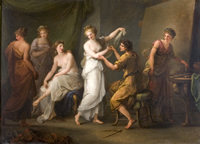
| Title: | Zeuxis Selecting Models for his Picture of Helen of Troy |
| Medium: | oil on canvas |
| Dimensions: | 30 3/4 in. h. by 43 in. w. |
| Acquisition Date: | Before 1907 |
| Provenance: | Rush C. Hawkins note: "The original of Angelica K -- was bought by J Corbett (en?) at the Rushout Bowles sale in 1879 for 136 pounds and George Bowles of the Grove, Wanstead has owned it since 1792." (Gerard, p 342.) |
| Hawkins Catalog Entry: | Yes, included in 1913 catalog |
| Hawkins Artist: | KAUFFMANN, ANGELICA |
| Hawkins Dates: | 1741-1807 |
| Hawkins School: | German School |
| Hawkins Note: | Maria Angelica Kauffmann was born at Coire, and taught by her father. Her precocity in music, languages, and painting is said to have been great. In 1754 her family took her to Milan, where she copied the masters. In 1759 she was in Rome, there painting portraits and attracting much attention. She went to Venice 1764 and thence in 1765 to England. There she was elected a foundation member of the Royal Academy. She is one of two cases, if not the unique instance, of a woman being member of the Royal Academy. She was unlucky in love, marrying a polygamist valet whom she mistook for his master. She had to pay out some L300 before she was relieved of him. Then she married Zucchi, an Italian painter and Associate of the Royal Academy. With him she returned to Italy. Angelica has the reputation of having been one of the most charming and accomplished women of her day; her social success in London was prodigious. Reynolds painted her twice. She died in Rome, 1807; pictures by her are in the Berlin, Dresden, Munich, St. Petersburg, and Vienna Galleries. |
| Hawkins Title: | No. 21. ZEUXIS SELECTING MODELS FOR HIS PICTURE OF HELEN OF TROY |
| Description: | Zeuxis is seated in the right centre profle left. Before him stands a woman turned to the right, and looking down to the left front. The painter holds her right arm, her left is raised holding a drapery. Further to the left sits a woman with a white robe round her waist unfastening her left sandal. Her torso is bare, and she looks towards Zeuxis. Two more women stand on the left, one with her back to the spectator, looking out of the picture to the left. On the right by Zeuxis' painting table a girl picking up a brush. A large clean canvas in the right background. Signed "Angelica Kauffmann Pinx." An admirable example of late XVIIIth Century classicism. Zeuxis, the best known of the Greek painters, but not the peer of the greatest, flourished about 468 B.C. He painted a picture of Helen of Troy, afterwards placed in the temple of Juno Lacinia, in Italy. This he painted for the people of Crotona who accommodated him with the choicest of their maidens for models. Zeuxis, like Paris in the celebrated Judgment, had to select the most beautifully formed of these girls, and ultimately retained five. In the above picture his models are preparing for a sitting. The fine spirit of the Crotonans, who were proud that their virgins should be the material for the great artist's inspiration, was echoed during the French Revolution, when it was a matter of emulation and great honour that the girls of the best standing in Paris should pose naked for Louis David's classic pictures. |
| References: | Hawkins Scrapbook 'Newspaper Cuttings Personal', p 89: Providence Tribune 23 June 1907. ". . . a graceful work, "Zeuxis Arranging the Pose for the Portrait of Juno." There is light and warmth, but above all, grace of attitude and movement in this admirable work; we might guess that the artist - was the case - was a musician as well as a painter from the touch of melody and motion she has given to this admirable scene." Gerard, Frances A. Angelica Kauffman. A Biography. London, Ward and Downey . . . 1892. 1983 Wendy Wassyng Roworth. "The Gentle Art of Persuasion: Angelica Kauffman's Praxiteles and Phryne." Art Bulletin, September 1983. Vol LXV, no 3. pp 488-89. (Copy included in file.) 1988 Wendy Wassyng Roworth. "Artist, model, patron in antiquity : interpreting Ansiaux's Alexander, Apelles, and Campaspe." Muse, annual of the Museum of Art and Archaeology of Missouri-Columbia. No 22, 1988. p 101. (Copy included in file.) 1992 Exhibited at the Winton Bell Gallery "Major Works from Brown Collections"; and in Milan Angelica Kauffman exhibit. Also mentioned in Angela Rosenthal's "Angelica Kauffmann Ma(s)king claims." ARt History. Vol. 15, no 1. pp 49 ff. File also includes correspondence from 1991 relating to her research. 1993 Work appeared on the cover of Perry and Rosington's Femininity and Masculinity, Expressing Art around Us, from Manchester University Press. 1995 Abrams used transparency in Marilyn Stokstad's Art History. 1999 Image used in Art and Gender, Book 3 of A216 Art and It's Histories, Yale University Press. Transparencies loaned for the catalogue of "Mehr Licht - Europe around 1770." |
| Notes: | File includes a student paper by Lynn Ristig, '80. January 12, 1979 for Art 57 for John Hallam: "An Evaluation of Angelica Kauffman's Artistic Merits Through a Comparison of an Early Work with a Late Work." 15 pages, including bibliography. |
| Formats: | 4"x5" B&W negative 4"x5" color transparency 35mm color slide |
| Recorded Price: | 50.00 |
| Material_Condition: | Excellent after restoration ending in January 1992 which involved removing old glue lining, cleaning, inpainting and new varnish. |
| Christies ID: | Yes |
| Christies Note: | Ian Kennedy, Christie's 1984 - "quite nice." |
| Catalog Text: | KAUFFMANN, ANGELICA 1741-1807, German School Maria Angelica Kauffmann was born at Coire, and taught by her father. Her precocity in music, languages, and painting is said to have been great. In 1754 her family took her to Milan, where she copied the masters. In 1759 she was in Rome, there painting portraits and attracting much attention. She went to Venice 1764 and thence in 1765 to England. There she was elected a foundation member of the Royal Academy. She is one of two cases, if not the unique instance, of a woman being member of the Royal Academy. She was unlucky in love, marrying a polygamist valet whom she mistook for his master. She had to pay out some L300 before she was relieved of him. Then she married Zucchi, an Italian painter and Associate of the Royal Academy. With him she returned to Italy. Angelica has the reputation of having been one of the most charming and accomplished women of her day; her social success in London was prodigious. Reynolds painted her twice. She died in Rome, 1807; pictures by her are in the Berlin, Dresden, Munich, St. Petersburg, and Vienna Galleries. Zeuxis is seated in the right centre profle left. Before him stands a woman turned to the right, and looking down to the left front. The painter holds her right arm, her left is raised holding a drapery. Further to the left sits a woman with a white robe round her waist unfastening her left sandal. Her torso is bare, and she looks towards Zeuxis. Two more women stand on the left, one with her back to the spectator, looking out of the picture to the left. On the right by Zeuxis' painting table a girl picking up a brush. A large clean canvas in the right background. Signed "Angelica Kauffmann Pinx." An admirable example of late XVIIIth Century classicism. Zeuxis, the best known of the Greek painters, but not the peer of the greatest, flourished about 468 B.C. He painted a picture of Helen of Troy, afterwards placed in the temple of Juno Lacinia, in Italy. This he painted for the people of Crotona who accommodated him with the choicest of their maidens for models. Zeuxis, like Paris in the celebrated Judgment, had to select the most beautifully formed of these girls, and ultimately retained five. In the above picture his models are preparing for a sitting. The fine spirit of the Crotonans, who were proud that their virgins should be the material for the great artist's inspiration, was echoed during the French Revolution, when it was a matter of emulation and great honour that the girls of the best standing in Paris should pose naked for Louis David's classic pictures. |
| Library: | Annmary Brown |
| Location: | Hay, AMB room |
| Image: | ab21.jpg |