Digital Production Services Homepage Brown University Library Homepage Brown University Homepage

c u r i o

Imaging rare, unusual, and intriguing objects at the Brown University Library

Coffee Pots and Clipping Paths

October 25, 2012 by | Comments Off on Coffee Pots and Clipping Paths

In addition to photographing Special Collections materials for ongoing digital projects, or for patron requests for publication, Digital Production Services also digitizes items to be featured in library-produced promotional publications. In 2008, a coffee pot once owned by “Dr. Bob” (Rober Holbrook Smith), a founder of Alcoholics Anonymous, was taken off the shelf and set against a simple white background to be photographed.

The photograph itself is a straightforward shot — at the time, captured using the John Hay Library’s Nikon Digital SLR camera. However, to remove the background for a publication layout, “clipping paths” were created in Adobe Photoshop. Clipping paths are a useful way to mask-out the background within a scene — in other words, clipping paths can be used to visually define the edge of an irregularly-shaped object which does not conform to a standard rectangle-based crop.


Above, L–R: detail of coffee pot digital image; detail of image with background removed via pixel-based selection; detail of image showing vector-based clipping path overlaying pixel grid; clipping-path-masked image as placed in final layout.

There are pixel-based methods of creating masks in Photoshop, although clipping paths offer a unique solution, storing resolution-independent Bézier-curved (vector-based) edges alongside the pixel-based image grid, particularly useful for layered layout designs. Curves used for clipping paths are the same vector-based curves now becoming more widely supported by web browsers, as part of the Scalable Vector Graphics (SVG) specification and HTML5’s <canvas> tag scripting. (For an example of resolution-independent, vector-based curves implemented solely via web-based technologies, see this proof-of-concept site by a Google employee.)

Almost as long as the river itself

October 19, 2012 by | Comments Off on Almost as long as the river itself

Recently, I was working on a patron request that involved photographing multiple foldout maps from a range of books. Foldouts in books are always tricky, and involve both conservation and photographic issues.
I like to work with a “First, do no harm” mentality when dealing with fragile materials; if I have any concern that they might be damaged during digitization, I head directly over to our Conservator. In fact, there were two books in this request that I did not photograph, because their foldout maps where either too fragile or too brittle to unfold (I find paper that’s been folded for over a century or so likes to stay folded).

Once I know that I won’t damage the foldout, the next challenge is to photograph it. This means supporting the entire foldout (usually with foam sheets) and making sure it’s as flat as it can safely get. From there it’s a dance of sorts to make sure the entire object is evenly lit (tough when you have creases that create shadows) AND that the entire expanse of the foldout is in focus (especially difficult when it doesn’t unfold completely flat).

We do sometimes run into foldouts that require photographing in multiple steps and stitching the pieces together. In these cases we are very careful to replicate the circumstances of each image exactly (i.e. with lighting and focus), and stitch the image together in Photoshop without changing the object in any way.


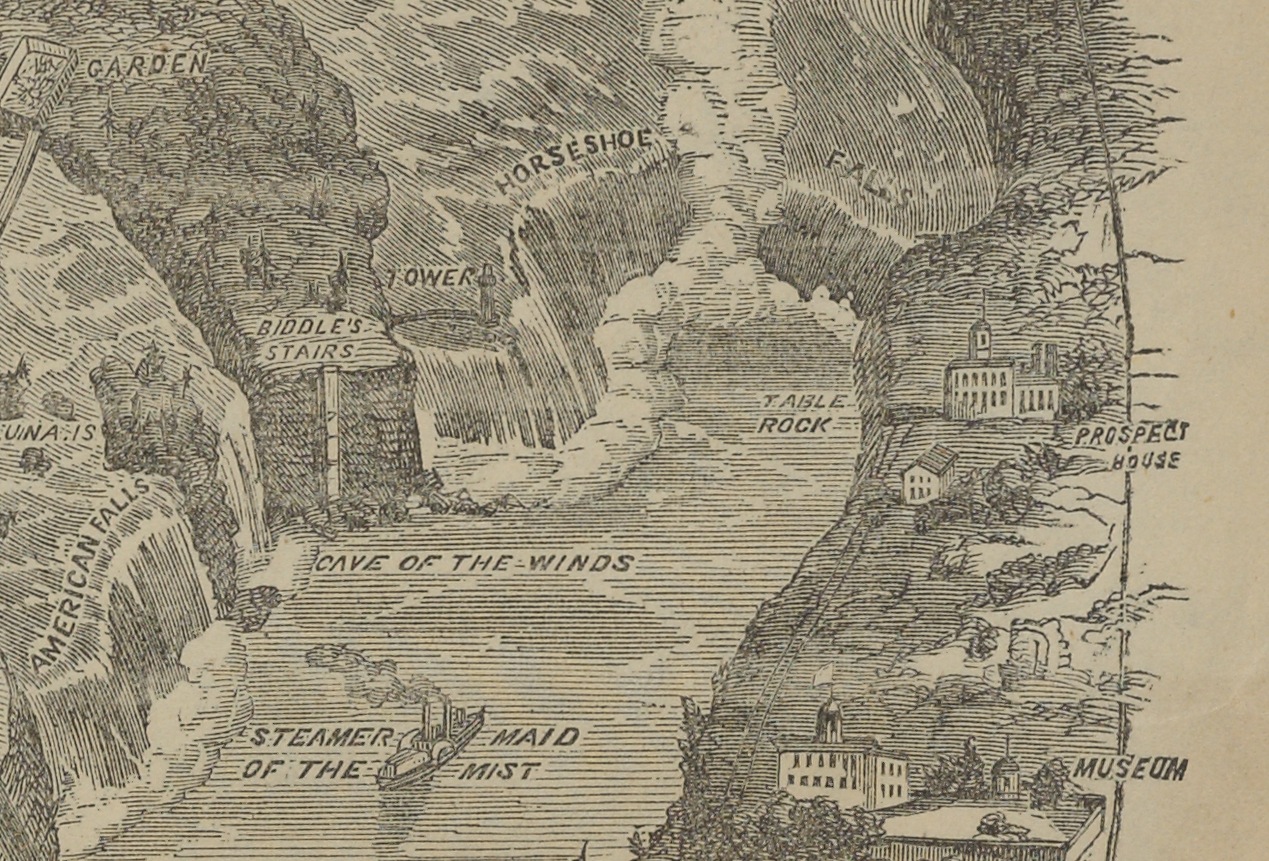
This image comes from Chisholm’s All Round Route and Panoramic Guide of the St. Lawrence: the Hudson River; Saratoga; Trenton Falls; Niagara … the White Mountains; Portland; Boston; New York, published in 1874. The book itself is five inches wide by 7.5 inches tall – the map is about 7.25 inches wide and almost 13 feet long. The vertical image on the left shows the length of the map, shot as nine separate images and stitched together very carefully in Photoshop.

Because the map was actually quite flat, I was able to shoot directly on our reprographic stand. Our camera is very high resolution (80 megapixels), as you can see with this detail shot, taken as a screen shot when the image was enlarged to 100%.

This map happens to be of the Niagara River, so we see Horseshoe Falls and even “The Maid of the Mist.” The entire map is this detailed, and it’s pretty amazing to see such a large map fold out of such a relatively small volume.

The map did photograph easily, but parts of the map had already torn (as visible in the long image, where you see some small breaks in the map). This went straight to Conservation after photography. Also visible are the color targets we include in each shot (I only included six of the nine I used; once for each shot). These ensure that our exposure, color balance and resolution are set properly to ensure an archival file viable for many future uses.


The Impish Spirit

October 11, 2012 by | 1 Comment

Digitized materials relating to The Garibaldi Panorama: Visualizing the Risorgimento from Brown University Library collections are continuously being made available to the public. Part of my job is to ensure that images are cropped, rotated , exported in our processing software (Adobe Lightroom 4.1), and fit for publication. Every now and then, this work exposes me to a fascinating object that I have never seen before.

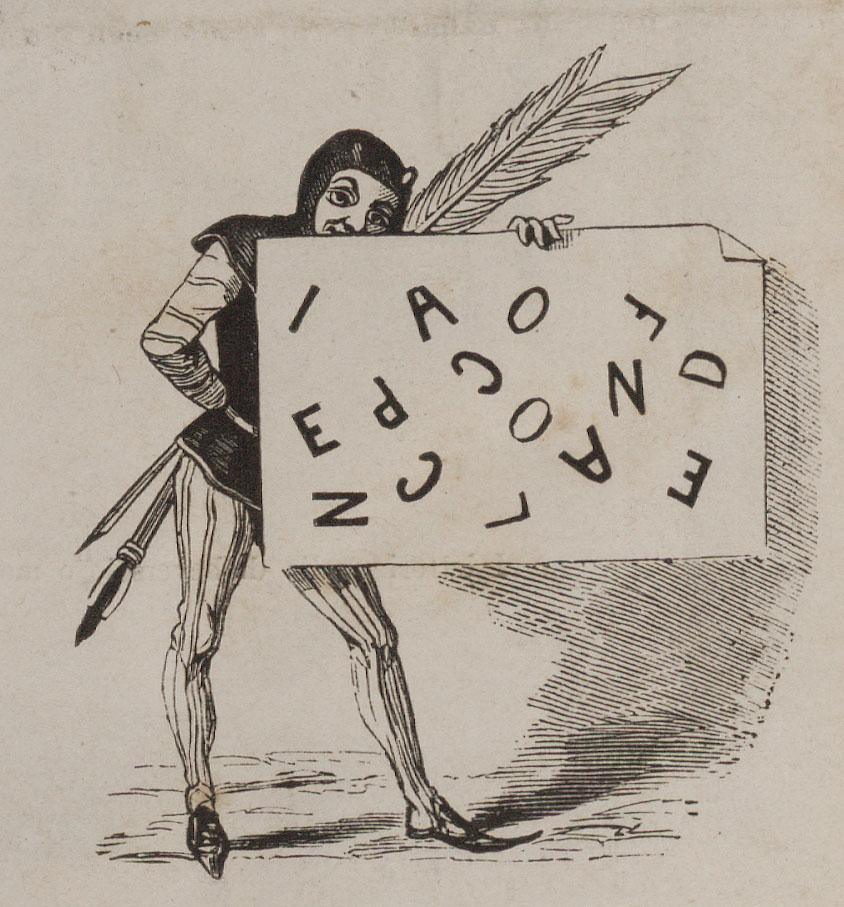
This week’s processing  work included Lo Spirito Folletto, a 19th century Italian illustrated humor journal or fumetto (literally translated as “little puff of smoke”, referencing speech balloons). Lo Spirito Folletto (or The Impish Spirit), was one of the first newspapers of Italian political satire and was published weekly in Milan from 1861-1885. Brown University Library owns a single volume from 1863, which now has been fully digitized, and will soon be added to the repository.

The periodical is heavily and beautifully illustrated with woodcuts and lithographs, as Harper’s Weekly or The Illustrated London News, but the content is devoted to Italian political satire, caricature, wit and humor.  Droll vignettes of imps, elves, goblins, and fairies are sprinkled among charades, riddles, puzzles, and articles lampooning Italian statesmen.

The richness and elegance of the artistic compositions, executed by gifted illustrators and caricaturists like Guido Gonin, Vajani, Vespasian (“Vespa”) Bignami, and Luigi Borgomainerio, resulted in the periodical gaining renown in Italy, as well as abroad. The newspaper was published in Paris as the L’Esperint Follet, and featured the best Italian designs together with works by distinguished french artists.

Aquatilium animalium historiae

October 4, 2012 by | Comments Off on Aquatilium animalium historiae

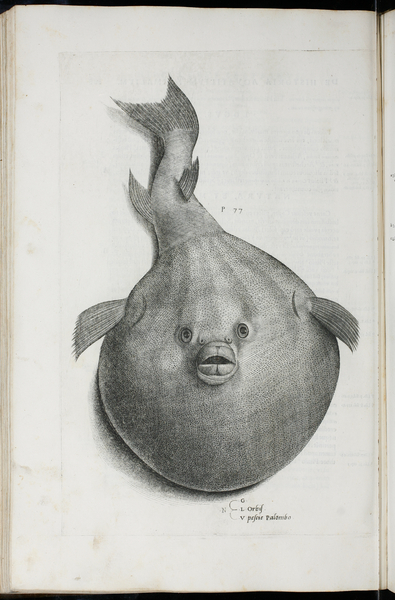
 The Aquatilium animalium historiae was  published in Rome in 1554 and is populated with 81 engravings of aquatic creatures by Antoine Lafréry and Nicolas Beatrizet. Salviani’s work is the first to use the technique of copper engraving for depicting fishes. The silvery, finely hatched lines of copper engraving represents the physical nature of fishes far more successfully than woodcuts. Lafréry and Beatrizet’s illustrations were ahead of their time, and their skill in depicting fish was unmatched for over a century. The book not only describes the different Mediterranean fishes, molluscs, and cephalopods, but includes information on capture techniques, nutritional value, and preparation.

“Serpent Marina.” Aquatilium animalium historia, liber primus (Ippolito Salviani, 1554).


“Orbis. Pesci Palombo.” Aquatilium animalium historia, liber primus (Ippolito Salviani, 1554).

Via Hot Air Balloon

September 27, 2012 by | 1 Comment

As a part-time employee at the Library, having briefly studied the Paris Commune (1871) some 10 years previously, in 2005 I was intrigued to find myself digitizing an original edition of Le Ballon Poste: Journal du Siege de Paris (1870–1871) for the Paris: Capital of the Nineteenth Century project. At the time, the newspaper was captured on the department’s Phase One PowerPhase FX+ scan-back system, with white paper placed underneath each page view, to enhance the legibility of print on the semi-transparent, very thin India paper.

Shown here is a close-up of the address panel, which gives a better sense of the fragility and lightness of each issue, delivered via hot air balloon.

(The French National Library now also hosts digital facsimiles of the newspaper issues.)

The French balloons are featured in this print held in Brown University Library’s Anne S. K. Brown Military collection, picturing a German soldier becoming distracted by a balloon overhead. The Brown University Library’s digital collections, culled from special collections, currently include over 100 items relating to the Franco-Prussian War, the conflict immediately preceding the Commune.

Hurricane of 1938

September 21, 2012 by | Comments Off on Hurricane of 1938

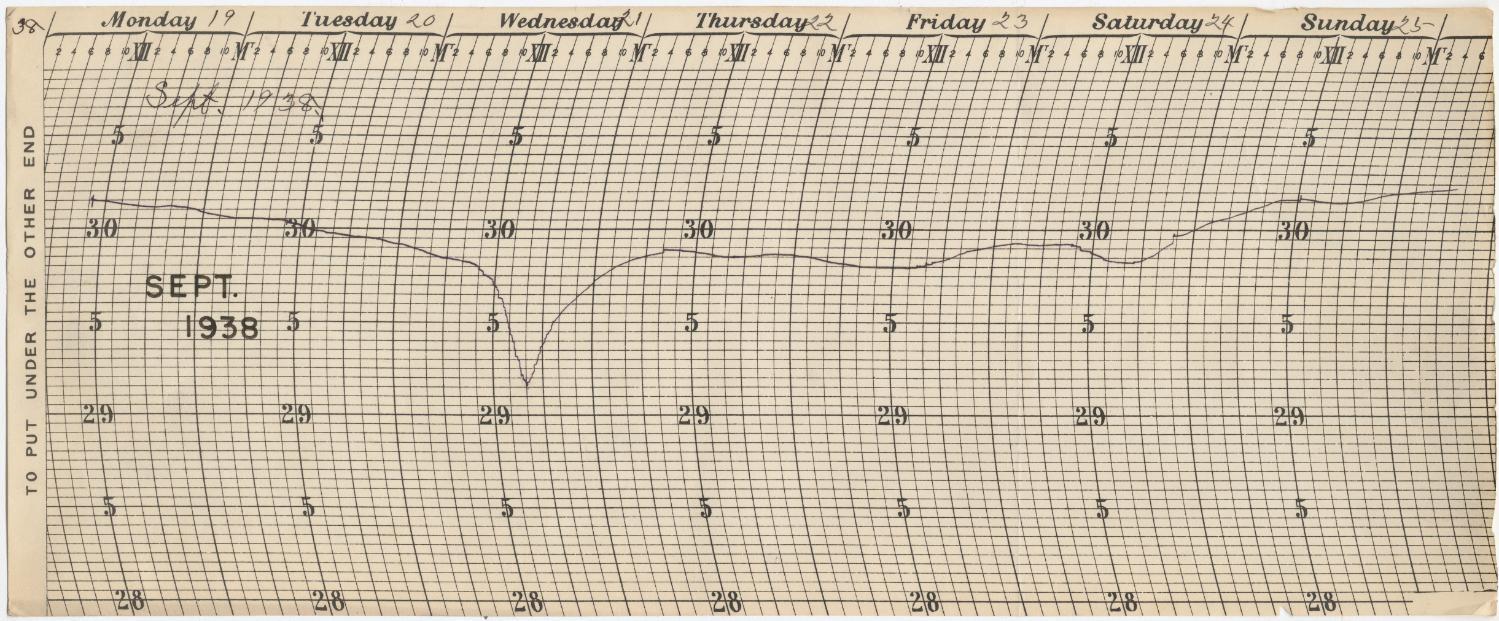
Today, September 21, 2012, is the anniversary of the Great Hurricane of 1938 which struck New England, killing approximately 600 people and causing millions of dollars in damage.

As a typical New Englander who is obsessed with weather-watching, I was excited to find this recording of barometric pressure for the week of the hurricane among the items Digital Production Services has digitized for the Ladd Observatory. The enormous dip in the pressure occurred the day of the hurricane.

Barometric pressure chart

Although Brown was fortunate in that it did not experience the same level of devastation which hit much of the state, there was still damage. Here an automobile (can you identify it?) is crushed by one of the stately trees on the campus.

Car crushed by tree

Setting up shop in the Lincoln room!

September 17, 2012 by | Comments Off on Setting up shop in the Lincoln room!

While many of the items we photograph are done in our studio, we do occasionally need to photograph items or objects where they reside at Brown. This is usually due to their size or other constraints that makes moving them too difficult. It then gives us the challenge to both light the object as well as safely maneuver ourselves and our equipment in a variety of spaces.

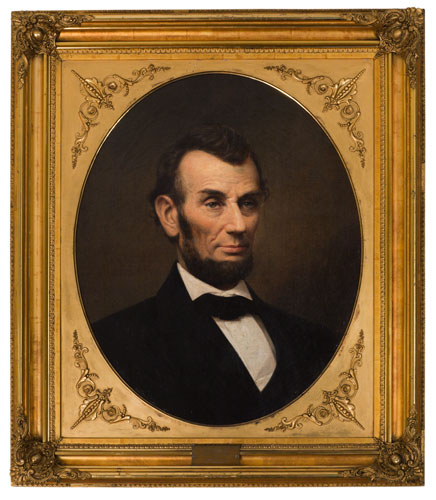
Baumgras-Lincoln

This is exactly what happened when I photographed this portrait of Abraham Lincoln by Peter Baumgras. Part of the Charles Woodberry McLellan Collection of Lincolniana at Brown, the portrait is housed in the Lincoln room at the John Hay Library. Beautifully framed, it’s a lovely portrait to shoot.

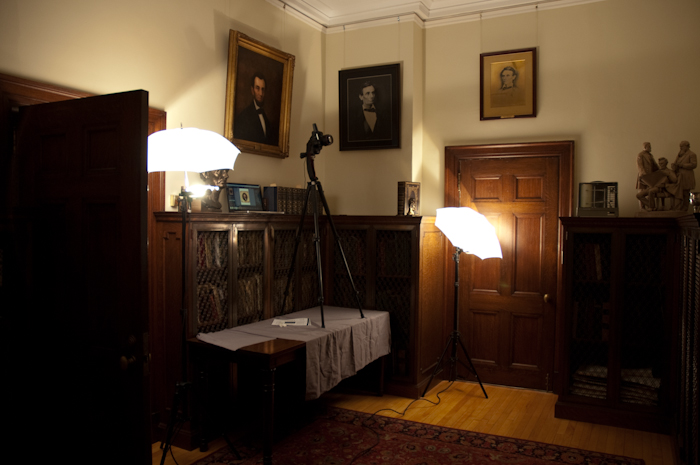
But it’s hung very high on the wall, at a significant angle, without a lot of space to photograph it without distortion. In came our portable lighting setup, our D-SLR (Canon 5D Mark II with 85mm f1.2 L series lens) and tripod, and Macbook Pro (for shooting tethered into Adobe Lightroom).

Lincoln room 1


While the painting itself is opposite the camera (naturally), you get a good idea of my setup here — you also get a pretty good idea regarding why this is referred to as the “Lincoln room.” Due to the height at which the portrait is hung, I had to actually put my tripod up on a table next to the bookcases. I have two hot lights (tungsten-based) with shoot-through umbrellas, which allowed me to light the entire space without lighting the painting too directly. (The painting has glossy oil paint and a highly reflective frame, so keeping reflections to a minimum was essential.)

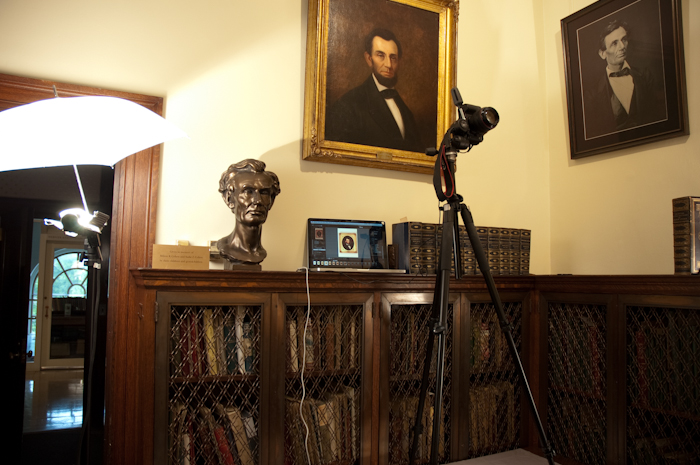
Lincoln room 2A closer shot of the setup shows the camera at an angle. This is not just because the painting is so high – yes, it’s way too high to shoot straight on with the camera, but it also leans forward off the wall by a few inches. It’s not a steep pitch, but enough that it’s easy to get an image that’s just not quite square (i.e. unacceptable).

You can also easily see here that I have the camera hooked up to a laptop for tethered shooting. This allowed me to check the focus, the angle of the camera, the white balance and the exposure all while shooting so I knew I had a usable shot before I packed everything up.

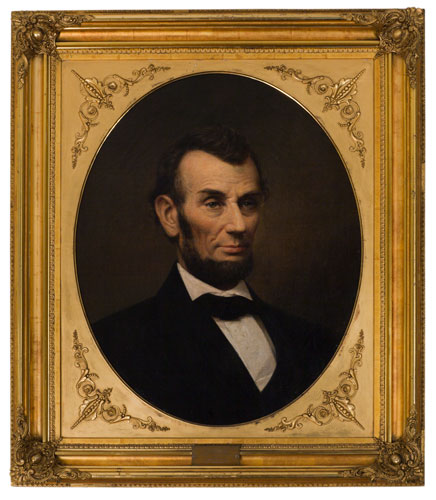
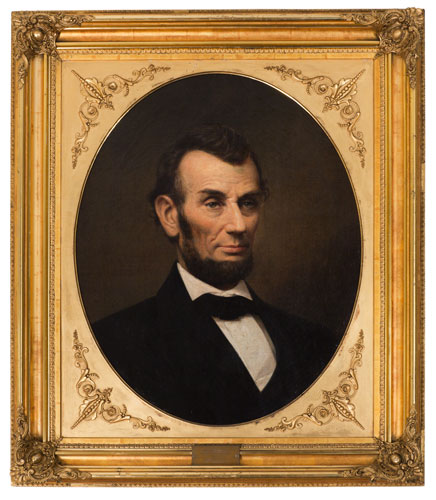
What you can’t see as easily in this shot is that I had to bracket, and ended up using two different exposures, combined into one, for the final image. I used one darker exposure for the bright frame, and a lighter exposure for the portrait itself, which has subtly textured shadows that I wanted to show. In Photoshop, I carefully made a path around the actual painting, and masked out the darker frame. Layered atop the brighter frame, we get the final image, which exposes correctly for both elements of the object.

Lincoln-before Lincoln Bright

1. Dark image, exposed correctly for the frame. 2. Light image, exposed correctly for the painting. 3. Detail of layered image, showing detailing in the frame and the painting.