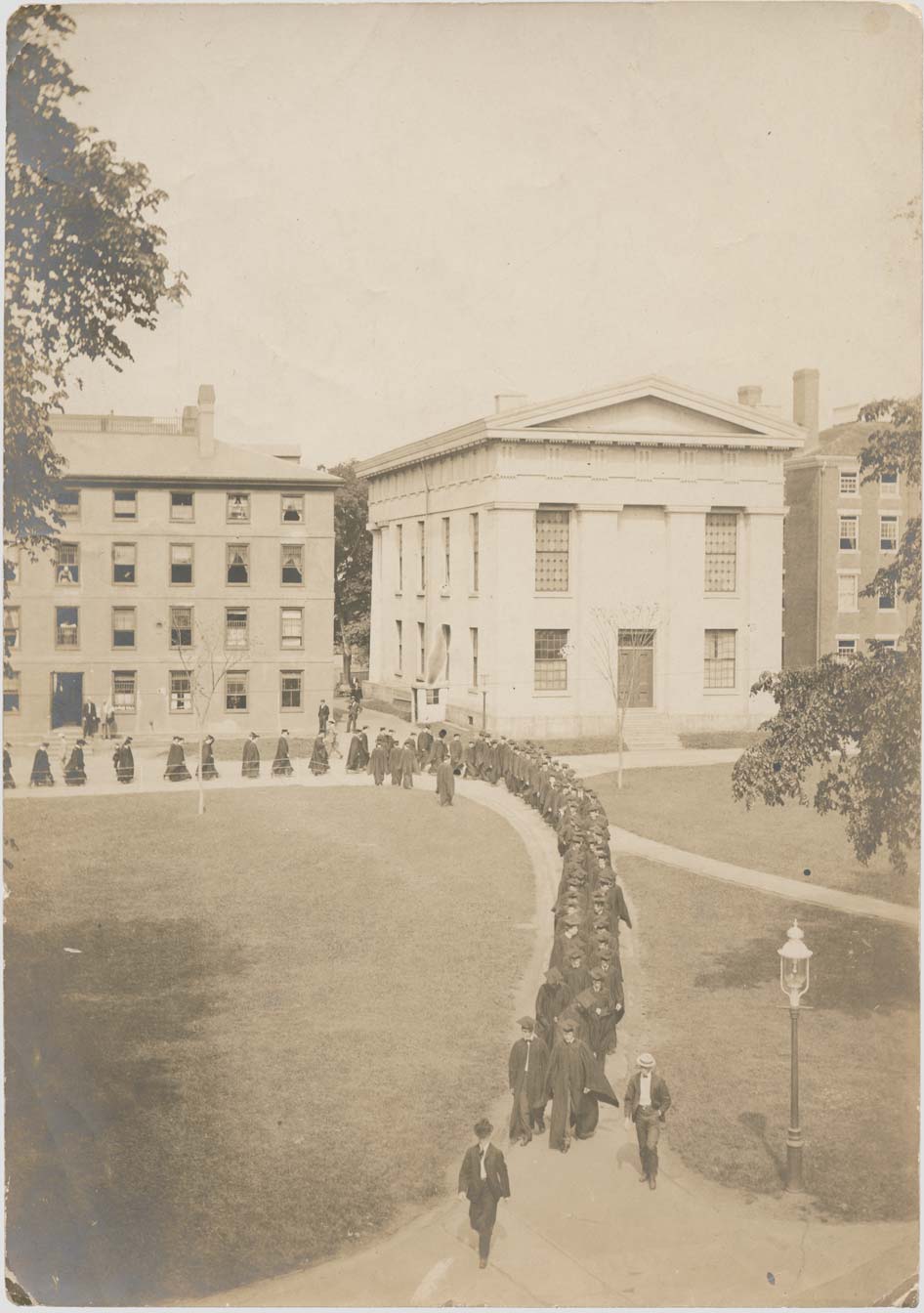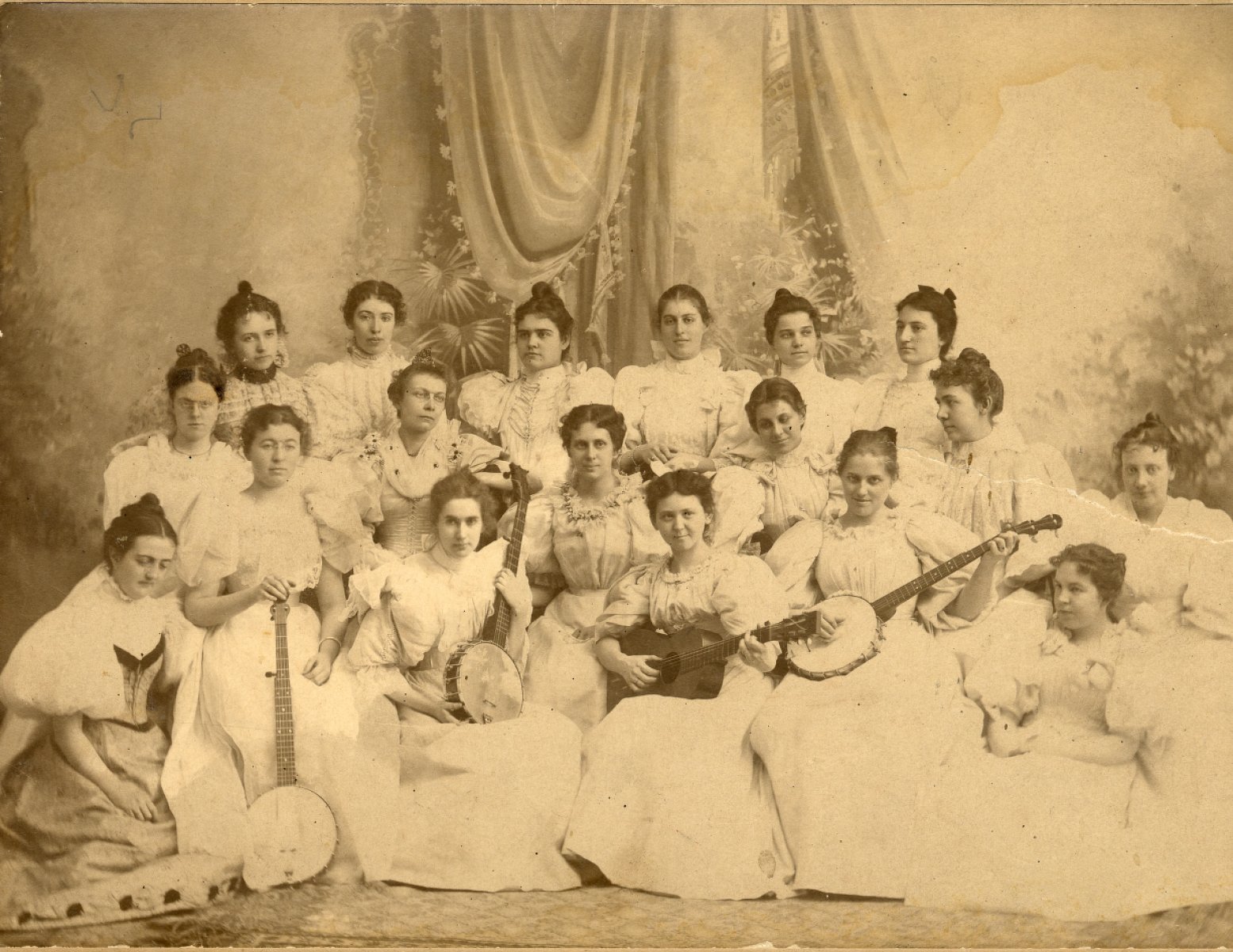
We’re celebrating May Day with this image of the Pembroke College Glee Club from the Pembroke Archives. The Images of Brown collection, which is home to this image, boasts more than 4,100 items (and counting) that capture the visual history of Brown.
Reproduced below is the broadside “Ode to the Mammoth Cheese…”, an 1802 nine-stanza poem presented to Thomas Jefferson (1743–1826) by Thomas Kennedy (1776–1832). The broadside was captured by Digital Production Services in 2008 at the request of a library patron. The poem states that “Cheese is the attendant of a New-Year’s day,” and is dated January 1, 1802.

“Ode to the Mammoth Cheese…” (1802)
 The blooming of the magnolia trees on campus is not far off (believe it or not!). With my thoughts on these long awaited blossoms, I type “magnolia” into the Brown Digital Repository and discover a beautiful 18th century hand colored intaglio print. The variety of magnolia represented in the print is known as Magnolia altissima lauro-cerassi folio, flore ingenti candido, Catesb. (commonly called the Laurel-Leaved Tulip Tree or Carolina Laurel) and is named for 18th century naturalist, Mark Catesby. Catesby spent three years documenting the flora and fauna of South Carolina, Florida and the Bahamas in the 1720’s. The tree featured in the print produced its flowers in the garden of Sr. Charles Wager at Parsons Green near Fulham, in August of 1737. The print was delineated and engraved by George Dennis Ehret (1708-1770), and is part of Joannis Martyn‘s Historia plantarum rariorum [1. The volume is part of the Albert E. Lownes Collection of Significant Books in the History of Science, a collection particularly strong for illustrated materials on natural history.]
According to the Campus Guide to Trees and Shrubs, Brown University is home to three varieties of magnolia trees; Magnolia acuminata or Cucumber Tree, Magnolia soulangiana or Saucer Magnolia, and Magnolia stellata or Star Magnolia. As the days warm, and I walk around campus during the coming month, I will be noting which of the fourteen stages the buds and blossoms are in.

1. The bud of the Flower as it first Appears.
2. The involucrum which encloses the Bud.
3. The Emplalement or Flower-cup.
4. The Flower-cup opening and discovering the Flower.
5. The cup falling of(sic) from the Flower.
6. The Flower-cup as it Appears before it is expanded.
7. The outside of the Apex or summit Represented.
8. The inside of the summit Represented.
9. The Ovary or Rudiment of the Fruit.
10. A Ripe Fruit with the seed falling from their cells and hanging by small threads.
11. A Seed as it Appears in it’s Cell.
12. A Seed falling out of it’s Cell.
13. The Footstalk with the marks where the Petals or Flower leaves were inserted.
14. A Flower fully expanded which is 11 inches in Diameter and has 10 Petals.
Because we photograph a great deal of prints and engravings, moiré patterning is an issue that we must consistently keep an eye out for. Moiré patterning often occurs during image capture; it can also happen if you’re viewing an image at a certain magnification, but this is easily addressed by changing the magnification. It’s when moiré patterning enters during image capture that you must address it immediately, since it’s difficult to remove without creating more image artifacts.
Moiré patterning happens when your subject has some type of regular pattern – in our case, this is usually regular lines in an engraving, but can also happen when photographing textures on paper or cloth that have a regular weave to them. When the regular pattern of the subject overlaps with the regular pattern of the image sensor, the moiré patterning is born. It’s usually seen as bands of color, or light and dark.

The two images above are examples of both kinds of moiré patterning. The image on the left, with the black-and-white pattern, happened due to image magnification. This image itself was fine, but viewing it at this magnification was problematic. The image on the right, however, shows moiré patterning that happened during the capture process. You can clearly see the bands of color that, rather than being a function of viewing the image, are actually present in the image itself.
Correcting the viewing problem is a non-issue; one must simply view the image on a different monitor or at a different magnification. Correcting the patterning that happens during capture is actually almost as simple: it’s all about the orientation of the original. Because moiré patterning is a function of the relationship between overlapping patterns, all we have to do to correct this is change that relationship; put another way, we have to change the alignment of the patterns. For this object (from our Rider Broadsides collection), I had been photographing all objects in the collection aligned as relatively straight verticals to the sensor. To correct the alignment, I simply tilted the image so it was crooked in the capture (it’s important that this isn’t a 90˚ tilt, but a more arbitrary tilt). This corrected the problem immediately. Below is the final image, as well as a detail of the most problematic area of the object.

The Rider Broadsides collection, currently being digitized by the Library, contains unique examples of cultural-political ephemera from the 17th–20th centuries. Shown below are front and back views of an “absolute money” bill, c. 1880, spoofing the period’s Greenback movement. (The majority of materials in the Sidney S. Rider Collection — a wide variety of pamphlets, manuscripts, broadsides, ephemera, scrapbooks and newspapers — are related to Rhode Island history.)