Digital Production Services Homepage Brown University Library Homepage Brown University Homepage

c u r i o

Imaging rare, unusual, and intriguing objects at the Brown University Library

Grossinger’s Natatorium

February 26, 2014 by | 2 Comments

When I recently came across an article about the abandoned and overgrown Grossinger’s Resort Hotel, I became fixated on the photographs of the pool within the resort’s natatorium. I recognized the space (but barely) from a collection of ephemera, which we digitized for The Catskills Institute several years ago.

pool

Grossinger’s New Indoor Swimming Pool. “Superchrome” postcard. c.196-

The distinctive, once orderly, deck chairs now stand alone in the muck and moss, or have been tossed like bones into the bottom of the graffiti laden pool, joining muddy strings of blue beaded lane markers. The signature tile work is faintly recognizable under the encroaching moss, and the star burst lamp still hangs from the ceiling. I knew how tragically abandoned the formerly thriving resorts in the Catskill Mountains had become, and had seen photographic evidence of just how overgrown and lost these spaces currently are, but the images of the natatorium haunt; the building sits upon the landscape like a perpetually decomposing corpse.  In the mid-century (when the indoor pool was constructed) the resort was thriving, as it had been since the 1920s. Grossinger’s gradually declined throughout the 1970s, a decline which hastened when the property was sold in 1986.[1. Abandoned NY: Inside Grossinger’s Crumbling Catskill Resort Hotel.] Many items of interest pertaining to Grossinger’s, including an Auction notice and contents for sale, can be found in Brown’s Digital Repository. Most of the resort’s buildings have now been demolished, but the natatorium still stands as a ghostly relic; its remnants pointing to fragmented memories, an uncanny space filled with abandoned objects of leisure being consumed by nature itself.

GrossingersResort-26

Photo by Pablo Maurer. Abandoned NY: Inside Grossinger’s Crumbling Catskill Resort Hotel


The more things change…

February 21, 2014 by | 2 Comments

As winter in New England quickly becomes the house guest that has greatly outstayed its welcome, I thought it would be interesting to browse through the Brown Digital Repository for images of snow in Providence. I came upon this image with a view up Williams Street of the Nightingale Brown House. Trade in the horse-drawn carriage for some contemporary vehicles, and it’s not too far from the Williams Street we saw on Tuesday.

* Update: Many thanks to Ron Potvin, for correcting the information about this image. We have updated the post as well as our metadata in the BDR to reflect his insights.

1207920280640625

Porcelain Figures from Brown’s Monuments Man

February 7, 2014 by | 7 Comments

Porcelain figures originally commissioned by John Nicholas Brown II (1900–1979) are currently on exhibit at the John D. Rockefeller, Jr. library through April 25, 2014. Brown II was a civilian-status Lieutenant Colonel, Special Cultural Advisor for Monuments, Fine Arts, and Archives (MFAA) in Europe toward the end of World War II — as well as husband to collector Anne Seddon Kinsolving Brown, the founder of the Library’s military art collection (a substantial part of which has been digitized for online viewing). While the 21 porcelains currently on display in the library were not salvaged works per se, they were commissioned by Brown in 1945 while he was a “monuments man” in Europe.

Thanks to a movie opening on February 7, 2014, directed by George Clooney and loosely based on historical accounts, the “monuments men” have been making a resurgence in both popular media and the cultural heritage community: from features in the New York Times (re: monuments women, as well), to educational reference resources showcasing the retrieved artworks (Scholars Resource set featuring 111 salvaged works), to recent commentaries by associated museums (“In the Footsteps of the Monuments Men: Traces from the Archives at the Metropolitan Museum”).

The image shown below, a porcelain commissioned by John Nicholas Brown II in late 1945 while serving with MFAA, was taken by Digital Production Services for the library’s exhibition publicity. Curator Peter Harrington describes the context of its commission:

While John Nicholas Brown was working with the allied forces in Germany in 1945 reporting on stolen art works, he visited the factory at Nymphenburg in Bavaria and ordered 21 porcelain figures for his wife, Anne S. K. Brown. Subsequent additions to this set came from the Dresden porcelain factory. Today these porcelains form a unique segment of the foremost American collection devoted to the history and iconography of soldiers and soldiering.

Photographing the Break Up of Time

January 16, 2014 by | Comments Off on Photographing the Break Up of Time

While the vast majority of my work involves photographing items in collection, it may also have become clear in my blog posts that I’m occasionally asked to document library events and library spaces. All of Brown’s libraries have some incredible spaces – for research, for teaching, for collaboration, and for study – and Brown has been diligent in their efforts to maintain their libraries as 21st-century learning environments. As a result, I often have the opportunity to document the renovation of these spaces, as well as the items in Brown’s collections that are on view in the libraries.

Sculpture-main
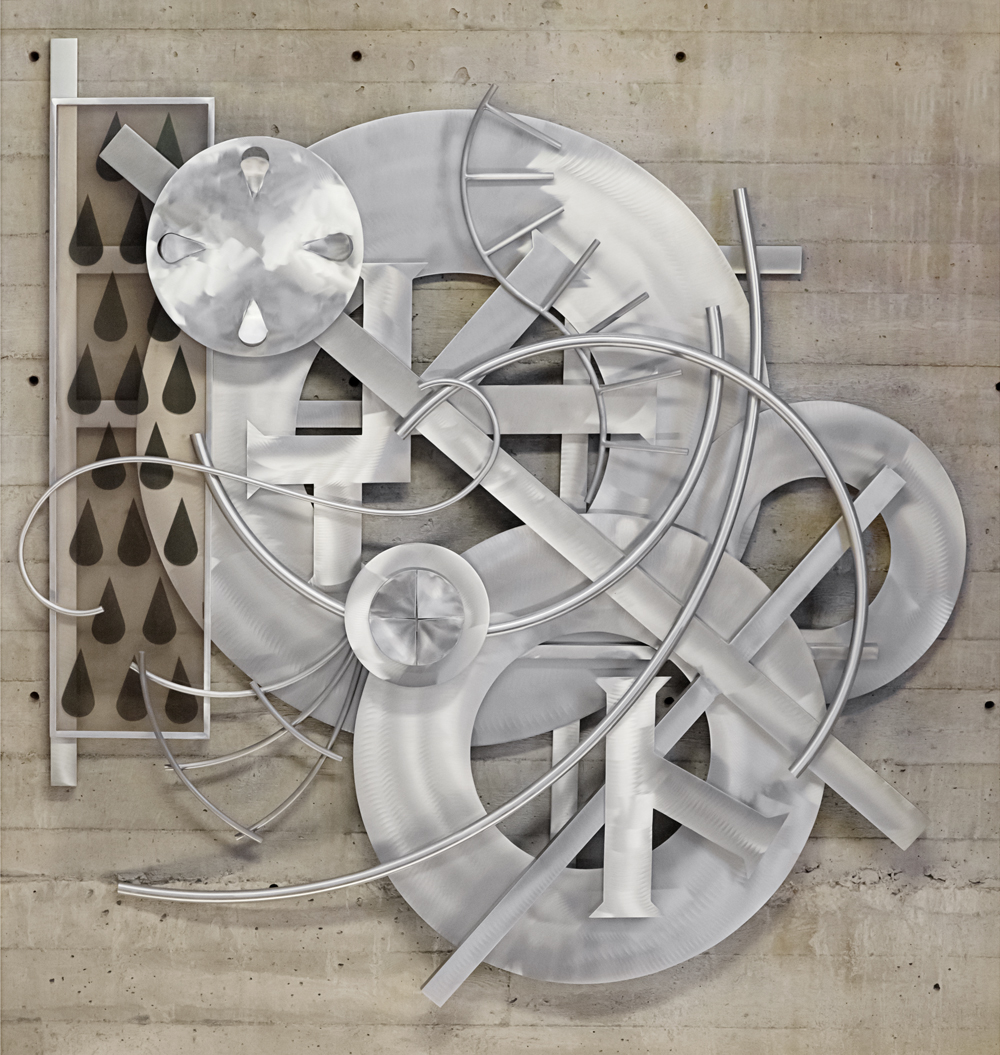
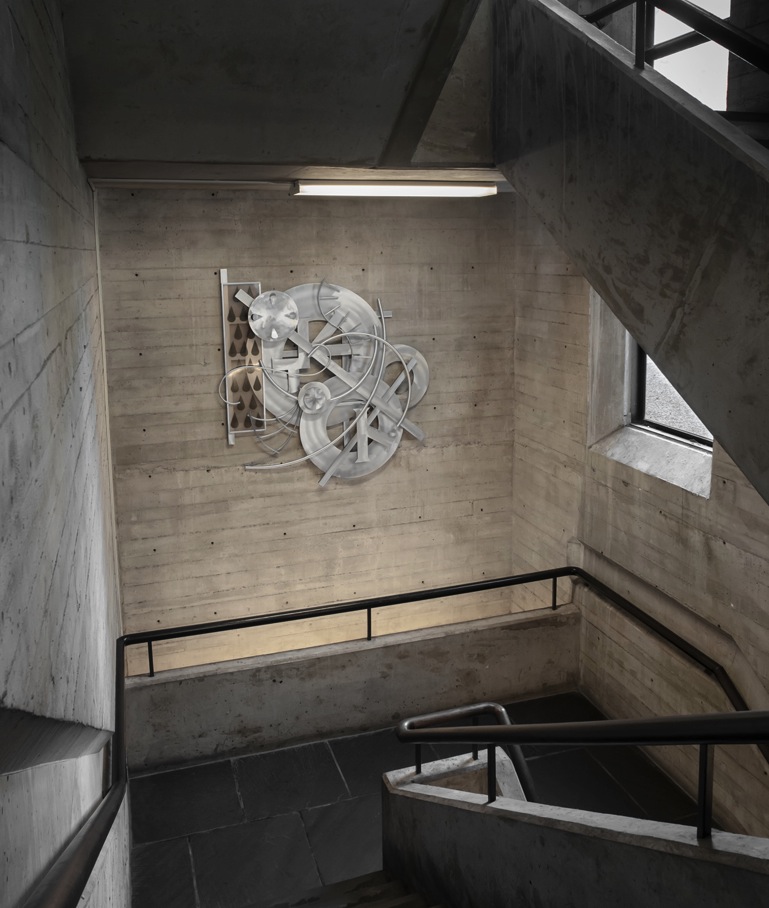
This past October, Brown alumna and generous Brown University Library supporter Elizabeth Z. Chace (’59, PHB ’96 hon., GP ’13, GP ’15) donated Break Up of Time, 2006, by John Okulick. The approximately 6′ x 6′ aluminum, resin, and wood sculpture was installed in our Sciences Library, in a bustling open landing right behind the main entrance.

Sculpture-birdseye

The challenging part about photographing the sculpture is its location; it’s great for visibility, but it’s tough to get a nice, straight-on shot of it. The sculpture is also lit by three light sources – overhead fluorescent, tungsten light underneath, and window side lighting. Because it’s a fairly high-polish metal, the sculpture is highly reflective and picks up the colors of the light and walls reflecting off of it.

Using my tilt-shift lens, I was able to get a straight-on shot without actually having to be directly in front of the piece. I bracketed for exposure and white balance to get a clean image (when layered in Photoshop). I also took some images that show a little more of the environment around the sculpture, again trying to avoid as much glare, color cast issues, and unnatural skewing of the object as possible.

This image (left) gives a view from the entrance to the staircase, where most people encounter the sculpture for the first time.


“And a glad New Year”

January 13, 2014 by | 2 Comments

Ringing in the New Year with this charming carrier’s message from 1893! This is from the John Hay Library collection of Carriers’ Addresses. These addresses were published in the United States by newspapers and delivered by newsboys, usually on News Year’s Day. About 900 of the addresses have been digitized and made available through the Brown Digital Repository, with more to come. You can read more about Carriers’ Addresses and search the online collection here.

How do you solve a problem like a foldout?

December 13, 2013 by | 5 Comments

When assessing how to photograph a book, we must first make several determinations. The key to photographing books well  – by which I mean providing well-lit images, in good focus, without damaging the book or its pages –  is to provide as much support as possible to both the book itself (especially the spine) as well as to each individual page. Evaluating the needs of a book requires that we look at the following criteria:

  • Size of book
  • Condition of book and its pages
  • Characteristics of leaves (plates, text, foldouts or tipped-in pages)

Smaller books in good condition are photographed on a glass cradle that allows us to hold the book open for optimal photography, but supports the spine and keeps the book in good condition. Larger or more fragile books are shot on a wooden cradle, which supports the book and its spine without putting any pressure on the pages. This requires additional work to get each page flat; some curvature is acceptable, but too much creates focus problems so we often add foam supports under parts of a page to keep it even.

This is a page with a small, minor foldout. Set in the wooden cradle, you can see the book as it’s shot, the nook that the book and page fit into with full support beneath them, and finally, the wood and foam supports that made it all possible.

niche

Then we have books that hit the challenging-to-shoot trifecta: they are oversize, have some element of fragility to them, and the plates involve spreads or foldouts that require even more supports and careful handling (and a sharp eye on even lighting and focus). I spent the past couple of weeks photographing just such a book: an oversize book of engravings that is in generally good condition, but whose spine required a bit of extra support. Luckily, each individual page was thick and in good condition, and the sharp, meticulous engravings made it easy to confirm focus. The majority of the book involved one-page plates, some two-pages spreads, and a handful of foldouts.

One of the foldouts was very large: 20″ x 46″ in total. In order to have decent lighting and any sort of viable resolution, the foldout had to be shot in sections, to be stitched together afterwards. Each section needed to be centered on the platform, at the same distance away from the camera and with no changes to the lighting or focus. The real challenge was to meet these requirements while supporting the book and each section of the foldout. After meeting with our Materials Conservator (the first step in any kind of endeavor like this), she gave me a great plan to make this happen: after the first shot (the part closest to the spine), I set up the book cradle on a book truck, slowly moved it backward to allow the foldout to unfold, and photographed each flat section. As the page opened up and was no longer supported by the pages beneath it, I used Foamcore to keep a level, stable support for the foldout. I also leaned the unfolded parts of the pages against a foam support and kept it in place with a lead rope, to ensure the paper remained intact. Below are the step by step shots (save the final one, which required me to hold some of the foldout closed while taking the photograph with the foot pedal).

IMG_0936

Foldout, Section II & III

IMG_0929

Foldout, Section I


IMG_0950-main

Foldout, Section IV (including book truck and foam core supports)

And then we have the final, fully stitched foldout. I did keep a reference shot with the color target, just to be safe.

folded

Thomas Alexander Tefft: Architect Extraordinaire

November 12, 2013 by | 3 Comments

I wear a couple of hats here at Brown University, one as staff member of Digital Production Services, aiding in the production of digitized resources for library collections and faculty projects, and another as a MA student in the Center for Public Humanities and Cultural Heritage. Often, these professional and academic roles overlap and intersect. Increasing student and faculty engagement with library collections through use of digitized materials within the Brown Digital Repository is a rewarding aspect of the work we do in Digital Production Services. Quite often, I find myself utilizing the digital resources that I have had a hand in creating in my own scholarly research. For instance, the topic under discussion in my graduate section for AMST1250B: Graves and Burial Grounds this week has been the gravestone designs of Rhode Island architect Thomas Alexander Tefft.

receiving-tomb

Original receiving tomb designed by Tefft.
Image: Swan Point Cemetery

The Thomas Alexander Tefft architectural drawings 1844-1859 are a part of Brown Archival and Manuscript Collections Online, and the nearly four hundred Tefft drawings that constitute the collection are available in the Brown Digital Repository. I knew that Tefft was a native Rhode Islander (born in Richmond in 1826), and a graduate of Brown University (Class of 1851).[1. Mitchell, Encyclopedia Brunoniana (Brown University Library, 1993; pp. 536-537).] I also knew that Tefft designed many local private residences and public buildings, like Providence’s first Union Station and Rhode Island School of Design’s Memorial Hall. What I didn’t know was that Tefft was also a prolific designer of tombs, monuments and gravestones, many of which can be viewed in Swan Point Cemetery.

Tefft's design for Central Congregational Chuch, now RISD's Memorial Hall.

Tefft’s design for Central Congregational Chuch, now RISD’s Memorial Hall.

Tefft’s signature rundbogenstil (or rounded arch) Romanesque style[2. Curran, The Romanesque Revival: Religion, Politics, and Transnational Exchange (Penn State Press, 2003; p. 139).] can be seen both in Swan Point’s receiving tomb, which I had the opportunity to view last week as a part of our class’s walking tour of the Cemetery, and in the details of RISD’s Memorial Hall (originally Central Congregational Church) on Benefit Street. The towers of the building, seen in Tefft’s drawing, were damaged in the 1938 hurricane and subsequently removed. While Greek and Gothic revival styles were all the rage in America during the 1830s and ’40s, Tefft favored the revival styles of the Renaissance and the Romanesque. Brown’s collection of Tefft architectural drawings include designs for over 50 gravestones and tombs, in which the range of revival styles can be seen in the Classical, Egyptian, and Romanesque motifs he employed.
Remarkably, Tefft’s substantial body of work was created in just 14 years. In 1859, at the age of 33, the architect died of a fever while in Italy on a Grand Tour.[3. Curran, The Romanesque Revival: Religion, Politics, and Transnational Exchange (Penn State Press, 2003; p. 139).] Initially, Tefft was buried at Florence’s English Cemetery, but in February of 1860 his body was shipped back to Providence and re-interred in Swan Point Cemetery. Teftt is buried beside James Bucklin, another important figure in Rhode Island architecture, under a gravestone of his own design.[4. Mitchell, Encyclopedia Brunoniana (Brown University Library, 1993; pp. 536-537).]
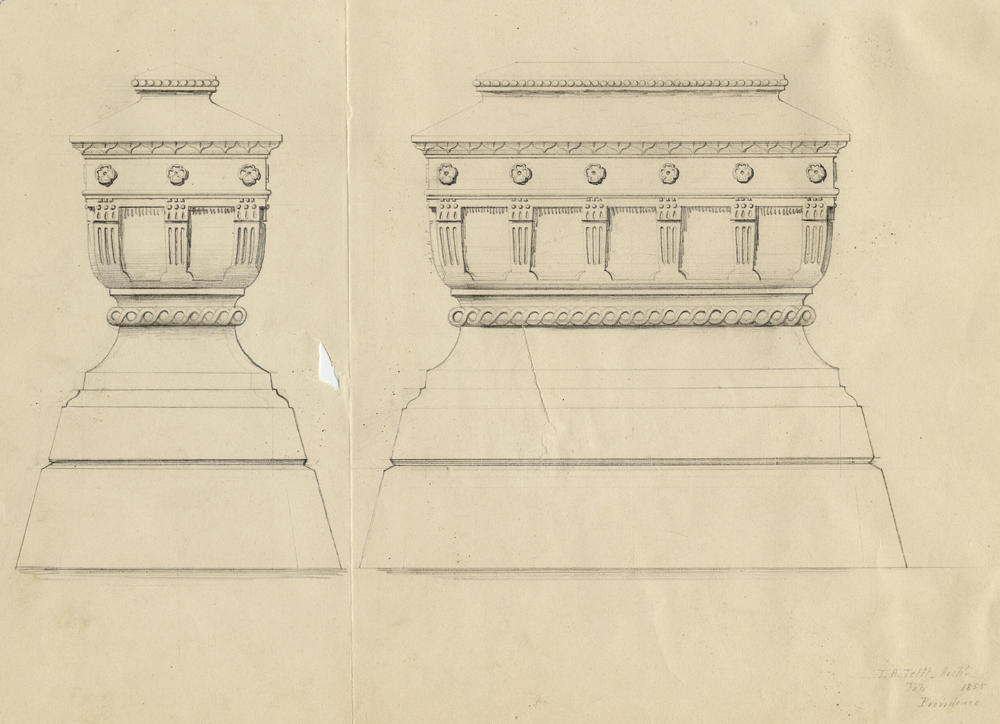
tefft_markerjpg

The Tefft gravestone design, which now marks his own grave in Swan Point Cemetery.

In 1988, the Department of Art at Brown University collaborated with the National Building Museum on a student-curated exhibit held at Brown’s Bell Gallery. The catalog for the exhibit, Thomas Alexander Tefft: American Architecture in Transition, 1845-1860 is a wonderful resource to consult for more information on Tefft’s short but astonishingly creative career.

RISD’s Memorial Hall. Image: Wikimedia Commons

romanesque