|
Remains of a Medieval Italian AntiphonalANTIPHONALS |
These leaves were once part of a large choir book whose size and setup indicate
it was for use by a group of people or choir, all looking on at once. . These
oversized song-books represent a particular class of Italian illuminated book-production
of the thirteenth to sixteenth centuries
1. Produced by a monastic scriptorium, they were intended to
be used in daily services by priests or monks, and reflect the unique rites
and offices of the specific sect or order and further, of that particular cathedral,
church or monastery. The book from which these leaves have been taken was most
likely an Antiphonale, one of several different kinds of liturgical books
required to carry out services. An antiphonal contains the chants for the Divine
Office
2 (Officium divinium), which, in the Roman Catholic Church
of the middle ages, consisted of nine services, or "hours," offering
prayer and worship each day of the week:
3
First Vespers (ad primam vesperam): at sunset
Compline (completorium): before retiring
Matins (matutinum): before sunrise
Lauds (laudes): at sunrise
Prime (ad primam horam)
Terce (ad tertiam horam)
Sext (ad sextam horam)
None (ad nonam horam)
Second Vespers (ad secundam vesperam) 4
Beyond the office hours, the daily ritual also includes the Mass, or Eucharist,
whose chants are contained in the Graduale, or gradual. Two other books
provide complete liturgical texts, including prayers, Scripture lessons, psalms,
etc: the Breviarium (Breviary) for the Office, and the Missale
(Missal) for the Mass. Together these four books supply all the chant and text
for all the services of each day of the entire liturgical year.
The chants contained in an antiphonal, like the one from which these leaves were removed, consisted of antiphons of several kinds: psalm antiphons, Gospel antiphons, and invitatory antiphons. Antiphonals also contain responsories and their verses; incipits of psalms; and sometimes doxologies, hymns, and sequences. An antiphon is "a brief text, originally a paraphrase of a psalm or other biblical verse, but later often newly written, set to melodic chant, and sung by the choir." 5 Psalm antiphons were sung before and after a psalm, or originally after each psalm verse; Gospel antiphons were sung before and after the Gospel canticles of Magnificat, Nunc dimittis, and Benedictus; invitatory antiphons were always sung with Psalm 94, Venite, as an invitation to Mass. All three of these types of antiphons can be found in the leaves. Also extant are pages containing responsories, sung by the choir, with their accompanying verses that are sung by a single cantor. This pattern of chant is associated with readings, and signaled by the {R} and {V} symbols in the leaves, as will be detailed later. The structure of these antiphons within each of the nine services is fixed according to season and feast day. For example, the service of Matins, prominent in these leaves, might typically proceed in this order:
Invitatory Ps. 94 with Antiphon; Hymn
Nocturn I: 3 Psalms 6 with 3 Antiphons; 3 Lessons with 3 Responsories
Nocturn II: Same
Nocturn III: sameLikewise, that of Vespers might proceed in this order:
5 Psalms with 5 Antiphons
Chapter with Hymn and Versicle
Canticle: Magnificat (Blessed Virgin Mary) with Antiphon 7
It is difficult to reconstruct the specific context of the antiphons that are written in these leaves, but their typical usage can be compared to those found in other medieval antiphonals. The method for identifying each antiphon is explained in the transcription.
The body itself of an antiphonal is sectioned into the Temporale, Sanctorale,
and Common of Saints, and may also include a Hymnal, Tonary, and Invitatorium.
The Temporale is an order of feasts in the round of weekdays and Sundays for
the liturgical year, from the first Sunday in Advent to the week before Advent;
the order is subject to variation, which can only be determined within the context
of a more complete book than offered by these eighteen leaves. The Sanctorale
lists the feasts of saints in calendar order, and the Common of Saints offers
particular occasions for common office.
8 Of the eighteen leaves, fourteen exist from the Temporale,
and five from the Sanctorale. By following the liturgical year, they can thus
be placed in approximate order of their placement within the entire book, though
it is impossible to tell what the original foliation was like.
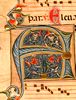
Image Source: Decorated initial 'A' from folio8v.
Collections Focus Home | Library Home
© 2003, Brown University Library.
All rights reserved.
Comments to: hay@brown.edu
This page was last updated on
Wednesday, 01-Apr-2015 11:53:15 EDT
.
You are the
[an error occurred while processing this directive]
visitor to this page since October 11, 2003.