

|
||
|
Hôtel de Ville de Paris, le 30 Juillet, 1830. [ Paris : 1830?]. Hand-colored engraving by Cropin ; drawing by Mavski. 30 x 43 cm. Anne S. K. Brown Military Collection Nominated to be king on July 30, historical sources indicate that Louis-Philippe presented himself to the people at the Hôtel de Ville, known to be the "heart of Paris," on July 31, rather than July 30 th as the engraving indicates. The people did not greet Louis-Philippe without resistance; although many Parisians welcomed the new king, many revolutionaries continued to express hostility towards his nomination. |
 | |
|
||
 [click on image to zoom] |
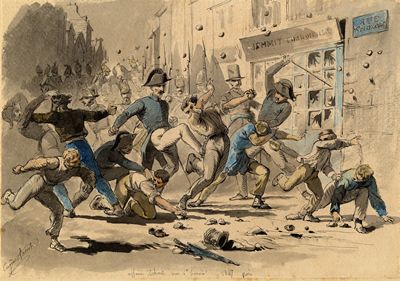
Lacoste, Eugène, 1818-1907. Affaire Schmit, rue St. Honoré, 1847. [ Paris : 1847?]. Original watercolor. 23 x 33 cm. Anne S. K. Brown Military Collection Preceding the Revolution of 1848, conflicts between the
Parisian working class and the government escalated in the capital city.
|
|
|
Lacoste, Eugène, 1818-1907. Paris février 1848. [ Paris : 1848?]. Original water-color. 23 x 33 cm. Anne S. K. Brown Military Collection |
 [click on image to zoom] |
|
 |
Gaildrau, Jules Attaque du Château d'Eau. Place du Palais Royal, le 24 Février 1848. Paris : Leclere éditeur, 29 Boulevard Poissonière, Imp. Lemercier, [1848?]. Hand-colored engraving. 26.7 x 32 cm. Anne S. K. Brown Military Collection The Château d'Eau was built in the early 18 th century as an indestructible stronghold for the French militia. On February 24, 1848 , the Château d'Eau was the site of heavy rioting by Parisian revolutionaries. Occupied by members of the Garde Municipale, as well as many insurgents that they held as prisoners, the Château d'Eau was a revolutionary target. Parisians stormed the building and demanded that the guards give up their weapons, but to no avail. Shooting broke out shortly after, and the insurgents responded by setting the Château d'Eau ablaze; surviving soldiers were forced to surrender. An estimated 11 soldiers and 38 citizens were killed in the riot.
| |
|
Lacoste, Eugène, 1818-1907. Translation des Arbres de Liberté. [ Paris : 1848?]. Original watercolor. 23 x 33 cm. Anne S. K. Brown Military Collection A return to the Republican symbolism of the Revolution of 1789, the icon of the Arbres de liberté, or liberty trees was resurrected during the Revolution of 1848 in an attempt to unify the interests of the people and those of the radical Republicans. Representing both freedom and equality, the trees were planted throughout Paris and its surrounding areas by the working-class and political revolutionaries of all ages, expressing once again a powerful message of independence, freedom and universalism. However, in the aftermaths of the revolution of 1848, the newly-elected prefects insisted that the trees be dug up, claiming they interfered with the flow of traffic. In 1852, Napoléon III ordered removal of the remaining trees in an attempt to rid Paris of the taints of the Second Republic .
|
| |
 [click on image to zoom] |
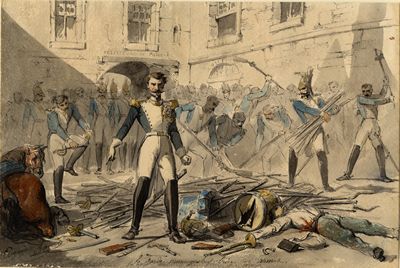
Lacoste, Eugène, 1818-1907. La Garde Municipale brise ses armes. [Paris : 1848?]. Original watercolor. 23 x 33 cm. The Garde Municipale was responsible for maintaining order in the capital city under Louis-Philippe's reign. During the Revolution of 1848, the Garde was in charge of protecting Parisian institutions from the escalating violence and rioting, and were sometimes forced to destroy weapons to ensure the capital's security.
| |
|
||
 [click on image to zoom] |
 Brand der Tuilerien und
Kampf auf der Barrikade von Belleville in Paris, am 24. Mai 1871.
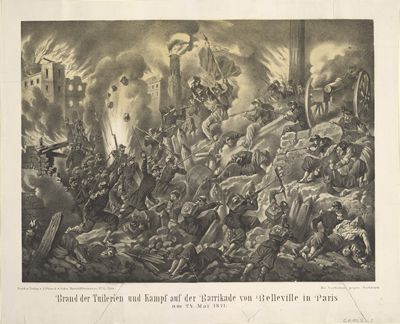
Brand der Tuilerien und
Kampf auf der Barrikade von Belleville in Paris, am 24. Mai 1871.Wien : Druck u. Verlag v. A Planck & Sohn, Mariahilferstrasse no. 75, [1871?]. Tinted lithograph. 40.5 x 57 cm. Anne S.K. Brown Military Collection Because it symbolized the absolute rule of consecutive monarchies, the Tuileries Palace, destroyed by the communards, was never rebuilt under the Third Republic, leaving the U-shaped Louvre now opening up to the Champs-Elysées.
| |
|
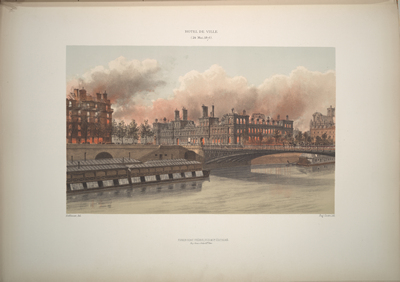
" Hôtel de Ville, 24 Mai 1871 " Hoffbauer, 1839-1922 Paris : Firmin-Didot, 1875-1882. Vol. 1, chapitre 1, pl. [VI]. Colored
lithograph by Eugène Cicéri, drawing by F. Hoffbauer. During the "semaine sanglante" of May of 1871, the Hôtel de Ville was set afire by the communards and took nearly eight days to be fully extinguished. Completely destroyed in the fire, the building was eventually rebuilt under the Third Republic. The total construction process took around ten years to complete, and the restored Hôtel de Ville was a near replica of that which was the center of Paris prior to the Commune.
|
[click on image to zoom] | |
 [click on image to zoom] |
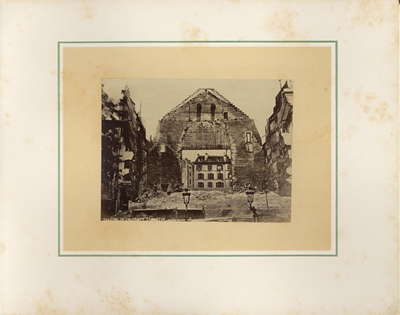
Album photographique des ruines de Paris : collection de tous les monuments et édifices incendiés et détruits par la Commune de Paris. Paris : Librairie rue Visconti, 22, [1871]. Photographic print (albumen) no. 16. John Hay Library Starred Books Collection The Théâtre de la Porte-Saint-Martin, located on the boulevard Saint-Martin, was inaugurated under this name in 1814. Invaded during the Commune in May of 1871, the federals fired guns at Parisian communards from the windows of the theatre before it was completely set ablaze and destroyed. It was eventually restored and re-inaugurated in 1873.
| |
|
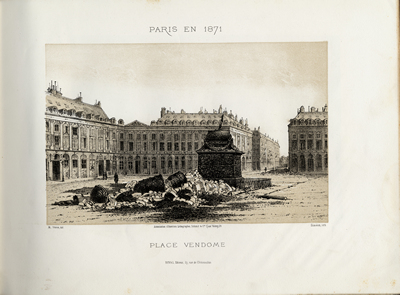
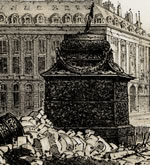
" Place Vendôme " Véron, Alexandre René, 1826-1897 Paris en 1871. [Paris] : Duval, éditeur, 27, rue de Châteaudun, [1871?]
([Paris] : Association d'ouvriers lithographes, Schmit & Cie., quai
Valmy, 21) #8. Tinted lithograph by Siméon; drawing by Véron.
Symbolically controversial during the periods to follow, the Colonne
Vendôme was dismantled and redesigned on multiple occasions during
the first half of the 19th century. In 1863, Napoléon III ordered
the construction of the present column, once again commemorating his
uncle Napoléon Bonaparte. This symbol of the greatly despised
Empire was dismantled once again by the Paris Commune on May 16, 1871.
Falling onto a bed of hay and manure, the Colonne Vendôme was
destroyed and broken into pieces in a symbolic gesture on behalf of
the Parisians. It was eventually restored in 1873, following the defeat
of the Commune, and weighed a total of 2,000 tons. It is located in
the first arrondissement. |
 | |
 July Revolution of 1830
  Revolution of 1848
 Commune, 1871
Street Scenes Home | Exhibits Home | Library Home | Brown Home
This page was last updated on Monday, 02-Mar-2015 11:45:58 EST.
© 2004, Brown University Library. All rights reserved
You are the [an error occurred while processing this directive]
visitor to this page since September 28, 2004.