

Date: 1644 Country: Germany City: Koenigsberg
The first Haggadah with musical notation and the first translation of the Passover Haggadah into German. Translation by Joannes Stephanus Rittangel (1606-1652) a Christian Hebraist and Professor of Semitic languages at the University of Koenigsberg in 1640.
Collection ID: CAT_009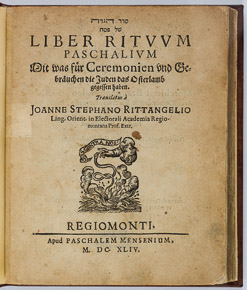
Date: 1710 Country: Germany City: Frankfurt am Main
Rabbi Aaron Teomim, (c. 1630–1690), was a member of the well-known Teomim-Fraenkel family which had settled in Prague. In 1670 he succeeded Samson Bacharach as the rabbi of the Jewish community of Worms. While there, during Passover of 1675, he fell very sick and vowed to write a commentary on the Haggadah if he should be restored to good health. Upon his recovery he published the present volume Maṭṭeh Aharon (Aaron's Rod).
Collection ID: CAT_013
Date: 1749 Country: Germany City: Frankfurt
Collection ID: CAT_016
Date: 1727 Country: Germany City: Frankfurt am Main
A personal prayer-book encompassing a selection of daily prayers recited in one’s home and around one’s table. The volume concludes with an illustrated Haggadah. All the texts in this volume are provided with an accompanying Yiddish translation.
Collection ID: CAT_018
Date: 1783 Country: Holland City: Amsterdam
This Haggadah, with a kabbalistic commentary by Rabbi Elhanan ben Moses of Schnaittach, was published by Yohanan Levi Rofeh and his brother-in-law, Baruch, in Amsterdam, 1783.
Collection ID: CAT_021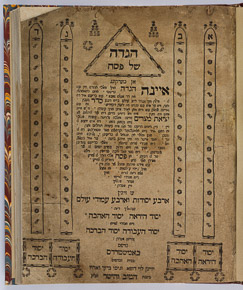
Date: 1791 Country: Gemany City: Karlsruhe
Jews settled in Karlsruhe, a city in southwest Germany, shortly after its foundation in 1715. In 1783, a decree issued by margrave Charles Friederich granted Jews permission to settle wherever they pleased in Karlsruhe and freed them from the death tax, paid to the Christian clergy for each Jewish burial. The title page of this haggadah documents the Jewish community’s appreciation for their ruler Charles Friederich and includes praise and the wishes that God “exalt his glory and uplift his sovereignty.
Collection ID: CAT_022
Date: 1830 Country: Germany City: Breslau
THE ONLY EXISTING COMPLETE COPY KNOWN! It includes an unusual series of illustrations not found in any other haggadot which are exceptionally interesting in their use of new iconography not based on the earlier models popularized in the iconic haggadot of Amsterdam, 1695 and Venice, 1629. The final folio includes a German text for a contract to sell one’s chametz.
Collection ID: CAT_029
Date: 1830 Country: Germany City: Berlin
This Haggadah appears to be an explanatory Haggadah for children but is, in reality, a missionary tract. The work, written in a Yiddish purports to be a three part explanation of Haggadah and Passover story but was actually "published . . . to rouse the hearts of Jewish children to seek the path of salvation."
Collection ID: CAT_030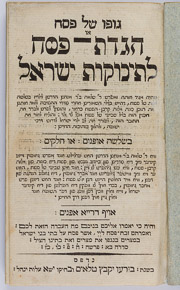
Date: 1838 Country: Germany City: Cologne
The special interest in this edition lies in its supplement which contains the notations of selected melodies of the Passover Seder scored by Isaac Offenbach, father of the famed composer Jacques Offenbach. These are described as “the old music which has come down to us through tradition and some newly composed melodies”
Collection ID: CAT_033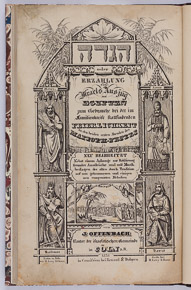
Date: 1841 Country: Germany City: Frankfurt am Main
The first separate edition of a Reform Haggadah. Authored by Rabbi Leopold Stein (1810-1882), a prominent leader of the Reform movement.
Collection ID: CAT_035
Date: 1885 Country: Germany City: Dusseldorf
Die Plagen was part of a three-volume set written and illustrated by Carl Maria Seyppel (1847-1913). Entitled, Aegypstische Humoreske: Schlau, Schlauer, am Schlausten; Er-Si-Es; Die Plagen, these books published from 1882-85 are illustrated anti-Semitic verse parodies of the story of the Exodus.
Collection ID: CAT_043
Date: 1927 Country: Germany City: Frankfurt
Collection ID: CAT_058
Date: 1946 Country: Germany City: Landsberg DP
The Landsberg Displaced Persons camp, 72 kilometers west of Munich, was set up in May 1945 in what had been the German Army base of Saarburg Kaserne. Until September of that year, the DP camp housed both Jewish survivors and non-Jewish political prisoners. The political prisoners thinned out as they were repatriated to their home countries, but the Jews, most of whom had no homes or families to return to, remained at Landsberg. Those who survived and were housed in the DP camp called themselves the She'erit Hapletah (the Saved Remnant). With the assistance of the Jews from Palestine who came to work among them, they began to prepare themselves to make aliya. The cover of this Haggadah published in the Landsberg DP camp in 1946 features the Hebrew words She'erit Hapletah (the Saved Remnant). At top left, an image of the pyramids indicating ancient slavery, is juxtaposed with that of a Concentration Camp at right. At the bottom of the page, the sun rises over a fertile landscape of Israel – a promise of better things to come.
Collection ID: CAT_072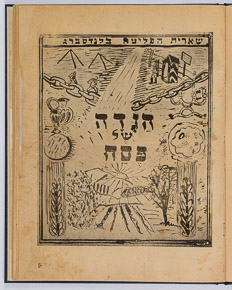
Date: 1946 Country: Germany City: Munich
In the winter of 1945-1946, Holocaust survivors in displaced persons camps around Munich prepared for the first Passover after liberation by creating an extraordinary illustrated Haggadah. This Haggadah was written and arranged by Yosef Dov Sheinson, a Lithuanian Jew who had survived four years of internment and heavy labor under the Nazis. The text in Hebrew and Yiddish, is surrounded by illustrated borders (hand-drawn by Sheinson), and includes seven stark woodcuts of scenes from the camps by the artist Miklos Adler, (“Ben Benjamin”), a Hungarian survivor. While the Passover story retells the Exodus of the Israelites from oppression in ancient Egypt, this Haggadah uses images that retell the parallel suffering and killing under the Nazis. For this reason, it is often called “The Survivors Haggadah.” This work, initially published through the joint efforts of two Zionist organizations, was reprinted by the U.S. Third Army with the guidance of its chaplain, Rabbi Abraham J. Klausner. It was used for a communal Seder that Klausner led in Munich on April 15 and 16, 1946 attended by DPs as well as American relief workers. The cover of the Haggadah is imprinted with the tricolor “A” insignia of the United States Third Army so that it could be printed as a U.S. government document. Although it is believed that about 400 were printed only a very few handful of the originals survive.
Collection ID: CAT_073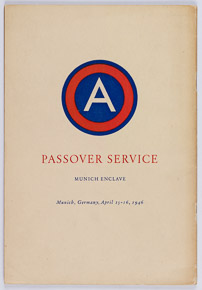
Photography and website design by
Ardon Bar-Hama