

Date: 1695 Country: Holland City: Amsterdam
First edition of the enormously influential Amsterdam Haggadah. With commentary by Isaac Abrabanel and numerous copper-plate engravings. Includes the folding map of the Holy Land. In the original gilt-tooled binding . This rare Amsterdam Haggadah is a milestone in the history of Hebrew printing and illustration. Of all the early printed illustrated Passover haggadot, the Amsterdam Haggadah of 1695 had the greatest impact on subsequent editions.
Collection ID: CAT_011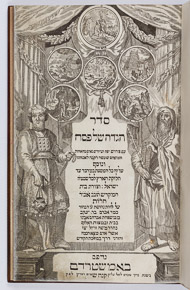
Date: 1695 Country: Holland City: Amsterdam
Printed by David Tartas, Amsterdam, 1695 a rare luxury edition, printed on blue paper From the earliest days of printing, deluxe copies of printed books were produced by enterprising printers. Parchment was considered a particularly sumptuous alternative to paper, and copies of books printed on parchment were especially cherished by bibliophiles. However, with the expense and technical difficulty of printing on parchment, another deluxe tradition sprang up – that of printing on richly colored blue paper. The first book printed on blue paper was produced in Venice by the distinguished printer, Aldus Manutius, Libri de re rustica (May 1514). Just as they had done with parchment, printers utilized blue paper to produce a limited number of exceptional copies of a work; these were of great interest to book collectors and would be given as presentation copies to members of the nobility, dignitaries and to patrons of the press. This new 'deluxe' medium was introduced into Hebrew printing by Daniel Bomberg, a Christian publisher of Jewish texts in Venice. His earliest imprint on blue paper was the 1517 edition of Tehillim. The desirability of this new medium, blue paper (in Italian carta azzurra or carta turchina), was fueled by the Renaissance fascination with the expensive indigo dye. Following Bomberg's lead, other Christian and Jewish printers of Hebraica, including David Tartas in Amsterdam and Vicenzo Conti and Jacob Marcaria in Riva di Trento, Cremona, and Mantua, issued deluxe copies on this special paper stock from their presses. Scholars have suggested that the special status of blue in the Jewish tradition led to the affinity for this color in the world of Hebrew books. This Haggadah includes three commentaries: Mateh Aharon by Aaron Te'omim, Kethonet Pasim by Joseph ha-Darshan of Przemysl and Shenei Luḥot ha-Berit by Isaiah Horowitz. It is the first appearance of the commentary by Rabbi Isaiah Horowitz. Rabbi Horovitz (1565–1630), was born in Prague and studied under the renowned Torah scholars, Rabbis Meir Lublin and Joshua Falk. Horowitz served on the rabbinical courts of Dubno and Ostróg, and in 1606 he was appointed to head the Bet Din of Frankfurt am Main. After the Jews were expelled from Frankfurt in 1614, he returned to Prague and assumed the prestigious position of chief rabbi of Prague. He is the author of the encyclopedic ethical work Shenei Luḥot ha-Berit, and is known as Ha-Shelah ha-Kadosh (The Holy Shelah) an honorific acronym drawn from the title of this work. After the death of his wife in 1621, he moved to Jerusalem and became the leader of the Ashkenazic Jewish community there. In 1625, Rabbi Horovitz was kidnapped, imprisoned and held for ransom by the ruling Pasha Ibn Faruh along with 15 other Jewish rabbis and scholars. Upon his release, Rabbi Horowitz moved to Safed, and later died in Tiberias on March 24, 1630. Despite the short time he spent in the Land of Israel, his name is associated with the great cultural and Kabbalistic revival there in the Sixteenth century. He stressed the joy in every action, and how one should convert the evil inclination into good, two concepts that informed Jewish thought through the eighteenth-century, and greatly influenced the development of the Chassidic movement.
Collection ID: CAT_012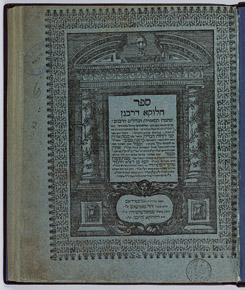
Date: 1712 Country: Holland City: Amsterdam
The celebrated second edition of the illustrated Amsterdam Haggadah. With engravings by Abraham bar Yaakov, a convert to Judaism who drew on his knowledge of art and the earlier biblical illustrations of Matthaeus Merian, (specifically his Icones Biblicae of 1625) to create an iconic series of artwork to enliven the text of the haggadah.
Collection ID: CAT_014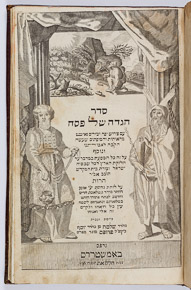
Date: 1775 Country: Holland City: Amsterdam
Collection ID: CAT_020
Date: 1783 Country: Holland City: Amsterdam
This Haggadah, with a kabbalistic commentary by Rabbi Elhanan ben Moses of Schnaittach, was published by Yohanan Levi Rofeh and his brother-in-law, Baruch, in Amsterdam, 1783.
Collection ID: CAT_021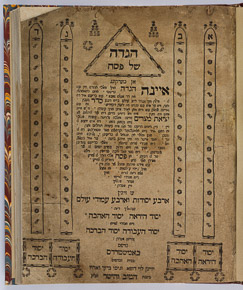
Date: 1810 Country: Holland City: Amsterdam
Collection ID: CAT_026
Date: 1945 Country: Holland City: Eindhoven
This abridged Haggadah printed in Hebrew with Dutch translation was issued by the “Joodsche Coördinatie Commissie voor het bevrijde Nederlandsche gebied” (Jewish Coordinating Commission for the Liberated Netherlands Government). It was published in Eindhoven, a city in Southern liberated Holland, at a time that the Northern part of the country was still under German occupation.
Collection ID: CAT_070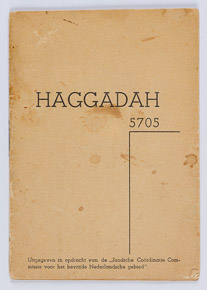
Photography and website design by
Ardon Bar-Hama