

Date: 1843 Country: Israel City: Jerusalem
This is the second Haggadah to be printed in Jerusalem; it was produced just two years after the founding of Bak’s pioneering press in that city. In addition to the Haggadah, the text includes prayers and readings for the entire month of Nissan, a commentary on the Passover Seder composed by Abraham Ankawa, as well as the ethical treatise Pirkei Avot (Ethics of the Fathers) and Shir Ha-Shirim (Song of Songs).
Collection ID: CAT_036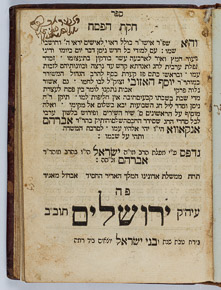
Date: 1946 Country: Germany City: Landsberg DP
The Landsberg Displaced Persons camp, 72 kilometers west of Munich, was set up in May 1945 in what had been the German Army base of Saarburg Kaserne. Until September of that year, the DP camp housed both Jewish survivors and non-Jewish political prisoners. The political prisoners thinned out as they were repatriated to their home countries, but the Jews, most of whom had no homes or families to return to, remained at Landsberg. Those who survived and were housed in the DP camp called themselves the She'erit Hapletah (the Saved Remnant). With the assistance of the Jews from Palestine who came to work among them, they began to prepare themselves to make aliya. The cover of this Haggadah published in the Landsberg DP camp in 1946 features the Hebrew words She'erit Hapletah (the Saved Remnant). At top left, an image of the pyramids indicating ancient slavery, is juxtaposed with that of a Concentration Camp at right. At the bottom of the page, the sun rises over a fertile landscape of Israel – a promise of better things to come.
Collection ID: CAT_072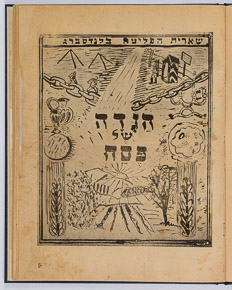
Date: 1947 Country: Israel City: Kibbutz Givat Hashlosha
This Passover Haggadah was printed for members of Kibbutz Givat Hashlosha in the Spring of 1947. It is a non-traditional Haggadah which includes texts and illustrations about life in the ghettos and concentration camps of Europe; it also touches on the difficult period of illegal immigration to Palestine. For many years, Passover was seen as the main holiday on the kibbutz. The Passover Seder, with the theme of redemption at its center, became the most important event of the year and kibbutzim often created their own versions of the Haggadah text.
Collection ID: CAT_074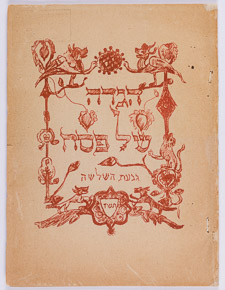
Date: ca. 1950 Country: Israel City: Tel Aviv
This volume published in Tel Aviv in the first years of the State of Israel is bound in a Bezalel-style binding; with a stamped brass panel depicting a map of Israel laid into the front board. The text is decorated with numerous black and white illustrations by Gustav Dore and four tipped-in color illustrations.
Collection ID: CAT_075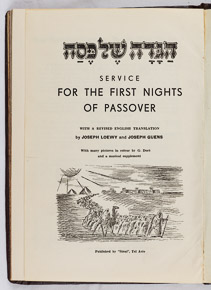
Date: 1952 Country: Israel City: Tel Aviv
Published by the public relations division of the Israel Defense Forces, this original and innovative text celebrating Israel’s Independence Day follows the format of the Passover Haggadah. Profusely illustrated with photographs and emblems, it is the work of Aharon Meged (b. 1920), a kibbutznik , author and editor of several literary magazines. Because of its appropriation of traditional religious tropes, it appeared as an unwarranted attempt to create new liturgy and was thus deemed too controversial by many traditional religious authorities, who demanded its withdrawal from publication. Surviving copies are extremely rare due to censorship.
Collection ID: CAT_076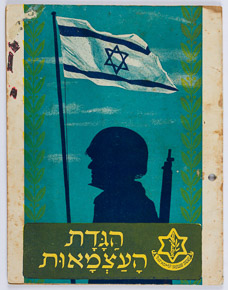
Photography and website design by
Ardon Bar-Hama