

Date: 1545 Country: Italy City: Venice
This first Haggadah printed in Venice is the second edition of Isaac Abrabanel’s enormously popular commentary on the Haggadah, Zevach Pesach. During the 16th century, the ruling authorities of Venice did not allow Jews to own printing presses. Therefore, Hebrew books produced in Italy during this period were published in Christian printing houses. The title page of this early Haggadah bears the printer’ emblem of Marco Antonio Giustiniani, a patrician Venetian who opened a Hebrew press in 1545. This Haggadah is the 3rd volume to come off of his press. Giustiniani’s emblem was a representation of the Temple in Jerusalem as it was imagined to have looked. Unexpectedly, the image of the building is modeled on the Muslim’s Dome of the Rock. The adoption of the Islamic imagery for the Holy Temple was the result of the popular acceptance of the Crusader’s representations of the Temple as the Dome of the Rock.
Collection ID: CAT_002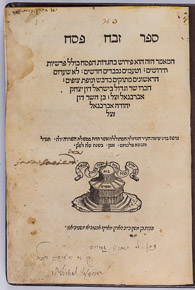
Date: 1557 Country: Italy City: Cremona
This rare edition of the Haggadah is a microcosm of the 16th century campaign against Hebrew books which began with the burning of the Talmud in Rome and Venice in 1553 and spread rapidly thereafter to other cities in Italy. Following the temporary cessation of the Hebrew presses in Venice, Jews found new places to print and for a period of 10 years (1556-1566) Hebrew books were produced in Cremona at the press of the Christian publisher, Vicenzo Conti. This Haggadah, dated 1557, is the eighth Hebrew book printed in Cremona.
Collection ID: CAT_003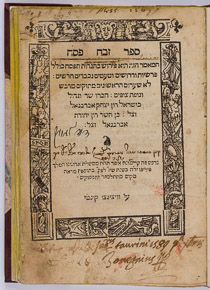
Date: 1569 Country: Greece City: Salonika
THE FIRST HAGGADAH PRINTED IN EASTERN EUROPE The printer, Kalonymus ben Mordecai Jaffe, together with his family and his staff, had all fled from the plague-ravaged city of Lublin to the village of Bistrowitz, on the city's outskirts. There they printed only a single work, the present Haggadah.
Collection ID: CAT_004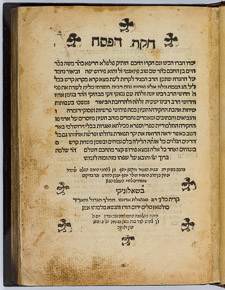
Date: ca. 1605 Country: Italy City: Venice
This exceptionally rare Haggadah was printed in Venice at the turn of the 17th century. Between the years 1599 and 1605, Giovanni da Gara published five Haggadot in small quarto editions with woodcut illustrations - of which almost no copies survive today. The Haggadah is replete with dramatic woodcuts that enliven every page.
Collection ID: CAT_007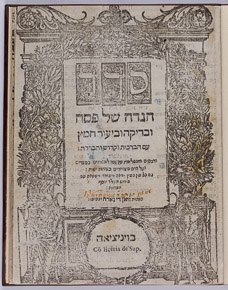
Date: 1629 Country: Italy City: Venice
The Venice Haggadah of 1629 is one of the most beautiful Haggadot ever printed. The present edition was commissioned by Moses ben Gershon Parenzo, the last of three generations of Hebrew printers, and issued at the Bragadini press. This Haggadah appeared simultaneously in three versions with translations in Judeo-German (Yiddish), Judeo-Spanish (Ladino), and Judeo-Italian, the three primary languages of the Jewish communities living in Venice at the time.
Collection ID: CAT_008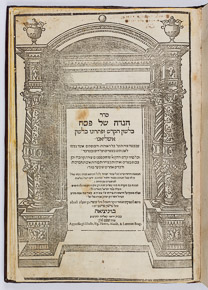
Date: 1692 Country: Italy City: Venice: Bragadin
The first edition of the Haggadah to appear with commentary by Chaim Benveniste, Chief Rabbi of Izmir (Smyrna), Turkey. An influential halakhic study of the Passover Haggadah that was incorporated into many later editions
Collection ID: CAT_010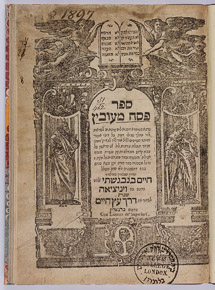
Date: 1827 Country: Italy City: Livorno
Text in Hebrew with a translation into Judeo-Spanish. Illustrated throughout with beautiful woodcut illustrations A rare Haggadah - the only other known copy is in the British Library.
Collection ID: CAT_028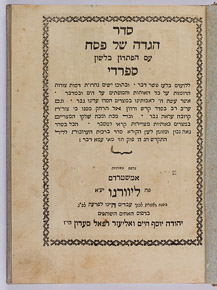
Date: 1864 Country: Italy City: Trieste
The most distinguished illustrated edition of the haggadah produced in Europe during the nineteenth century. Edited by Abraham Hai Morpurgo, scion of a noted scholarly Italian-Jewish family and featuring vivid illustrations expertly executed by Kirchmayer.
Collection ID: CAT_041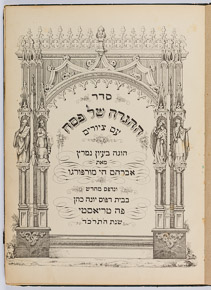
Date: 1945 Country: Italy City:
This extremely rare wartime Haggadah, printed in just a handful of copies, reflects the unique perspective of the "Palestinian" Jews (as they were then referred to), serving in the British Army. It brings together prayers of the traditional Haggadah along with elements of Zionist idealism concerning rebuilding the Land of Israel.
Collection ID: CAT_069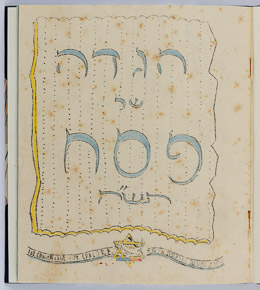
Date: 1946 Country: Italy City: Caserta
This Haggadah with new series of illustrations was produced in 1946 for members of the Company 179 of the Royal Army Service Corps in Capua, a city in the province of Caserta (where they were based) in southern Italy. It opens with the heartfelt plea: "This Haggadah is presented to the people of our unit and to the visitors dining with us, in the hope that this Seder - the third for us in Italy- will be the last for us in a foreign country.
Collection ID: CAT_071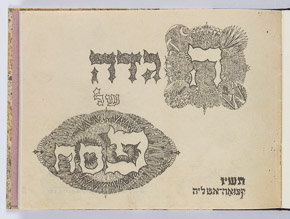
Photography and website design by
Ardon Bar-Hama