
Havre-de-Grace: Making a City Fit for a King
Nathaniel Walker
Jean Baptiste Descampes (1706-1791). Relation de l’arrivée du roi au Havre-de-Grace, le 19. Septembre 1749, et des fêtes qui se sont données a cette occasion. Paris: Hippolyte-Louis Guérin et de Louis-François Delatour, 1753.
An account of the arrival of the King at Havre-de-Grace, 19 September 1749, and the celebrations that were given on this occasion.
After receiving notice of an impending visit by King Louis XV of France, who was returning home by sea from the Netherlands after signing a treaty ending the War of Austrian Succession, the leaders of the port city of Havre-de-Grace scrambled to prepare a festival in his honor. Committees were formed to organize special events, youth were divided into parade companies and issued specially design uniforms, old veterans were enlisted to help ensure the ceremonies bore a properly martial air, and the city’s many sailors prepared massive displays of their naval prowess, to be conducted in the harbor for the king’s amusement.
Havre-de-Grace had for several centuries enjoyed a long and mutually beneficial relationship with the French crown, and was proud of it. King Louis XII had founded the city in 1517, and after it began to thrive King François I fortified it to protect it from invasion or incursion by land or sea. Louis XIII surrounded the city with a second belt of protective walls and built a citadel, which Louis XIV augmented. In preparing to host King Louis XV, known as Louis “The Beloved,” the town was not only expressing its gratitude for past support, but also presenting a case that the crown’s investments had been worthwhile, and that more civic assistance and attention might be justified.
When the King arrived on September 19, 1749, he was escorted with great decorum to the main gate of the citadel, where he was handed the keys to the city. Such displays had multiple layers of meaning: the King was welcomed with a gesture of trust and submission and the city was “marked” as his territory (Geertz, 16), while the keys were accepted in an implicit promise of protection and care. The ruler was praised for his virtues, and thanked for his kindness and generosity—-the sort of compliments that, when offered to a king, implicitly bear a request for more of the same. The remainder of the day was filled with elaborate ceremonies and celebrations, with a special focus on demonstrations of boatmanship, including naval jousts, which the king observed from a balcony overlooking the harbor (Figure 1). Such displays reinforced the city’s importance to the kingdom as a thriving port of economic and military value, and were also, naturally, very entertaining.
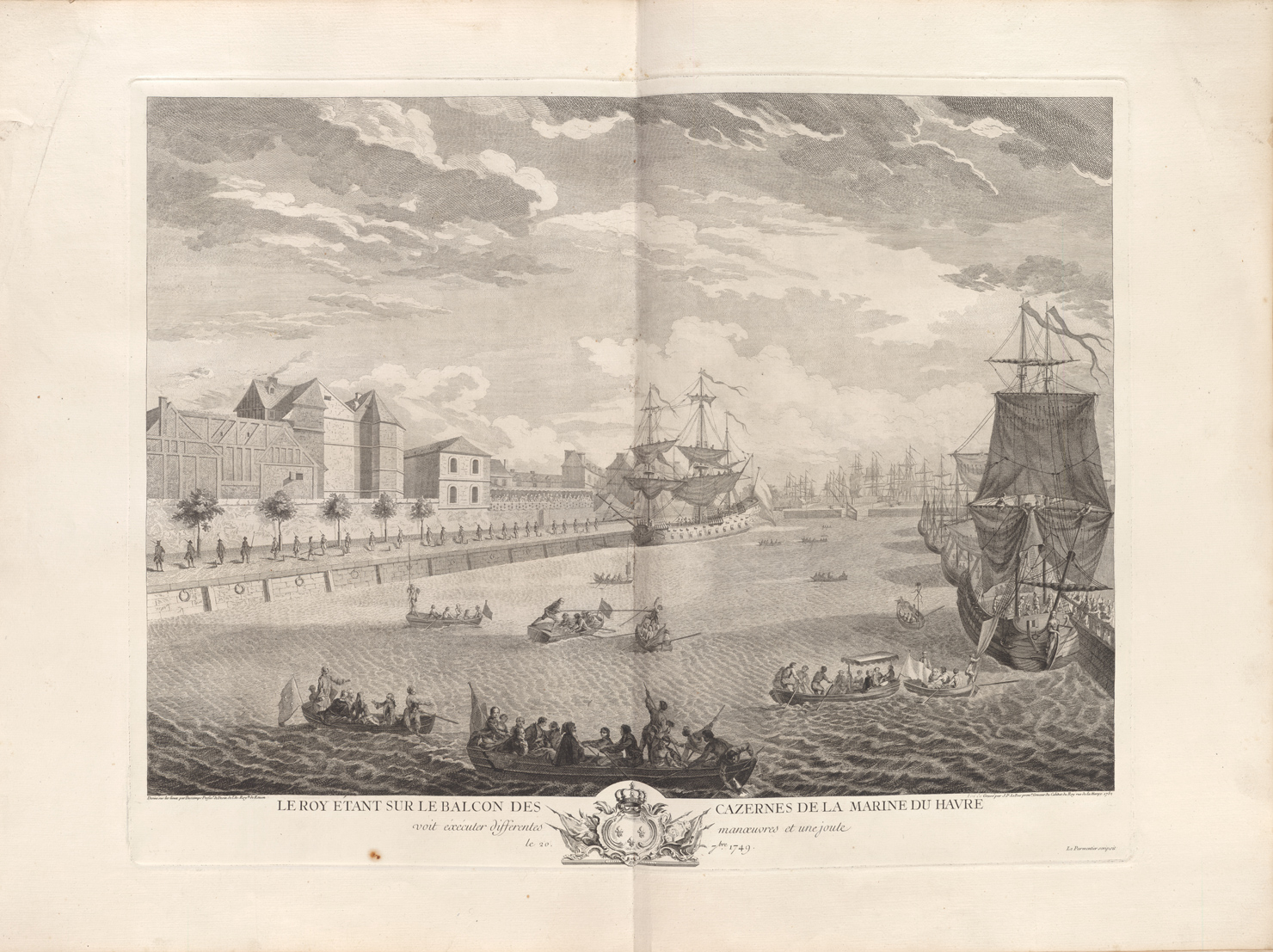
Figure 1
That evening, a special event known as an “illumination” was conducted, in which the city’s causeways, walls, squares, trees, and buildings were covered and hung with countless scores of flickering candles and glowing lanterns. The Grande Rue—the city’s most important street, a civic corridor linking the port with the town hall—received special attention. To transform its hodge-podge buildings into the walls of a ceremonial axis befitting the King, a special decorative “portico,” made of ivy and laurel, was affixed to the entire lengths of either side, alternating in form between pediment and arch (Figure 2). This device not only unified the architecture, it also accommodated thousands of luminous candles. Terminating the view, in a manner evocative of an architectural monument such a palace or church, was one of the city’s great vessels; this, too, was completely outlined by candles. In many European cities architectural transformations for special events such as these were necessarily temporary, as in the case of Havre-de-Grace. But, in their expression of symmetry and decorum on an urban scale, they nonetheless shed light on the forms of more permanent grandly scaled urban alignments, and realignments, made later in cities such as Paris and Barcelona (Bonnemaison and Macy, 6).
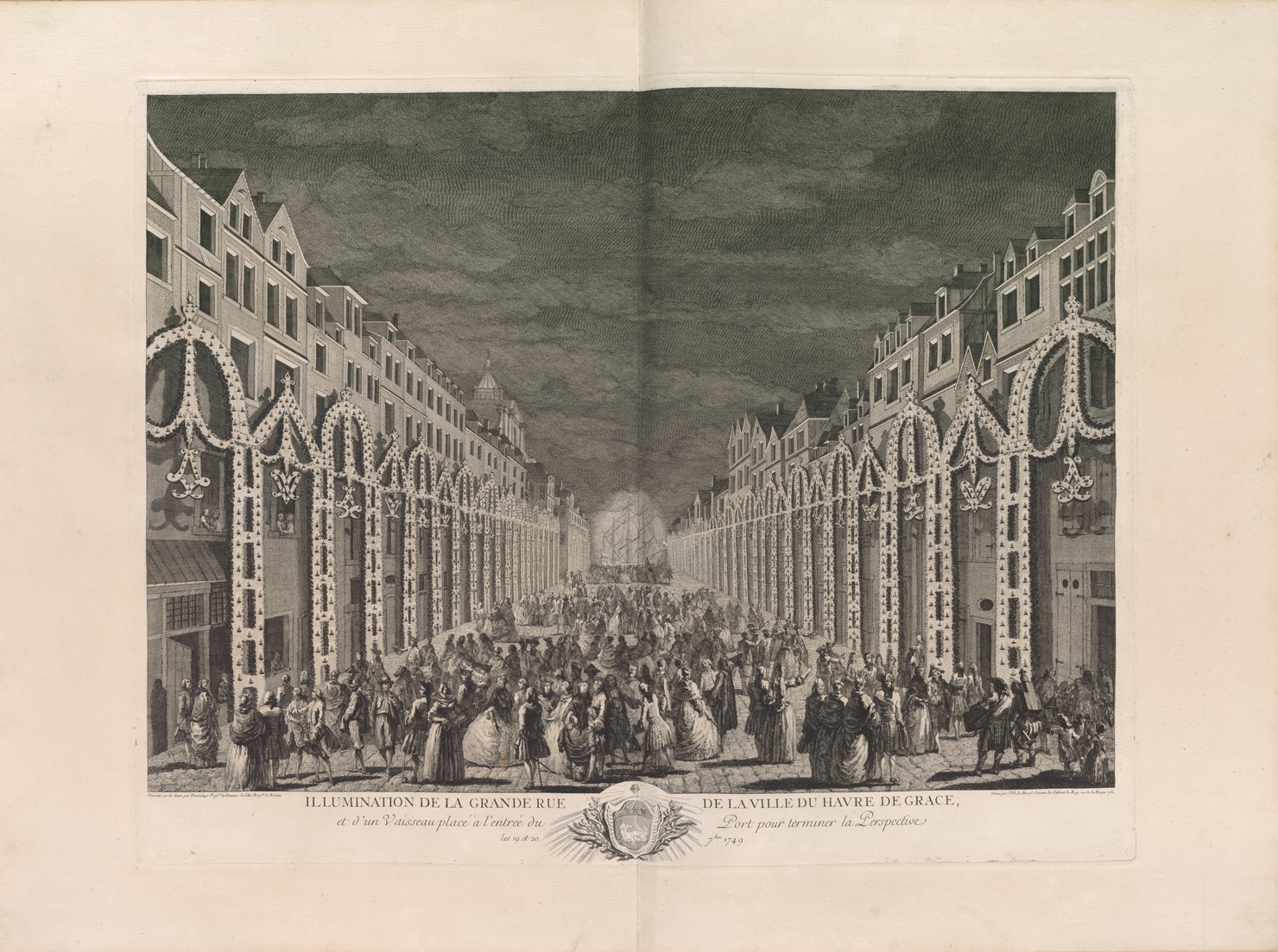
Figure 2
Eventually, the King returned home to his court–the candles went out, the ivy porticoes withered, and the ships of Havre-de-Grace returned to the labors of the sea. But so that nobody would forget the special events that were prepared for that momentous occasion, and the magnificent transformations the city underwent to become a stage fit for the King, the leadership of the city commissioned a book to record the festival of the royal visit. This book was filled with careful prose, lavishly engraved and carefully printed illustrations, and presented to the King a few years after his visit. It included, in addition to images recounting the celebrations, a depiction of the moment the King took a journey beyond the walls to survey the prosperous port from a nearby hill. Exposed as he was, the king’s mounted guards had to rally to drive off adoring subjects lest they mob his Highness (Figure 3)—and this was, all around, a fitting and memorable demonstration of the fidelity and love of the people for their monarch, which, like the candles on the illuminated vessel, would shine perpetually from these pages for the King’s amusement, and consideration.

Figure 3
Bibliography
Bonnemaison, Sarah, and Christine Macy, editors. Festival Architecture. Abingdon: Routledge: 2008.
Geertz, Clifford. “Centers, Kings, and Charisma: Reflections on the Symbolics of Power.” In Wilentz, Sean, editor. Rites of Power: Symbolism, Ritual, and Politics Since the Middle Ages. Philadelphia: University of Pennsylvania Press, 1985.
Watanabe-O’Kelly, Helen. “The Early Modern Festival Book: Function and Form.” In Mulryne, J. R., Helen Watanabe-O’Kelly, and Margaret Shewring, editors. Europa Triumphans: Court and Civic Festivals in Early Modern Europe. Aldershot, Hampshire: Ashgate Publishing Limited, 2004.