
E-Newsletter
Recent Posts
Latest News
-
John Hay’s China Policy Symposium
|
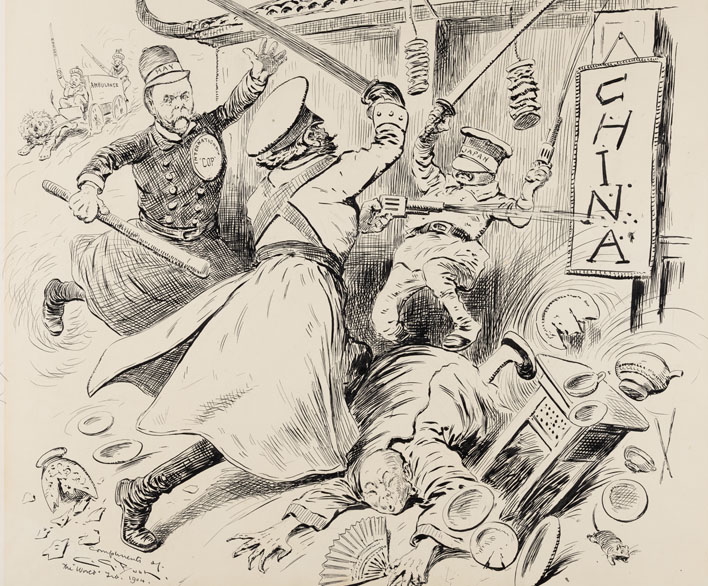
Edgren, Robert W., “John Hay as International Cop” John Hay’s China Policy. Brown Digital Repository. Brown University Library. https://repository.library.brown.edu/studio/item/bdr:zkr8a6xn/ Join the Brown University Library for a one-day symposium on John Hay’s China Policy on Saturday, May 2, 2026, from 9 a.m. to 5 p.m. at the Rockefeller Library. The interdisciplinary symposium will feature talks by distinguished participants ranging from historians and a diplomat to musicians who will examine John Hay’s Open Door Policy through new research on diplomacy, empire, narrative-making, and global power. The event will also include a special musical component.
Free and open to the public. Hybrid event.
Sponsored by Brown University Library, Brown 2026, China Initiative, Cogut Institute for the Humanities, and UTRA.
Registration Required
Participants
Peter Perdue (Keynote)
Professor Emeritus of History at Yale University
“John Hay, China, and the World of the 1900s”John Hay is best known for announcing the Open Door policy toward China, in which the United States attempted to preserve equal access to trade by the foreign powers while ensuring the territorial integrity of the Qing empire. Historians have debated whether this policy was unrealistic, misguided, or an expression of rising U.S. power in the world, but they have often neglected the Chinese and foreign views of this policy. Less attention has also been paid to other global trends of the time which had an impact on Qing and U.S. relations. By connecting Hay and his views to the world of the 1900s, we can better appreciate his contributions and limitations in shaping U.S. China relations.
Matthew Mosca
Dau-lin Hsu Endowed Professor, Jackson School of International Studies and Associate Professor of History, University of Washington
“William W. Rockhill and the Conceptualization of the Qing Empire”William W. Rockhill, whose expertise lay behind the Open Door notes, was also a leading scholar and scientific traveler. His diplomatic vision of the Qing Empire was informed by extensive travels in Mongolia and Tibet, and the translation of Chinese and Tibetan sources. This short essay examines how Rockhill articulated his understanding of the internal complexity of the Qing realm, and how this helps us better understand the “China” whose territorial integrity he considered the United States interested in protecting.
Jeffrey Wasserstrom
Distinguished Professor of History, University of California, Irvine
“The Boxer Uprising in the American Imagination”This presentation will explore the varied ways that a wide array of Americans, ranging from journalists and diplomats to poets and the creators of dramatic spectacles, have thought about and portrayed the anti-Christian Boxer insurgents of 1900. It will look at both how the anti-Christian militants and the events involving them, such as the Siege of Beijing, were represented at the turn of the nineteenth and twentieth centuries and how these figures and those events figure in some works produced well after the fact. Individual Americans discussed will include such famous figures as the historian Henry Adams, a close friend of John Hay; the poet Julia Ward Howe, best remembered now as the author of “The Battle Hymn of the Republic” and composer of two poems about the Siege of Beijing; the showman Buffalo Bill; and the novelist Pearl Buck. Attention will be paid to how American approaches to the Boxers have changed over time and the similarities and differences between ideas about the group in the United States and in other places, especially Britain and China.
Ambassador Chas Freeman
“The American Misimagination of China: Dealing with China When It’s Up, Down, and Ascendant”
Wang Lu
Composer and Associate Professor of Music, Brown University
“Resonance and Projection: From Yellow Music to Urban Sonic Memory”This talk examines early 20th-century “yellow music” within the geopolitical framework of Open Door Policy associated with John Hay tracing how imagined and mediated sonic representations of China emerged alongside expanding global and urban modernities. It concludes with my own composition for pipa, performed live, which reinterprets these histories through contemporary urban soundscapes to propose an alternative mode of listening and cultural presence.
Yang Jin
Pipa Faculty, Bard College Conservatory of Music — Performance
Benet Ge
Ph.D. Candidate, History of Art and Architecture, Brown University
“Edward Carrington’s Providence in China”In 1802, Edward Carrington embarked on a journey from Providence to serve as the American Consul in Canton (Guangzhou) for the next decade. Carrington’s service in this role–procuring exquisite teas and textiles for Americans and navigating often fraught diplomatic relations with Cantonese and European merchants alike–left behind one of the richest textual archives of Sino-American exchange available to researchers today and has served as an integral source in influential histories of the “Old China Trade.” In parallel with yet in total isolation from this textual history stands the history of the collection of Chinese art objects collected by Carrington during and after his time in Canton, which forms a significant portion of the exemplary objects published in Carl Crossman’s seminal art historical account of Cantonese trade art, The China Trade: Export Paintings, Furniture, Silver and Other Objects. I bring these two exemplary archives of Sino-American artistic and economic exchange together for the first time, highlighting previously unresearched objects and the circuitous route they took from Canton, to Carrington’s house in Providence (which was briefly part of RISD Museum), and finally to the John Brown House Museum, where they remain today, within walking distance of their corresponding textual archive at the Rhode Island Historical Society.
Adam Reiffen
Military Fellow, Watson School of International and Public Affairs, Brown University
“Who Opened the Door? Reexamining Outside Influences on John Hay’s China Policy”Through the “Open Door” notes, diplomatic maneuvering, and indemnity following the Boxer Rebellion, John Hay’s time as Secretary of State was consequential in reorienting American foreign policy towards China and the greater Pacific at the dawn of the 20th Century. New archival research and analysis show, however, the extent to which these seminal ideas may have represented the interests of foreign powers as much as the United States itself. What do these new discoveries tell us about this period of colonialism and the nature of global influence? This talk will serve as a targeted reexamination of the impacts of historical Great Power Competition on American foreign policymaking, life and trade in Pacific nations, and John Hay’s legacy as a driver of change in US-China relations.
-
Reduced Access at John Hay Library, Summer 2026
|

John Hay Library The John Hay Library is renovating its exterior this summer! As a result, there will be reduced access to this library and special collections. Please refer to the John Hay Library website for up-to-date hours.
Operating Schedule
May 25 to September 7, 2026
The John Hay Library will be closed.
June 8 to August 28, 2026
The special collections reading room at the Hay will be closed during this time with a temporary special collections reading room set up in the Absolute Quiet Room on level A of the Rockefeller Library.
The temporary special collections reading room will be open on the following schedule by reservation only. Please see Visiting the Brown University Special Collections for information about scheduling a reading room appointment via Aeon.
- Monday and Tuesday: 1 to 5 p.m.
- Wednesday and Thursday: 10 a.m. to 5 p.m.
- Friday: 10 a.m. to noon
Closed Collections
The following collections will be closed from May 25 through September 7, 2026:
- Anne S.K. Brown Military Collection (oversized prints only)
- Corthell Engineering Library
- Damon Collection of Occult and Visionary Literature
- Albert E. Lownes Collection of Significant Books in the History of Science
- Charles Reitman Pharmacopoeia Collection
- Rhode Island Medical Society Collection
- Nineteenth century English and American drama [microfiche]
- Ethnic and native Canadian literature, 1850-1979 a bibliography of primary and secondary materials [microfiche]
Classroom Requests
Please place requests for classrooms at the Hay through the Brown University Library Instruction Request Form. Classes will be scheduled based on classroom and staff availability. There will be a limited number of library classrooms this summer due to the exterior renovation.
Requests received by May 15, 2026 will be prioritized.
-
Critical AI Learning Community – Spring 2026
|
The Library’s Critical AI Learning Community (CAILC) meets bi-monthly during the spring and fall semesters on Mondays at noon in the Sidney E. Frank Digital Studio on the first floor of the Rockefeller Library. The meetings will take place bi-monthly alternating between in-person only and hybrid meetings.
All members of the Brown community are welcome to attend. Lunch is provided on a first come, first served basis for in-person attendees.
Register to Attend
Please register to attend for both in-person and online attendance.
Spring 2026 Schedule
- March 2, 2026: AI as a Thought Partner: a Discussion with Dr. Michael Satlow, Professor of Religious Studies and Judaic Studies (Hybrid)
- March 16, 2026: Casual Conversations (In-person only)
- April 6, 2026: AI in Humanities Research (Hybrid)
- April 20, 2026: Year-End Reflection and Celebration (Hybrid)
What is the Critical AI Learning Community?
CAILC is a participant-led learning community where students, faculty, and staff meet to explore and critique artificial intelligence technology and its implications for learners and researchers throughout the Brown community. Learners of all levels and backgrounds are encouraged to share their experiences, questions, and ideas.
Goals
The goals for this community include:
- Become familiar with key concepts and terminology related to artificial intelligence
- Learn the basics of using generative AI tools
- Develop skills for evaluating and critiquing AI technology
- Explore emergent applications of AI technology
- Develop an understanding of the opportunities and drawbacks posed by AI technology
- Explore opportunities for applying critical pedagogy and critical information literacy to our understanding of AI
Community Driven
We shape this community together! The CAILC aims to center issues related to power and social justice, and to explore engagement with the structures that shape our experiences at Brown and in higher education. We encourage all participants to also be contributors — to help design, inquire, and share throughout our lunchtime meetings. Our hope is that participants will discuss and propose their own ideas and share in the stewardship of this respectful, inclusive, and generative space.
Engaging Speakers and Conversations
The meetings alternate between invited speakers or discussions that explore specific themes in AI, and casual participant led, small group conversations. Past themes have included AI, Surveillance and the Military; Exploring Facial Recognition Technology; Building AI for Citizenship Surveillance; Human and System Bias in AI Tools; AI in Medical Education at Brown; and Teaching AI in the Context of Information Literacy.
The goal of the casual conversations is to provide a low-stakes space to explore AI in the context of higher education generally, and Brown University specifically. The conversations focus on practical skills, critical thinking, ethical issues, and social impact. These conversations are an opportunity to ask questions and to learn from one another. You’re welcome to bring your own conversation topics!
Want to know more, or do you have a theme to suggest?
Share it with the team at lorna_dawes@brown.edu.