
E-Newsletter
Recent Posts
Latest News
-
Building Your Digital Humanities Toolkit – Spring 2026
|
Digital Humanities is a vibrant and wide-ranging research domain, but at times it can be difficult to get started in it. The Center for Digital Scholarship at Brown University Library is delighted to offer our Spring 2026 workshop series, “Building Your Digital Humanities Toolkit,” to help students build their skills and theoretical knowledge in the field.
Lunch will be provided on a first-come, first-serve basis for all workshops that are held during the noon lunch hour.
One helpful way we have found to get started in the field is by focusing on specific skills and theoretical discussions and gradually expanding your toolkit. The first workshop will be on how to build helpful strategies to build your own knowledge in the field. CDS will offer workshops in-person at the Rockefeller Library nearly every week through March to focus on specific skills and knowledge. (Please note that you need to register for each workshop separately). We hope to see you there!
Schedule
Building your Digital Humanities Toolkit
- Date: Thursday, February 5
- Time: 9:30 to 10:30 a.m.
- Instructor: Ashley Champagne, Director of the Center for Digital Scholarship
Static Sites with Collection Builder
- Date: Thursday, February 12
- Time: 1:30 to 3 p.m.
- Instructors: Cody Carvel, Digital Scholarship Technologist; Patrick Rashleigh, Head of Digital Scholarship Technology Services; Tarika Sankar, Digital Humanities Librarian
Twine for Digital Storytelling
- Date: Tuesday, February 17
- Time: Noon to 1:30 p.m.
- Instructors: Khanh Vo, Digital Humanities Specialist
Basic Natural Language Processing with Python Workshop
- Date: Tuesday, February 24
- Time: Noon to 1:30 p.m.
- Instructor: Micah Saxton, Humanities Librarian
Version Control for Humanists
- Date: Thursday, February 26
- Time: 2 to 3 p.m.
- Instructor: Elizabeth Yalkut, Digital Scholarship Front End Developer
Cleaning your Data with OpenRefine
- Date: Tuesday, March 3
- Time: Noon to 1 p.m.
- Instructor: Patrick Rashleigh, Head of Digital Scholarship Technology Services
A Critical Look at AI for Text Analysis in ProQuest TDM Studio
- Date: Thursday, March 12
- Time: 2 to 3 p.m.
- Instructor: Tarika Sankar, Digital Humanities Librarian
-
DH Salons – Spring 2026
|
Please join the Library’s Center for Digital Scholarship this fall for the Digital Humanities (DH) Salons! The DH Salon series, hosted by the Center for Digital Scholarship, is a regular, informal presentation series bringing together digital humanities work across the Brown campus. Join us either in the Patrick Ma Digital Scholarship Lab (Room 137) on the first floor of the Rockefeller Library (with lunch!) or on Zoom at https://brown.zoom.us/j/94785313318.
Please register to attend by clicking on the registration links next to the sessions listed below.
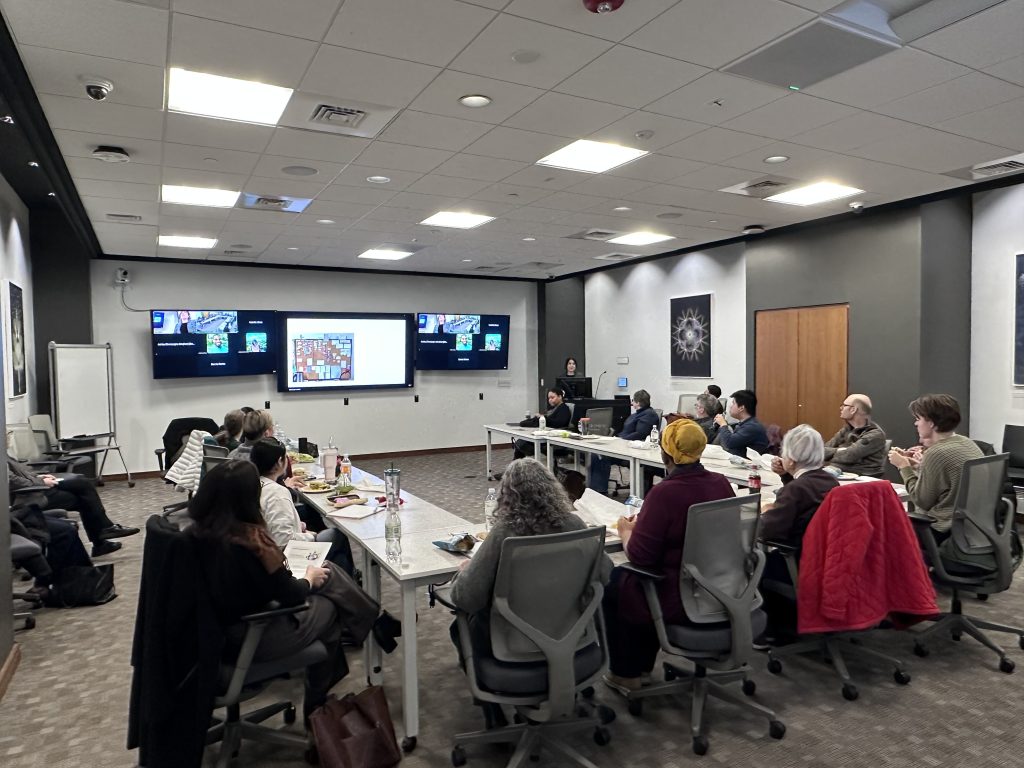
DH Salon in the Digital Scholarship Lab DH Salon Schedule
The Lives and Pseudonyms of Literary Scholars 1849–1949: The Case of Notes and Queries
Thursday, January 29 at noon – Register
- Kenneth Haynes, Professor of Comparative Literature and Classics, editor of the project
- Elizabeth Yalkut, Digital Scholarship Front End Developer, Center for Digital Scholarship
The talk will introduce the ongoing digital project identifying anonymous and pseudonymous contributors to the journal Notes and Queries (founded in 1849) and supplying their brief biographies. The project is a contribution to attribution studies, the history of literary knowledge, and the biobibliography of Victorian writers and scholars. The talk will have two parts. First, the project will be motivated by describing the special place of Notes and Queries within the history of scholarship in the humanities, especially in the Victorian and Edwardian periods. Second, the new capacities of digital scholarship for the history, geography, and prosopography of literary scholarship will be outlined.
The Stolen Relations Project: Lessons and Challenges in Going Public
Thursday, February 12 at noon – Register
- Linford Fisher, Associate Professor of History
- CDS staff members
In May 2025, the Stolen Relations: Recovering Stories of Indigenous Enslavement in the Americas project went live during a day-long syposium at Brown. Nearly a decade in development through collaborations between PI Linford Fisher, CDS staff, and regional tribal nations, this layered project required a number of technical adjustments and innovations to collect and present the archival information and related materials in a way that would be sensitive to and legible for descendent communities and the wider public. This presentation will involve multiple members of the team sharing brief insights into some of the various aspects of the project.
Knowledge Indiana: A New Approach to the Online State Encyclopedia
Thursday, February 26 at noon – Register
- George Elliott, Assistant Teaching Professor in Cornerstone and History, Purdue University & Research and Administrative Manager, Knowledge Indiana
This presentation explores the ongoing planning work for the upcoming digital humanities project Knowledge Indiana. KI aspires to be a next generation online state encyclopedia, building on previous online encyclopedias, in Indiana and other states across the country. Unlike most current online encyclopedias, KI will be born digital and will utilize recent new technologies, such as AI, in its construction. KI also will include components not traditionally associated with encyclopedias, such as virtual historic site tours, video games, and contemporary data-based maps. The project is currently and will remain supported by wide-scale collaboration across institutions of higher learning, archives, and community experts.
U2 Egypt: Comparing Aerial Images of Archaeological Sites Over Time
Thursday, March 12 at noon – Register
- Laurel Bestock, Joukowsky Family Associate Professor of Archaeology and the Ancient World and Egyptology and Assyriology, Associate Professor of History of Art and Architecture
- Lutz Klein, Digital Technology Specialist for Archaeology and the Ancient World
In the 1950s the United States flew reconnaissance missions in the Middle East using U2 planes equipped with high resolution cameras. Co-PIs Laurel Bestock and Oren Siegel have worked to digitize declassified photographic negatives in the National Archives from two such flights over Egypt, and working with a CDS small project team at the library, have built a website that shows those digitized images overlain on a map. In a second phase of this project, students have been locating archaeological sites visible in the U2 photographs and comparing them to more recent satellite imagery, including CORONA images from the 1960s and more modern images in Google Earth. The comparisons are stark, showing both the quality of the U2 imagery and the steep loss due to encroachment of sites. Data for the comparisons are being collected in Kiosk, an archaeological recording platform developed at Brown. In this DH salon we will discuss both the value of the comparative data and their collection in Kiosk, and the early stages of an expanded scope to the CDS project in which we will web-publish the gathered data.
Urban Removals: Warning-Out Peoples of Color in Providence, 1800-1850
Thursday, April 2 at noon – Register
- Patricia Rubertone, Professor of Anthropology
My project looks at “peoples of color,” a racialized label applied to Indigenous and African Americans and individuals of mixed ancestry, warned out and removed from Providence in the decades prior to and after its incorporation as a city in 1832. Marking them as “indigent” as well as “inconvenient,” “nuisances,” “disorderly,” and “vagrant” was a tactic of the settler-colonial urban project of elimination that targeted persons not legally settled and thus, not eligible for poor relief from the town treasury. Many illegal residents evaded authorities’ attempts to bring them before authorities for questioning or returned after being forcibly removed at the risk of fines and corporeal punishment. Minutes of Providence town and city council meetings contain personal testimonies that reveal the voices of people generally muted in colonists’ historical documents and offer insights into municipal colonialism’s tactics of control and surveillance aimed to rid the city of undesirable residents. Collaboration with Brown’s Center for Digital Scholarship enables the data set of over 500 individuals (not counting family members) to be displayed and analyzed in terms of distinctive life experiences and invites broader community engagement.
AI and the Humanities: Opportunities and Perspectives
Thursday, April 16 at noon – Register
- Ellie Pavlick, Associate Professor of Computer Science and Cognitive and Psychological Sciences
- Michael Satlow, Professor of Judaic and Religious Studies
- Ken Sacks, Professor of History
Whether or not we like it, the AI revolution is already underway. Various corners of academia have responded with varying degrees of embrace and caution. If AI is here to stay, what are the implications for the humanities? Are there ways to utilize its strengths without competely giving up on humanistic thinking and writing? Our panelists will share perspectives from their own work and wrestling with these questions.
Project Showcase Celebration: Unfinished Conversations
Thursday, April 23 at noon – Register
- Renée Ater, Associate Professor Emerita in the Department of Art History and Archaeology at the University of Maryland
- Dannie Ritchie, Clinical Assistant Professor of Family Medicine
Description TBD
Digital Humanities Lightning Talks
Thursday, May 7 – Register
- Ashley Champagne, Director, Center for Digital Scholarship
Graduate students in the Digital Humanities Doctoral Certificate program will present informal lightning talks on their digital humanities projects.
-
Library Services During Winter Break 2025-26
|
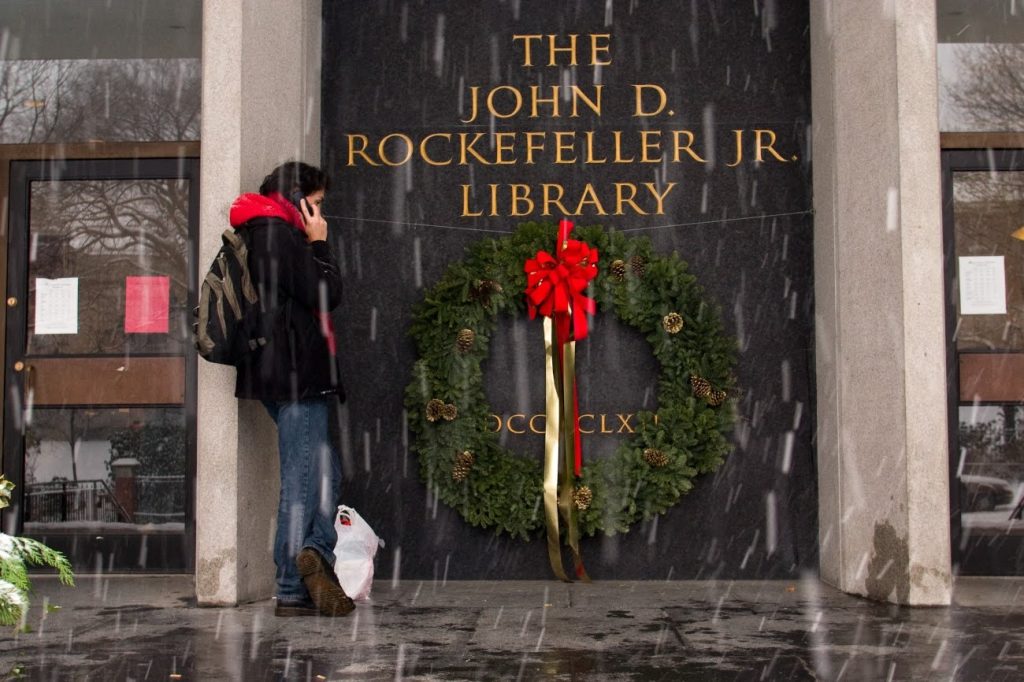
Rockefeller Library during winter snowstorm. Photo by Kenneth C. Zirkel. Brown University will be on winter break from the close of business on Monday, December 22, 2025, through Monday, January 5, 2026, returning on Tuesday, January 6.
In order to maintain support of students, faculty, and researchers during this time while giving dedicated library staff members well-deserved time off, the University Library will be offering limited building hours and services. Please take note of the time-sensitive services listed below so that you can plan ahead and obtain the materials you will need in advance of the break.
Who can use which building?
The Rockefeller Library will be open without library services by swipe card access only from 9 a.m. to 5 p.m. on December 29, 30, and January 2 for current Brown ID holders only. Visitors without a current Brown ID will not be able to access the building. Please see Libraries and Hours for details. The John Hay Library, the Sciences Library, and Orwig Music Library will be closed during the break.
Will you close completely for some days?
All University Library locations will be closed with no on-site or online services on Christmas Eve (Wednesday, December 24), Christmas Day (Thursday, December 25), New Year’s Eve (Wednesday, December 31), and New Year’s Day (Thursday, January 1).
Self-checkout
Self-checkout of circulating materials will be available at the Rockefeller Library as usual.
How can I get help from a library expert?
Limited support for the Brown community and researchers working on time-sensitive projects will be available on the days when we are not fully closed via email at rock@brown.edu. Please allow 12 to 24 hours for a response.
Can I view special collections material?
Requests for special collections material can be made at any time through Aeon. John Hay Library staff will respond to requests that come in over break beginning January 6.
Thousands of items have been digitized and are available for view at any time through the Brown Digital Repository. The Gildor Family Special Collections Reading Room will have limited hours during Winter Session in January, by appointment only. Detailed information about appointments is available at Visiting the Brown University Special Collections. Please check Libraries and Hours for updated information. Reference requests received via the Question Form will be reviewed starting on January 6.
Who will be on-site when the buildings are open?
The Library will have security guards in the buildings when they are open by card swipe access only. Please note that security guards are not library employees. They are not able to answer research questions and cannot retrieve library materials.
Happy Holidays
Best wishes to all for a peaceful, healthy, and restorative winter break.