
E-Newsletter
Recent Posts
Latest News
-
Workshop | Sustaining DH
|
Sustaining DH
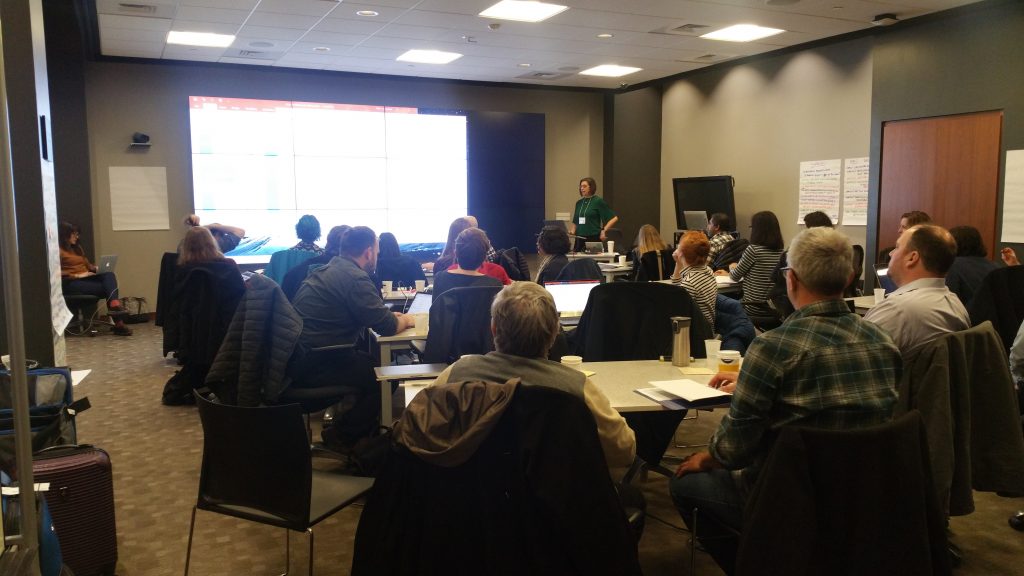
On April 4 – 5, 2019, the Library hosted a National Endowment for the Humanities (NEH) workshop entitled, Sustaining DH: An NEH Institute for Advanced Topics in the Digital Humanities. Brown is one of five sites in the US to host the two-day workshop.
Taught by University of Pittsburgh Professor Alison Langmead (Clinical Associate Professor and Director, Visual Media Workshop; Associate Professor, School of Information Sciences) and Chelsea Gunn (PhD candidate, Information Culture and Data Stewardship; research assistant Sustaining DH), the workshop is designed to help archivists, librarians, and digital humanities practitioners create sustainability plans and address preservation concerns at any point in the life of a digital humanities project.
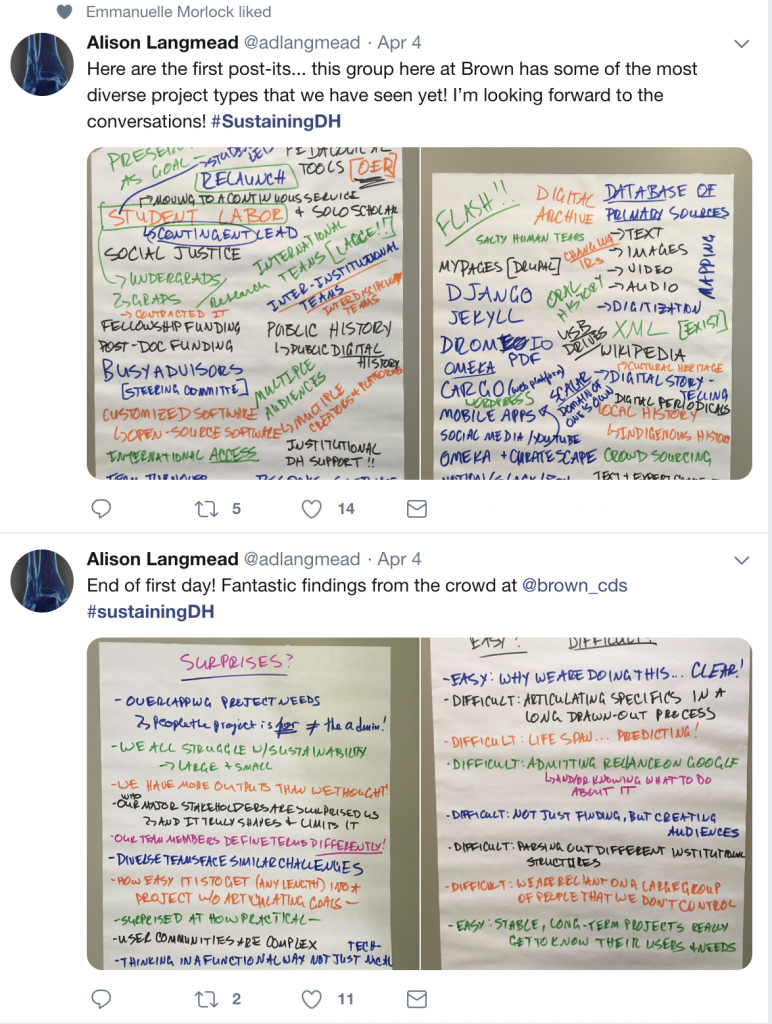
Over the course of the two-day workshop, 35 attendees representing eight project teams from New England, New York, Canada, Oklahoma, and Pennsylvania, critically examined their respective projects, creating detailed plans for sustainability and preservation.
Modernist Journals Project
Among the projects was the Modernist Journals Project, which was initiated at Brown by Professor Bob Scholes in 1994 and is jointly hosted by Brown and the University of Tulsa. It is currently supported by the John Nicholas Brown Center for Public Humanities and Cultural Heritage with help from the Library’s Center for Digital Scholarship (CDS).
Sustainability
In addition to creating sustainable plans for their own projects, the attendees are also encouraged to become trainers in these sustainability practices moving forward, and they can avail themselves of support as trainers through the Sustaining DH initiative. Members of the Brown community can make use of the resources and expertise available in the Library’s Center for Digital Scholarship, which performs and promotes the use of digital technology for scholarship at Brown. The staff within CDS advise, design, and carry out projects and workshops for every discipline on campus.
-
A Student’s Journey through Special Collections and the Creation of “Fields of Hay”
|
A student-driven project led by undergraduate Shira Buchsbaum ’19, the recently launched website Fields of Hay offers students a guide for making use of the John Hay Library and Brown’s special collections resources.

Written by Shira Buchsbaum ’19
Mary Elizabeth Sharpe and My First Foray into Special Collections
My journey to the John Hay Library was meandering and inconsistent. My first semester at Brown, my writing professor, Kate Schapira, assigned a piece that required drawing from any archive in Brown’s libraries. I picked the Mary Elizabeth Sharpe collection, which ended up being 20 boxes of letters, blueprints, photographs, contracts, and designs from Sharpe’s life.
Mary Elizabeth Sharpe was married to Henry Dexter Sharpe, the Chancellor of Brown from 1932-1952, and she was a go-getter. Sharpe designed much of the landscaping on campus, including for the then-new Sharpe Refectory and, later, the Sciences Library. She was a critical player in establishing India Point Park and fighting oil money in Providence.
I learned all of this about Sharpe in a few afternoons at the Hay, sitting with her papers and imagining the fierceness of this lady who took meticulous notes about trellises and leaf piles on our campus greens. I kept Mary Elizabeth Sharpe in the back of my head throughout my first two years at Brown, marking the John Hay Library as the place where I learned about our highly manicured campus and the woman behind it.
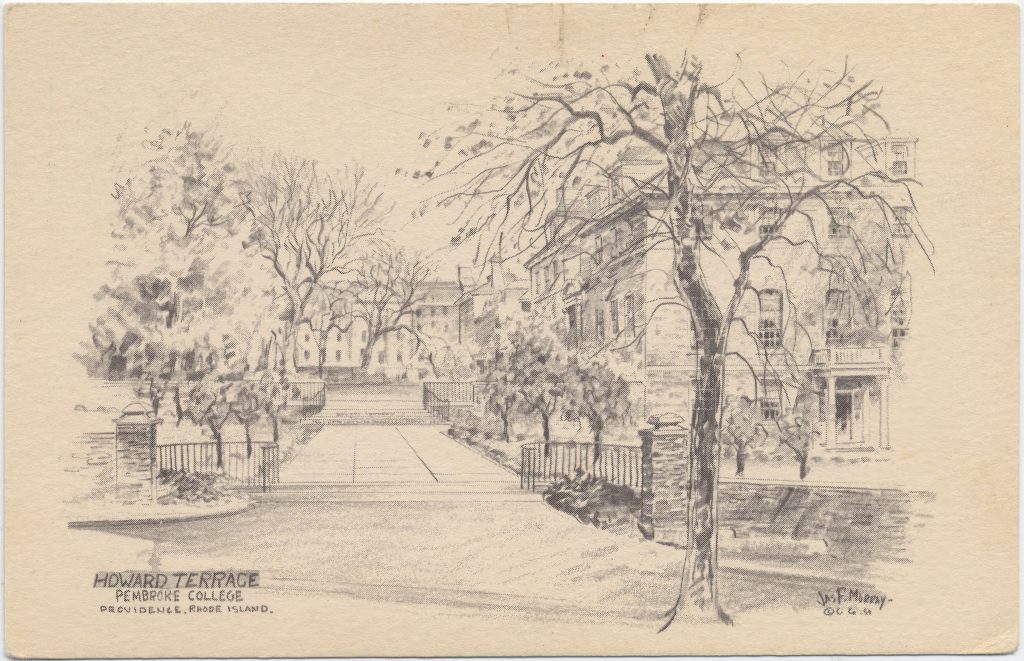
“Howard terrace, Pembroke College, Providence, R.I.” (1960). Landscaping directed by Mary Elizabeth Sharpe. Images of Brown. Brown Digital Repository. Brown University Library. A Reintroduction: Shakespeare’s First Folio and Working at the Hay
My junior fall, I stumbled back into the building during a reception and met William Shakespeare’s first Folio on the second floor of the John Hay Library. Brought to tears as I turned the pages of this nearly 400-year-old volume, I asked the lady behind the table, “Do students, like, work here?” The serendipity of that moment landed me in the midst of archives and collections once again, this time as a collections assistant.
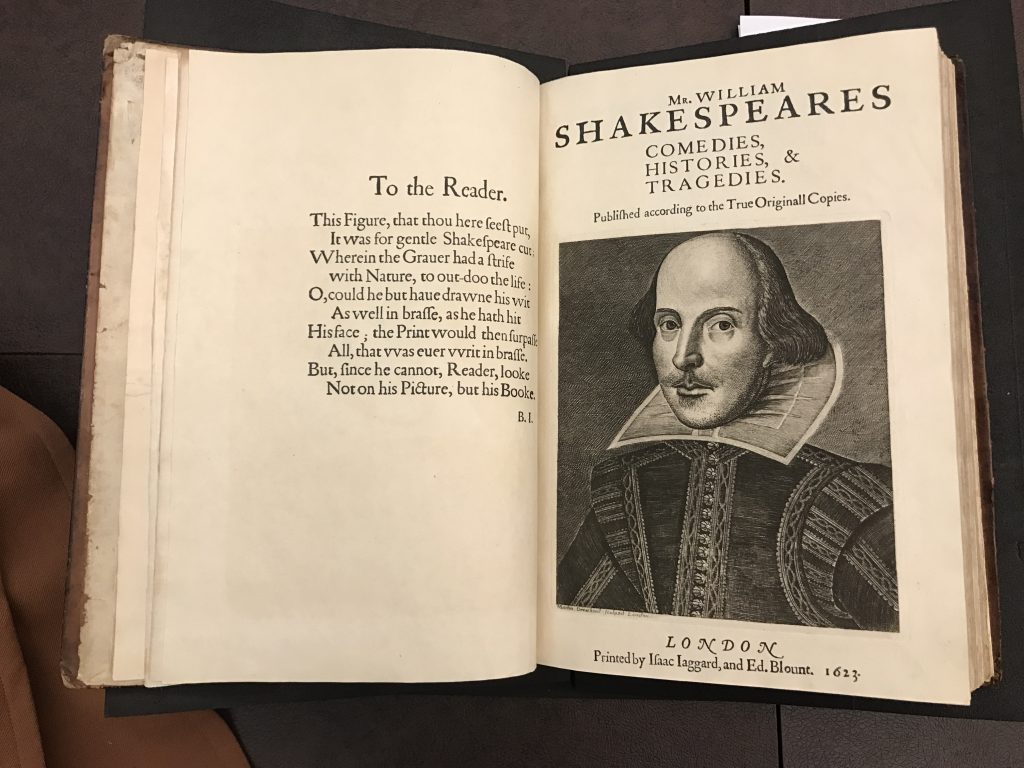
John Hay Library’s copy of Shakespeare’s first Folio. Photo by Shira Buchsbaum. Fields of Hay: An Undergraduate Research Guide to the John Hay Library
In our first conversation, Heather Cole, my new boss, and I discussed creating a guide for undergraduates to access the John Hay Library with more ease. I spent the next 18 months chatting with curators, requesting materials, conducting research, and honing how to convey the richness and variety of the materials here and their availability for student scholarship.
On March 7, 2019, World Book Day, we launched Fields of Hay, the undergraduate research guide to the John Hay Library. On Fields of Hay, students can learn about materials housed at the Hay, read about standing collections, find information on how to request materials, see featured projects by other students, and register student academic or activity groups for programs at the Hay. Fields of Hay aims to demystify the Hay by demonstrating its accessibility and breadth of materials to all students. It also seeks to promote student scholarship by showing that working with primary resources need not be an elite, selective process: it is as simple as finding one compelling item and spending time with it. The website aims to transform haphazard, wayward discoveries of the Hay into a far-reaching, common experience for Brown students. Fields of Hay is home base.
The Impact of Special Collections and an Invitation
I wish I hadn’t treated my interaction with Mary Elizabeth Sharpe as a one-off experience designed for a single class with no lasting implications on my life at Brown. Had I been able to return to the Hay through mechanisms designed for me – through a website that clarified how I could ingratiate myself with these materials – I would have returned sooner. As soon as students arrive at Brown, Fields of Hay can guide them to original, exciting research, or simply enjoying items connected to their interests – no strings or requirements or assignments necessary. Come on in and get started.
Shira Buchsbaum ’19 studied Anthropology and English Non-Fiction Writing and was the primary creator of Fields of Hay, under the advisor-ship of Heather Cole. She wrote her senior thesis about curatorial decision-making for the Harris Collection of American Poetry and Plays as reflective of changing conceptions of American literature. Any inquiries about Fields of Hay and materials or programming at the Hay can be sent to shira_buchsbaum@brown.edu.
-
ILLiad system unavailable Wednesday-Thursday
|
The interlibrary loan system ILLiad, which the Library relies on to fulfill patron requests for certain materials from other libraries, will be unavailable starting the afternoon of Wednesday, April 3, and running through the following day. Service is expected to be restored by Thursday afternoon.