
E-Newsletter
Recent Posts
Latest News
-
Announcement | Emily Ferrier, Social Sciences and Entrepreneurship Librarian
|
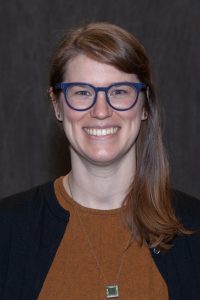 The Brown University Library welcomes Emily Ferrier as the Social Sciences and Entrepreneurship Librarian.
As the primary liaison to the Nelson Center for Entrepreneurship and the department of Economics, Emily will assist researchers, students, and other University stakeholders as they develop entrepreneurial projects, conduct market research, explore business models, and engage in community partnerships to strengthen the local, national, and international scholarly community. As a member of the Academic Engagement unit, Emily will work with other subject librarians, as well as the Center for Digital Scholarship, the digital repository team, and others in the Library and across campus to provide the resources and services to support this work.
Emily will provide synchronous and asynchronous instruction on topics related to business and entrepreneurship, such as market research, business analysis, intellectual property, patents, and finance, and scholarly resources to support research and teaching in entrepreneurship and economics.
Emily joins Brown from Olin College of Engineering where she has has served as the Senior Librarian since 2016. Most recently she has also served as the Acting Library Director. At Olin, Emily has supported open scholarship and Olin’s open access policy to provide preservation and access to scholarship including student and faculty research, data, and software.
Emily has demonstrated commitment to diversity and inclusion through cross-institutional activities focused on ways to design support systems to address systemic issues that result in first year students, students with disabilities, and marginalized community members feeling excluded from campus and classrooms. Along with a cross-disciplinary team consisting of faculty, student affairs and the library, Emily and her co-authors’ related peer-reviewed paper, “Proactive Inclusion of Neurodiverse Learning Styles in Project-Based Learning: A Call for Action,” was presented at the American Society for Engineering Education conference in June 2018.
Prior to joining Olin College of Engineering in 2016, Emily worked in the libraries of intellectual property law firms where she specialized in IP research, with expertise in legal, intellectual property, and business intelligence research. Emily earned her MLIS from San Jose State and a BA in History from Northeastern University.
In addition to her professional accomplishments, Emily is a media producer of titles such as COLD HUDSON: A Slow Film. Slowness is a theme that has worked its way into cooking, photography, and now to the old house she is renovating.
-
New Workshop | Research Photo Management with Tropy
|
 If you’ve ever returned from the archives with interesting images, but no plan as to where to preserve those images and write the proper metadata for them, Tropy is a new resource that may interest you. Tropy is free, open source software that allows you to easily import, preserve, edit, and describe your photographs and primary source documents. The Brown University Library is hosting the first Tropy workshop on the Brown University campus on January 31, 2019 from 11 a.m. – 12 p.m. in the Digital Scholarship Lab in the Rockefeller Library. The workshop will be led by Ashley Champagne, Ph.D., Digital Humanities Librarian at the Brown University Library and Jim McGrath, Ph.D., Postdoctoral Fellow in Digital Public Humanities at the John Nicholas Brown Center for Public Humanities and Cultural Heritage
In this interactive workshop, we’ll offer an overview of the software and present a case study on how you might use the software for your own research. In short, here are a few things that you can do with Tropy:
- Easily import your photos into Tropy
- Organize your photo collections into folders
- Add and edit metadata in bulk (or individually). For example, when you return from a given archive, you can add one location and the data of access across the entire image collection.
- Allow the metadata categories guide your own research needs.
To demonstrate some of Tropy’s features, we’re providing a walkthrough of a particular research project involving archival materials in the Michael J. Ciaraldi Comics Collection at the John Hay Library. (Thanks to Heather Cole and the staff at the John Hay Library for helping us access these materials.)
Many of us use cameras on our smartphones to create images of what we’re reviewing in archives or documenting on field research. We then look at these photos on our laptops or desktops, especially when we need to consult these images while writing or when conducting additional research. While storing copies of files in cloud-based storage services like Dropbox or Google Photos has its advantages (and might be part of your research workflow in some capacity for the purposes of creating backup files, among other reasons), saving research images locally on your hard drive allows you to take advantage of Tropy’s capabilities including metadata creation and management, transcription, and organization. Importing batches of files into Tropy is pretty easy: you can even quickly drag and drop materials into your virtual workspace.

The 29 image files you see above are related to two issues of the 1990s comic book anthology series Dark Horse Presents. There are images of various story installments, front and back covers, advertisements, letters, columns, and editorial commentary. While this collection includes extensive photos (there are duplicates in cloud storage just in case something is blurry or cropped!), the researcher might not want to wait too long to revisit the material. Even though cloud storage allows us to quickly migrate images from our phone to spaces that can be accessed by a range of devices, the convenience of these features can also make it easy for us to forget important contextual information related to our research. And sometimes, even when we take extensive notes by hand or on digital devices, that material can get lost or be difficult to retrieve if we’re not careful.
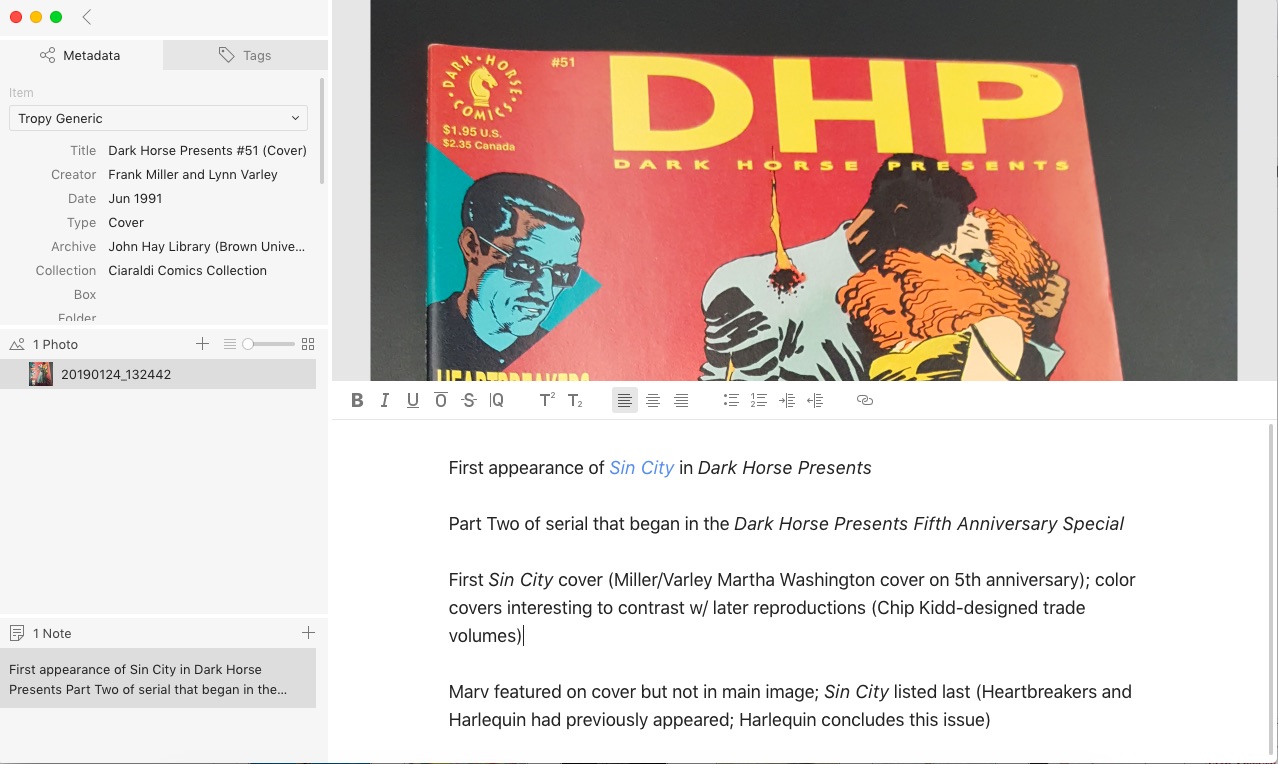
Tropy makes it easy to connect contextual materials directly to research files through its notes, metadata, and tagging capabilities. (You can even get this work started in Tropy right in the Special Collections Reading Room at the Hay, if you’ve got a camera, a laptop, a wifi connection, and enough time!)
Tropy allows you to use metadata in the way that works best for your particular research projects and workflows: it offers generic categories and Dublin Core fields, but you can also import templates or create customized templates with fields most relevant to your work. You can export metadata created in Tropy to use elsewhere. Whether you’re interested in documenting context for the purposes of searching and later citation, or you’d like to create organized data for use in Omeka S or other contexts, Tropy can help keep your work organized in the present and the future.
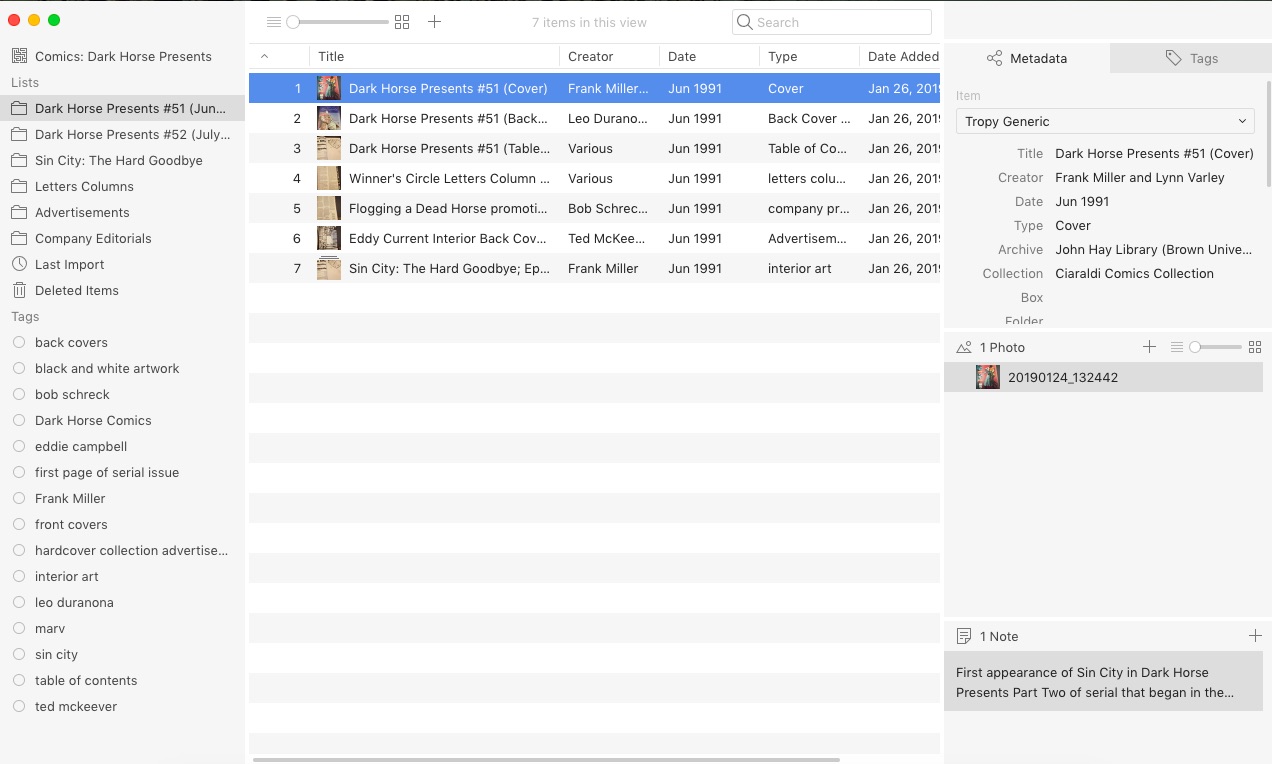
As you organize, it’s important to keep in mind the terms Tropy uses. A “Project” refers to the larger research project (in this case, research into the Dark Horse Presents publication). Items only live in one project. “Lists” allow you to further organize the various parts of your project: in this case, we’re using this feature to organize images related to individual publications (issues of Dark Horse Presents), stories (Sin City: The Hard Goodbye, a serial that appears across several issues of DHP), and particular content we’ll be focusing our research on more generally (advertisements, letters columns, and company editorials). “Tags” are ways to link items by particular people, themes, or other keywords. We’re using tags to track names of artists and editors of interest, names of characters and franchises, and kinds of artwork. You can edit, rename, reorganize, and revise lists and tags as you go. We’ve already tweaked our organizational habits a few times this week as our research has developed and we’ve grown more comfortable with Tropy.
As you can see, we’ve come a long way to organizing our material. There’s detailed documentation on what Tropy can and can’t do over at the project’s web site, and we’ve highlighted a few features that seem of particular interest to general users. You can register for the Tropy workshop here. We hope to see you there!
Date: Thursday, January 31, 2019
Time: 11 a.m. – 12 p.m.
Location: Patrick Ma Digital Scholarship Lab, Rockefeller Library, 10 Prospect Street, Providence, RI
Workshop Leaders: Ashley Champagne, Jim McGrath -
Announcement | Dr. Zhuqing Li Appointed Faculty Curator, East Asian Collection
|
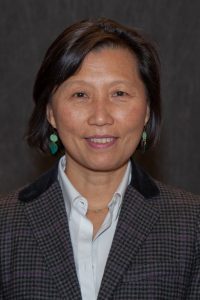
Dr. Zhuqing Li The Brown University Library is pleased to announce the appointment of Dr. Zhuqing Li, Visiting Associate Professor of East Asian Studies at Brown, as Faculty Curator, East Asian Collection. Professor Li has taught in the Department of East Asian Studies since 2014. Her role as Faculty Curator began on January 1, 2019.
In this new role, Professor Li will work with the curatorial staff of Brown’s East Asian Collection and other Library experts to explore ways to strengthen the use of these materials for teaching and research on campus, and to increase their visibility to the broader scholarly community through a variety of means including description, exhibits, digital projects, workshops, programs, and publication. Professor Li will also continue to teach in the Department of East Asian Studies.
Zhuqing Li
A linguist specializing in Chinese historical linguistics and dialectology, Professor Li received her Ph.D. in East Asian Language and Literature from the University of Washington and taught at Boston College for 13 years before coming to Brown. Her research has focused on the study of the Chinese language, the historical experiences of Chinese returnees, and the linguistic aspects of Chinese-English translation.
Professor Li’s research began with the study of the phonology and grammar of Fuzhou dialect, which has the most complicated sound-change system in the Chinese language family and is a window into how Chinese sounded in ancient times. Her work on Chinese returnees looks at the social phenomena of Chinese-born citizens who study abroad and return home, reintegrating into Chinese society. She is currently exploring the prosodic and scientific properties of the Chinese language.
Professor Li is the author of four books: Reinventing China: Experience of Contemporary Returnees from the West (Bridge 21, 2016), Minnan-English Dictionary (Dunwoody Press, 2008), The Structure of Fuzhou Dialect (Dunwoody Press, 2002), and Fuzhou-English Dictionary (Dunwoody Press, 1998), as well as numerous academic articles.
Brown’s East Asian Collection
The East Asian Collection, located on the third floor of the Rockefeller Library, holds nearly 200,000 volumes of East Asian language print books in addition to print serials, audio-video materials, and electronic resources. The Collection was developed from an initial gift of approximately 30,000 volumes donated to Brown in 1961 by the noted sinologist Charles Sidney Gardner. Dr. Li Wang, Curator of the East Asian Collection, and Toshiyuki Minami, Senior Library Specialist, offer students and researchers support in their use of the Collection and will be collaborating with Professor Li throughout her work with the Library.