
E-Newsletter
Recent Posts
Latest News
-
Workshops | Reading, Resisting, and Reimagining The Map
|
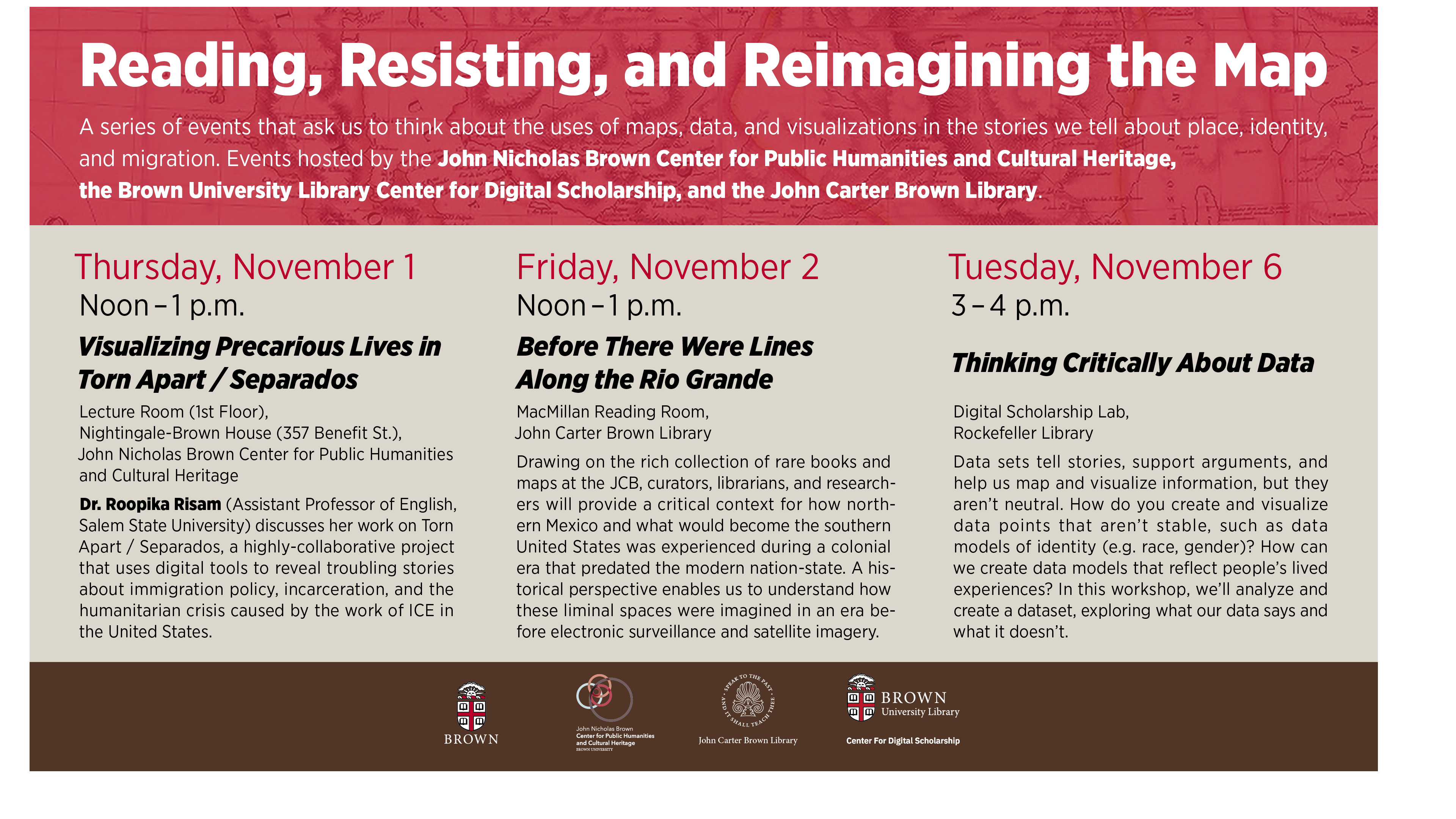 The John Nicholas Brown Center for Public Humanities and Cultural Heritage, the Brown University Library Center for Digital Scholarship, and the John Carter Brown Library present a series of events that ask us to think about the uses of maps, data, and visualizations in the stories we tell about place, identity, and migration. Entitled, Reading, Resisting, and Reimagining The Map, the series consists of three workshops:
Visualizing Precarious Lives in Torn Apart / Separados
Thursday, November 1 from 12 – 1 p.m.
Lecture Room (1st Floor), Nightingale-Brown House (357 Benefit St.), John Nicholas Brown Center for Public Humanities and Cultural Heritage
Dr. Roopika Risam (Assistant Professor of English, Salem State University) discusses her work on Torn Apart / Separados, a highly-collaborative project that uses digital tools to reveal troubling stories about immigration policy, incarceration, and the humanitarian crisis caused by the work of ICE in the United States.Before There Were Lines Along the Rio Grande
Friday, November 2 from 12 – 1 p.m.
MacMillan Reading Room, John Carter Brown Library
Drawing on the rich collection of rare books and maps at the JCB, curators, librarians, and researchers will provide a critical context for how northern Mexico and what would become the southern United States was experienced during a colonial era that predated the modern nation-state. A historical perspective enables us to understand how these liminal spaces were imagined in an era before electronic surveillance and satellite imagery.Thinking Critically About Data
Tuesday, November 6 from 3 – 4 p.m.
Digital Scholarship Lab, Rockefeller Library
Data sets tell stories, support arguments, and help us map and visualize information, but they aren’t neutral. How do you create and visualize data points that aren’t stable, such as data models of identity (e.g. race, gender)? How can we create data models that reflect people’s lived experiences? In this workshop, we’ll analyze and create a dataset, exploring what our data says and what it doesn’t. -
Workshop | Thinking Critically About Data
|
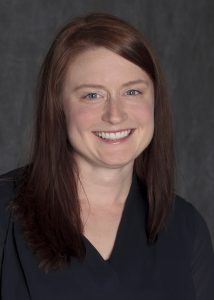
Ashley Champagne, Digital Humanities Librarian On Tuesday, November 6, 2018 from 3 – 4 p.m., Ashley Champagne, Digital Humanities Librarian, will offer a workshop entitled, “Misconceptions of Data: Thinking Critically About Data.” Part of the Reading, Resisting, and Reimagining The Map series, the workshop will take place in the Digital Scholarship Lab at the Rockefeller Library. The workshops are free and open to the public.
Thinking Critically About Data
Despite our increasingly digital world, data sets on all kinds of topics are missing, limited, and misunderstood. Mimi Onuoha uses the term “missing data sets” for “the blank spots that exist in spaces that are otherwise data-saturated.” She documents a series of questions that have no answers. Questions like, “How many people have been excluded from public housing because of criminal records?” are impossible to answer because there is incomplete, unreliable, missing data. And even when data sets exist, they may not be publicly accessible.
The team behind the Torn Apart / Separados project encountered the lack of data surrounding the question of where children were living after they were separated from their parents due to Donald Trump’s “zero tolerance” immigration policy in 2018. Public discourse surrounding the crisis focused on how Immigration and Customs Enforcement (ICE) officials held children at the United States/Mexico border. But the Torn Apart / Separados map tells a different story due to the data that the team rapidly collected, analyzed, and published. ICE centers holding children separated from their parents are all over – not just along the border, but in the middle of the United States and everywhere in between.
The Torn Apart / Separados team were thankfully able to collect the data they needed, but for certain research questions there is little quantitative data to gather. Particularly in such cases, qualitative data can illuminate areas of study where quantitative data is limited or impossible to gather. The population size of transgender individuals in the United States, for example, isn’t well known partly because there isn’t a lot of data on gender identity. One way to find out some information on questions that do not have clear answers is to collect qualitative data, like articles that include the word “transgender,” and explore that qualitative data through text mining. Text mining offers the researcher the ability to find patterns and themes in large corpora.
One of the ways the Torn Apart / Separados team went about collecting the data was by using Application Programing Interfaces (APIs). At the Center for Digital Scholarship in the Brown University Library, we teach workshops on everything from data literacy to text analysis to thinking critically about data. On behalf of our center, I’m offering a workshop to explore how to use an API to collect full text articles to create a dataset.
APIs offer limited information, such as the web URLs, keywords, titles, and sometimes other metadata. They will get researchers part of the way to collecting a qualitative dataset, but not the whole way there. But from the initial API data, we can use web scraping software to gather full text articles. There will always be missing data sets, but beginning to collect data to find answers to our questions is a good start.
Ashley Champagne
Digital Humanities Librarian
Brown University LibraryDate: Tuesday, November 6, 2018
Time: 3 – 4 p.m.
Location: Patrick Ma Digital Scholarship Lab, Rockefeller Library, 10 Prospect Street, Providence, RI -
Event | Whiteness, Indigeneity, and Power in Amazonia with Michael Cepek
|

On Friday, November 2, 2018 at 4 p.m. in the Digital Scholarship Lab at the Rockefeller Library, Michael Cepek will give a talk entitled, “Whiteness, Indigeneity, and Power in Amazonia.” Sponsored by the Watson Institute for International and Public Affairs, the Center for Latin American and Caribbean Studies, and the Brown University Library, this event is free and open to the public. A light reception will follow the talk.
This talk is part of the Sawyer Seminar series on race and indigeneity in the Americas. The event will be hosted Professor James Green, Professor of Modern Latin American History and Portuguese and Brazilian Studies, and director of the Brazil Initiative. Special remarks will be given by student Hugo Lucitante ’19, co-founder of the Cofán Heritage Project whose mission is to preserve the culture and history of the Cofán tribe of which he is a member.
Michael Cepek
Michael Cepek is Associate Professor in the Department of Anthropology at the University of Texas at San Antonio. His research explores the relationship between environmental change, cultural difference, and political power at the margins of global orders. In his studies with indigenous Cofán people in the Amazonian forests, Andean foothills, and capital city of Ecuador, he investigates cultural politics, environmental conservation projects, and environmental justice movements from the perspective of longstanding concerns in social theory and emerging debates in the anthropology of Latin America.
In addition, he is a fellow in the program for Science Action for Conservation & Community at the Field Museum of Natural History, and he works as Book Review Editor for Environment and Society: Advances in Research, a publication affiliated with the Earth Institute at Columbia University. Cepek is also president of the board of the Cofán Survival Fund, a non-profit organization that supports Cofán-directed conservation and sustainable development initiatives in Amazonian Ecuador.
Date: Friday, November 2, 2018
Time: 4 – 6 p.m.
Location: Patrick Ma Digital Scholarship Lab, Rockefeller Library, 10 Prospect Street, Providence, RI