
E-Newsletter
Recent Posts
Latest News
-
Brown’s Faculty Open Access Policy
|

Brown’s First Open Access Policy
In the summer of 2021 the Brown Faculty voted to adopt the University’s first Open Access Policy, in which the faculty commits to making a version of their journal articles available open access online free to read. This could either be via the sharing of a pre-peer reviewed manuscript on disciplinary not-for-profit sites for sharing scholarly pre-prints or working papers (such as arXiv, medRxiv, BioRxiv, NBER or Humanities Commons) or via the deposit of the final peer-reviewed manuscript accepted for publication in a funding agencies’ repository (such as PubMed Central, NSF-PAR, DOE-PAGES) or in the Brown Digital Repository (BDR) in accordance with the timeline permitted by their publisher. In 2022 the White House Office of Science and Technology (OSTP) issued a memorandum (the Nelson Memo) to federal funding agencies directing them by 2025 to adopt policies requiring investigators to make their final peer-reviewed manuscripts accepted for publication resulting from federally-funded research immediately available. The Brown Faculty Open Access Policy and 2022 OSTP Memo will help to increase the global access to scholarly work by Brown researchers.
Brown Faculty Open Access Policy FAQs
Q: Do I need to pay to publish my article in an open access journal (“Gold” open access) to comply with the policy?
A: No. The policy does not dictate how or where faculty publish. Brown faculty members do not have to pay for selecting any publisher’s open access option or have to publish in an open access journal. The Open Access Policy only requires faculty to share either a pre-print or final peer-reviewed manuscript accepted for publication (“Green” open access or self-archiving). Find your journal’s policy here: https://www.sherpa.ac.uk/romeo/
Q: Will depositing my article in ResearchGate, Academia EDU, Figshare or SSRN satisfy compliance with the policy?
A: No. While faculty can choose to deposit a pre-print or final peer-reviewed manuscript in these repositories, they do not satisfy compliance with the Brown Open Access Policy. The policy’s only requirement for repositories is that they be a non-commercial repository, such as a not-for-profit option such as one offered by a federal funding agency or the Brown Digital Repository (BDR). Locate a not-for-proft repository here: https://www.re3data.org/
Q. If I did want to publish in an open access journal that required a fee, does Brown have a fund for paying for the cost of open access publication?
A. No. While Brown does have some agreements with a few publishers to cover the cost of immediate open access in their journals as well as some discounts on the cost with others, at this time there is no fund available and faculty would either have to use grant funds or seek funding from their department or dean. If there are no funds, the best path is to publish in a non-open access journal and make a version of the manuscript open by depositing either a pre-print or final peer-reviewed manuscript accepted for publication in a repository for online access.
-
The Ocean State Spatial Database
|
Frank Donnelly (Head of Library GIS and Data Services) and his team of student workers at GeoData@SciLi recently released the Ocean State Spatial Database (OSSDB), a geodatabase for conducting basic geographic analysis and thematic mapping within the State of Rhode Island. This open source database is intended to serve as a foundation for contemporary mapping projects, and as an educational tool for supporting GIS coursework and introducing spatial databases and SQL. The database is packaged in two different formats which can be used in desktop GIS software, such as QGIS and ArcGIS Pro.
The database contains geographic data compiled from the US Census Bureau and several other public sources. It includes census boundaries for towns and cities, census tracts, and zip codes, census data tables that can be used for mapping demographic and socio-economic characteristics, and reference layers for roads, railroads, and bodies of water. As part of the project, the team also created a series of scripts and a workflow for producing geospatial data for Rhode Island schools, colleges and universities, public libraries, and hospitals, so that RIGIS (the state’s official GIS repository), would have updated versions of these layers on an on-going basis.
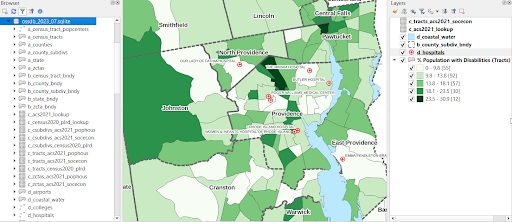
The database, documentation, metadata, and code used for generating a subset of the tables and features are available for download from the Library’s GitHub page.
GeoData@SciLi is the Brown University Library’s geospatial data hub, and is a component of the Center for Library Exploration and Research (CLEAR). The database project exemplifies a number of goals of the CLEAR program, including: promoting teaching and research with data, publishing open resources that can be freely used by communities throughout the state, partnering with members of local government to create new data, and providing experiences for Brown students to engage in creative and scholarly research in the library.
-
Welcome to Open October 2023
|
You may have heard of Open Access Week: well, this year the Brown University Library is bringing you Open October! Rather than focusing on Open Access for just one week, we’re inspired by our colleagues at Washington University in St. Louis, and will be talking about Open@Brown throughout the month.
During October, we’ll be sharing information about various Open initiatives at Brown: the GIS/Spatial data projects, the Faculty Open Access Policy, a cancer wiki, and more. Many of our Library workshops also cover Open themes: publishing Open Access, using Open resources, and more.
The theme of the 2023 Open Access Week is “Community over Commercialization.” We hope that you’ll join the conversation.