
E-Newsletter
Recent Posts
Latest News
-
Black Joy Day at the John Hay Library – Feb. 15
|
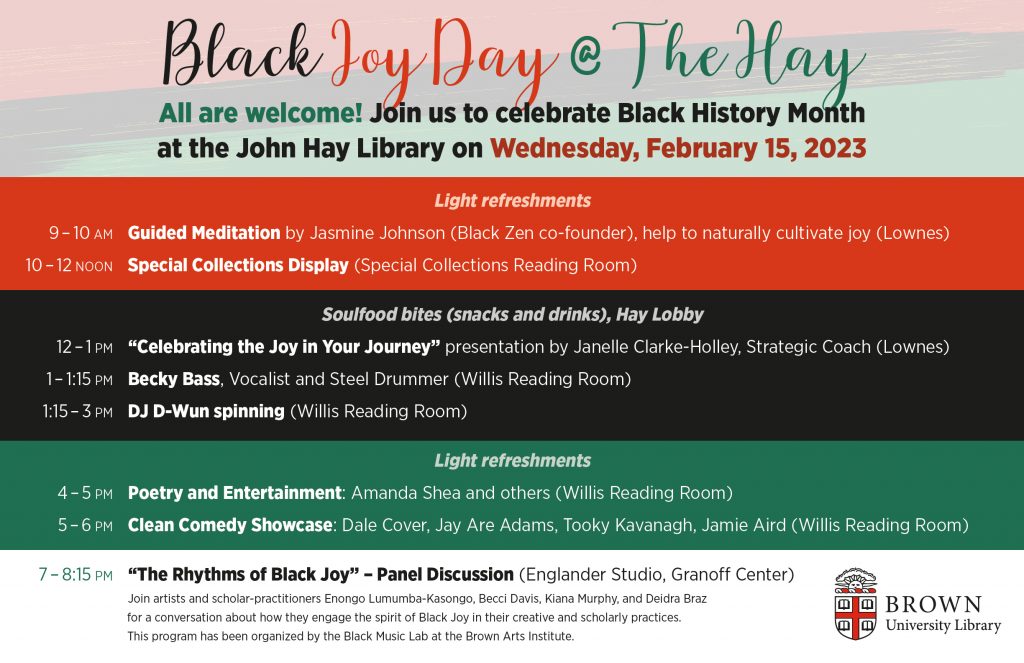
The John Hay Library will host its first celebration of Black Joy Day on Wednesday, February 15. The Hay invites the Brown community and members of the public to enjoy the full day of activities.
Schedule of events:
- 9 – 10 a.m. – Guided Meditation by Jasmine Johnson (Black Zen co-founder), one of the few Black meditation experts (Lownes Room, 2nd floor)
- 10 a.m. – 12 p.m. – Special Collections Display (Gildor Family Special Collections Reading Room, 1st floor)
- Soulfood bites (snacks and drinks) (Lobby, 1st floor)
- 12 – 1 p.m. – “Celebrating the Joy in Your Journey” presentation by Janelle Clarke-Holley, Strategic Coach (Lownes Room, 2nd floor)
- 1 – 1:15 p.m. – Performance by Becky Bass, Vocalist and Steel Drummer (Willis Reading Room, 1st floor)
- 1:15 – 3 p.m. – DJ D-Wun spinning (Willis Reading Room, 1st floor)
- Light refreshments
- 4 – 5 p.m. – Poetry and Entertainment: Amanda Shea, Rhode Island Black Storytellers, and others (Willis Reading Room, 1st floor)
- 5 – 6 p.m. – Clean Comedy Showcase: Dale Cover, Hay Are Adams, Tooky Kavanagh, Jamie Aird (Willis Reading Room, 1st floor)
- 7 – 8:15 p.m. – “The Rhythms of Black Joy” – Panel Discussion (Englander Studio, Granoff Center). Join artists and scholar-practitioners Enongo Lumumba-Kasongo, Becci Davis, Kiana Murphy, and Deirdre Braz for a conversation about how they engage the spirit of Black Joy in their creative and scholarly practices. This program has been organized by the Black Music Lab at the Brown Arts Institute. (Note: This event takes place at the Granoff Center for the Arts, 154 Angell Street, not the John Hay Library.)
-
Brown Library’s Second Born-Digital Publication Wins PROSE Award
|
Presented by the Association of American Publishers, PROSE awards recognize the very best in professional and scholarly publishing
The Association of American Publishers has named Shadow Plays: Virtual Realities in an Analog World by Professor of Italian Studies Massimo Riva the category winner in eProduct for the 47th Annual PROSE Awards. PROSE awards recognize the very best in professional and scholarly publishing by celebrating the authors, editors, and publishers whose landmark works have made significant advancements in their respective fields of study each year.

Shadow Plays was published in June 2022 by Stanford University Press. The open access book explores popular forms of entertainment used in the eighteenth and nineteenth centuries to transport viewers to a new world, foreshadowing present-day virtual, augmented, and extended reality experiences (VR, AR, and XR). Typically studied as part of the pre-history of cinema or the archaeology of media, analog technologies such as the mondo nuovo or cosmorama, the magic lantern, the moving panorama, and the stereoscope evoked shadow-copies of our world long before the advent of digital technologies and exercised a powerful pull on minds and imaginations. Through six case histories and eight interactive simulations, Professor Riva explores themes of virtual travel, social surveillance, and utopian imagination, shedding light on illustrious or, in some instances, forgotten figures and inventions from Italy’s past.

Shadow Plays is Brown Library’s second multimodal monograph developed by Brown University Digital Publications, with additional support provided by the Office of the Vice President for Research. The Library’s first born-digital monograph, Furnace and Fugue: A Digital Edition of Michael Maier’s Atalanta fugiens (1618) with Scholarly Commentary, was awarded the 2023 Roy Rosenzweig Prize in Creativity in Digital History by the American Historical Association.
Questions about Shadow Plays can be addressed to Allison Levy, Director of Brown University Digital Publications (allison_levy@brown.edu).
About Brown University Digital Publications
Brown University Digital Publications — a collaboration between the University Library and the Dean of the Faculty, generously launched with support from the Mellon Foundation with additional support from the National Endowment for the Humanities — creates exciting new conditions for the production and sharing of knowledge. Widely recognized as accessible, intentional, and inclusive, Brown’s novel, university-based approach to digital content development is helping to set the standards for the future of scholarship in the digital age.

-
Theory to Practice: Context-Aware Systems Symposium
|
The Theory to Practice: Context-Aware Systems Symposium, taking place March 10 and 11, 2023 in the Patrick Ma Digital Scholarship Lab at the Rockefeller Library, is an immersive applied workshop series presented in collaboration with Mellon Foundation, Black Beyond Data Project at Johns Hopkins University, Data Science Initiative, Department of Africana Studies, Center for Digital Scholarship at the Brown University Library, and Civic Software Foundation.
Inspired by a “theory to practice” mindset, the event offers four sessions over two days and is designed to reach beyond discourse and criticism of the current data ethics landscape to offer tangible principles, methodologies, and frameworks for participants to experience what more equitable approaches to technology creation feels like in action.
The structure combines lecture presentations and lab activities which ground theories of contextual technology development through curated learning examples and brings to life how embedded assumptions can distort the structures, interpretations, and impacts of data. Examples of learning material may include case studies, real datasets, dataset imaginaries, schema samples, simulated project environment elements, and hypothetical or gamified scenarios.
Sessions Overview
Keynote: Sonia Gipson-Rankin, “The Details are in the Data: Igniting the Catalyst for Transformative Change”
WORKSHOP #1
Lecture: Architectures of Friction and Flattening
Immersive Lab: “Les Deliverables”WORKSHOP #2
Lecture: Data Constituent Engagement
Immersive Lab: “Data-Driven Gaslighting”WORKSHOP #3
Lecture: Beyond Performative Dashboards
Immersive Lab: “Dashboard Glow Up”WORKSHOP #4
Lecture: Remediating Bias With Contextual Metadata
Immersive Lab: “Hansel and Gretel Bias”*See workshop session descriptions below
Registration details
Register through Eventbrite
Registration is REQUIRED for each session and it is recommended to register early. Capacity for the keynote with Sonia Gipson-Rankin and Architectures of Friction and Flattening is capped at 40 in-person and 100 online participants. Capacity for sessions #2, #3, and #4 and “Les Deliverables,” the workshop portion of session #1, are capped at 25 participants, with additional spots which may be made available via waitlist.
Workshops are designed to be modular, and you may register for one session or attend multiple/all sessions. Lecture attendance is mandatory for participation in the associated lab exercise.
No prerequisites are necessary, and we encourage participation from faculty and graduate students from all disciplines. There will be something to learn for everyone, and the workshop structure provides opportunities for multidisciplinary collaborators to be creatively engaged and challenged in different ways.
Event Dates
Friday March 10 + Saturday March 11, 2023
Event Location
Patrick Ma Digital Scholarship Lab at the Rockefeller Library
Schedule
Friday, March 10
- 8:30 to 9:15 a.m. – Continental Breakfast
- 9:15 – 9:30 a.m. – Welcome and Opening Remarks from Brown (in-person and live streamed)
- 9:30 – 10:15 a.m. – Keynote: Sonia Gipson-Rankin, “The Details are in the Data: Igniting the Catalyst for Transformative Change” (S#1 Lecture) (in-person and live streamed)
- 10:15 – 10:45 a.m. – Catherine Nikolovski, Architectures of Friction and Flattening (in person and live streamed)
- 10:45 – 11 a.m. – Break
- 11 a.m. -12:30 p.m. – “Les Deliverables” (S#1 Lab)
- 12:30 – 1 p.m. – Brown Bag Lunch (lunch provided)
- 1 – 2:15 p.m. – Data Constituent Engagement (S#2 Lecture)
- 2:15 – 2:30 p.m. – Break
- 2:30 – 3:45 p.m. – “Data-Driven Gaslighting” (S#2 Lab)
- 3:45 – 4 p.m. – Closing Remarks from Brown
- 5 – 7 p.m. – Dinner offsite
Saturday, March 11
- 9:30 to 10:15 a.m. – Continental Breakfast
- 10:15 – 10:30 a.m. – Opening Remarks from Brown
- 10:30 a.m. – 12 p.m. – Beyond Performative Dashboards (S#3 Lecture)
- 12 – 12:20 p.m. – Brown Bag Lunch (provided – lunch continues as working session)
- 12:20 – 1:50 p.m. – “Dashboard Glow-Up” (S#3 Lab)
- 1:50 to 2 p.m. – Break
- 2 – 3:15 p.m. – Remediating Bias With Contextual Metadata (S#4 Lecture)
- 3:15 – 3:30 p.m. – Break
- 3:30 – 3:45 p.m. – Hansel and Gretel Bias (S#4 Lab)
- 4:45 – 5 p.m. – Closing Remarks from Brown
- 5 – 6 p.m. – Closing Reception
Workshop Descriptions
Session #1
Architectures of Friction and Flattening
In this workshop, participants will learn to shift mindsets from data being objective and neutral to recognizing how cultural and environmental factors impact how we perceive information. We will present strategies to bring attention to what is lost in the gap between reality and what can be captured by information structures, in particular, embracing intersectional representation and lived experience.
We invite participants to imagine (and experience) how processes that center equity and impact not only improve industry-standard models, but are intrinsically necessary to break barriers and achieve the next stage of modern innovation.
“Les Deliverables”
An experiential game that simulates the experience of building and trying to successfully deliver an equity-based software product. The scenarios (dramatic, thrilling, and sometimes treacherous) are based on composites of real case studies and projects.
Session #2
Data Constituent Engagement
This session expands on concepts from traditional human-centered design to include the role of “data constituents” and presents examples and case studies which illustrate how inclusive practices are not a marketing or PR strategy, and can measurably inform data structures, validation cycles, and interpretation of analytics.
“Data-Driven Gaslighting”
Focusing on questions of information provenance, the participants will investigate the culture of confidence in data-driven decision-making with special emphasis on elusive ways that confidence may be misplaced when key constituents are left out of the process and the structures of accountability are not properly in place.
Session #3
Beyond Performative Dashboards
In this session, we will deconstruct how data visualizations are a product of decision-making processes influencing what gets prioritized, obscured, or made hyper-visible—with a special emphasis on how cookie-cutter practices and constraints of the genre can perpetuate harmful distortions without proactive awareness.
“Dashboard Glow Up”
Working in teams, participants will get a chance to work with their hands (paper prototyping: craft kits will be provided) to redesign a real open data dashboard, applying the concepts around key metadata from the earlier presentation. Teams will come together at the end to present their changes “before and after” style and share how their decisions impact the narrative and perceptions of the data.
Session #4
Remediating Bias with Contextual Metadata
Datasets can become distorted by misplaced assumptions or biases, and when overlooked they can compound into larger problems—rendering your data unusable or actively inflicting harm to a constituency. Particularly when those assumptions are deeply rooted in a legacy system and amplify race, gender, or historic marginalization factors, action can feel unclear and overwhelming.
In this session, we will present the CIVIC Contextual Metadata schema as a method to uncover and critically assess datasets, demonstrating how it can be applied to annotate datasets, discover bias, and increase the integrity of future use cases.
“Hansel and Gretel Bias”
Participants will work in teams to navigate a series of questions and prompts in order to author inputs for metadata schema fields. Each team will be assigned a specific scenario and related sample data. Following “breadcrumbs,” the teams will go through a guided investigation as the workshop facilitators role-play data custodians, stakeholders, and/or constituents to aid teams in completing all questions.