
Case 2

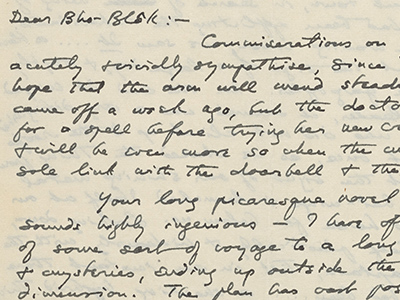

… all I know of dreams seems to contradict flatly the “symbolism” theories of Freud.
It may be that others, with less sheer phantasy filling their minds, have dreams of the Freudian sort;
but it is very certain that I don’t. *
H. P. Lovecraft to Robert Bloch, 1933 August 4
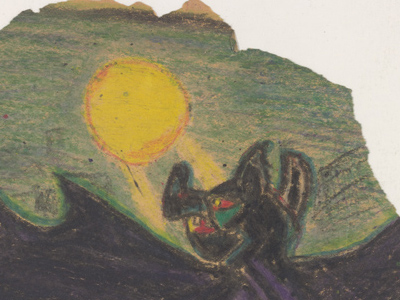
From plot ideas to fantastic settings and frightful beings, many of Lovecraft’s tales were inspired by dreams. The letter and illustration in this case are part of a string of correspondence written over several months in which Lovecraft relates a memorable dream to both Robert Bloch and Clark Ashton Smith. Writing to Bloch, Lovecraft described both the content of the dream and his interest in using dreams as “weird fiction material.” His young mentee responded with a drawing of the figure that haunted Lovecraft’s sleep and a promise to compose a story about it.
Both Lovecraft’s own dreams and the atmospheric quality of stories by Lord Dunsany and Edgar Allan Poe, the progenitors of the modern horror and fantasy genres, influenced the author’s creation of the imaginary realms and other-worldly elements that became the defining characteristics of his eponymous genre of fiction—Lovecraftian horror. He regularly discussed these influences with those in his circle. A selection of Lovecraft’s work has been categorized as the “Dream Cycle.” This Cycle includes all of the tales that take place within the “Dreamlands”—alternate dimensions that can only be accessed through sleep.
“You astonish me when you say you dream but twice a year. I can never drop off for a second—not even in my easy—chair or over my desk—without having dreams of the most vivid sort; not always bizarre or fantastic, but always clear-cut and lifelike. I seldom dream of recent everyday things, but tend to hark back 30 years or more to my boyhood–which was by all odd the happiest period of my existence. [….] But besides these comparatively mundane dreams, I occasionally have boldly fantastic ones which make good weird fictional material. Only last night I was with a party of silent, apprehensive men armed with some peculiar occult device like an ankh or crux ansata–climbing up ladders and picking a precarious way over the huddled sagging roofs of a rotting and incredibly ancient town, in search of a vague being of infinite + incredible evil which had been inflicting the inhabitants. Once—in the light of a leprous, waning moon–we saw It….a black, large-eared, crouching thing about the size of a large dog, + roughly resembling one of the Notre Dame gargoyles. […] That’s all there was to it—not enough for a story, but typical of the sort of dream I have every week or so—or perhaps twice a week. This kind of dreaming is not as rare as one might think—I suppose you know that Edward Lucas White derives initially all his strange and highly original stories from actual dreams he has experienced. Did I tell you of the dreams I had at the age of six, when I used to encounter a flock of bat-winged entities to which I gave the name of ‘night gaunts(?)’? I may add that all I know of dreams seems to contradict flatly the ‘symbolism’ theories of Freud. It may be that others, with less sheer phantasy filling their minds, have dreams of the Freudian sort; but it is very certain that I don’t.”
H. P. Lovecraft to Robert Bloch, 1933 August 4 (Arkham House dates this letter to 1933 September)
Case Contents:
H. P. (Howard Phillips) Lovecraft (Providence, Rhode Island 1890-1937 Providence, Rhode Island)
Letter to Robert Bloch
1933 August 4 (Arkham House dates this letter to 1933 September)
Autograph letter signed (four pages on two sheets)
John Hay Library. Howard P. Lovecraft Collection, 1894-1971. MS.Lovecraft
First and second page of a four-page letter written from Providence, Rhode Island. Text from page one reproduced.
Robert Bloch (Chicago, Illinois 1917-1994 Los Angeles, California)
Dream Thing
Circa 1933
Crayon on paper
John Hay Library. Star Collection. RARE 3-S PS3523.O82 Z98 L7