Digital Production Services Homepage Brown University Library Homepage Brown University Homepage

c u r i o

Imaging rare, unusual, and intriguing objects at the Brown University Library

Photographing Clara

May 31, 2013 by | Comments Off on Photographing Clara

As a followup to last week’s post about John Hay, I thought it would be a good time to discuss photographing the portrait of Clara Stone Hay. The wife of Brown alumnus John Hay, Clara Stone Hay’s portrait hangs in the John Hay Library, where the university’s special collections are housed. I was charged to photograph the portrait for the 2010 edition of Special Collections of the Brown University Library: A History and Guide.

Hay

The John Hay Library, home to many of Brown’s Special Collections.

Photographing the portrait was no easy feat. The painting had to be photographed in place; it is too large and too heavy to move for photography. This made controlling many aspects of the lighting incredibly difficult. The painting is done in oils, which have a reflectance that can range anywhere from a slight slimmer to a strong glare. Additionally, the painting is behind glass – and decidedly not the anti-glare variety. Both these obstacles can be dealt with through careful placement of the lighting, including adjusting the angle and directionality of the lights to minimize reflections. However, this painting is in a marble hallway, with windows and reflective surfaces at every turn. While no windows shine directly onto the painting, the light that they bring into the hallway not only interferes with the lights I had brought to illuminate the painting, but they also create hot spots and highlights on the work itself. The other paintings and objects in the hallway also create their own reflections in the glass.

The hallway in the John Hay Library where the portrait of Clara Stone Hay was photographed. Clara's portrait is top right.

The hallway in the John Hay Library where the portrait of Clara Stone Hay was photographed. Clara’s portrait is top right.

A tilt-shift lens, showing the shift to the right (while maintaining parallel).

A tilt-shift lens, showing the shift to the right.

I’m a big believer in preempting as many imaging issues as possible during the actual capture. Because I had scouted this painting beforehand, I knew about the glass and the lighting issue. The primary challenge with the painting being behind glass is that there’s no way to photograph the painting straight on, without myself or the camera (or both) being directly reflected in the image. I brought in my tilt-shift lens (also called perspective control, described here) so that I could photograph the painting from the side.

The t-s lens allows the photographer to photograph an object from the side, above, or below, with keeping  the lens parallel to the object (otherwise, we would see great distortion). This is called shift: the lens and film plane/digital sensor are parallel to the object and to each other, but the image circle shifts within the camera, allowing you to capture a different area of the scene than that which is directly in front of you.

I took multiple shots with the tilt-shift lens, bracketing for exposure. I was able to capture a faithful reproduction of the painting, which required very little processing. I had to fix some minor distortion on the right side of the frame – an artifact of the lens not being 100% parallel with the painting. I also had to reduce some of the reflections on the painting which were unavoidable – the painting opposite that of Clara could not be moved, and could not be removed during capture. The progress of these changes and the final version are shown below.

The stages of processing the Clara Stone Hay portrait.

The stages of processing the Clara Stone Hay portrait.

From Brown and Back Again

May 24, 2013 by | Comments Off on From Brown and Back Again

On June 1, 2013, Brown’s John Hay Library — built in 1910 and now home to the Library’s special collections — will close its doors for a major renovation of the first floor. (Updates on the project can be followed on the John Hay Library Renovation website and blog.) Many of the materials that Digital Production Services regularly captures, especially those from signature collections, are housed at “the Hay,” named after the Brown alumnus (1838–1905).

Photograph of John Hay, taken at the time of his marriage to Clara Stone (1874), by an unknown photographer.

Photograph of John Hay, taken at the time of his marriage to Clara Stone (1874) by an unknown photographer.

Sargent's portrait of Hay, on cover of new 2013 biography

Sargent’s portrait of Hay (detail), featured on the cover of a newly published biography.

Earlier this month, a substantial new biography of John Hay was published by Simon & Schuster (see a recent review from the New York Times). Several images featured in the book were captured by Digital Production Services, including the John Singer Sargent (1856–1925) portrait used for the book’s cover, a photograph of a young John Hay, and a portrait of his wife, Clara Stone Hay.

Clara Stone Hay by Anders Zorn (1860–1920), gift of Stuart Symington

Clara Stone Hay by Anders Zorn (1860–1920); gift of Stuart Symington.

Apart from his connections to Brown, Hay was Abraham Lincoln’s secretary and a diplomat under Theodore Roosevelt. The Library’s online exhibit from 2008, “John Hay’s Lincoln and Lincoln’s John Hay,” curated by American Historical Collections Librarian Holly Snyder, highlights the Hay-Lincoln connection by way of additional original documents — now stored at the Hay.

Plant Your Victory Gardens!

May 16, 2013 by | Comments Off on Plant Your Victory Gardens!

As spring arrives, many of us begin to plant our vegetable gardens. Our cold weather crops–peas, spinach, and carrots–are already in the ground and we’re dreaming of ripe tomatoes.

During World War I, many citizens planted Victory Gardens, vegetable, fruit and herb gardens, at homes and parks. These were designed to reduce the pressure on the food supply while boosting morale. The National War Garden Commission, organized in 1917, launched this war garden movement as well as a poster campaign encouraging the planting of these gardens.

The Anne S.K. Brown Military Collection is fortunate to own a number of posters promoting Victory Gardens.
wargardensoverthetop
War Gardens Over the Top” shows a young boy with a hoe chasing fleeing ripe vegetables. The drawing is by Maginel Wright Barney, a children’s book illustrator and younger sister of architect Frank Lloyd Wright.


seedsofvictory

The image in “The Seeds of Victory” was used in a number of posters. The illustrator, James Montgomery Flagg, is best known for his political posters, particularly his World War I recruiting poster featuring Uncle Sam pointing at the viewer with the caption “I want YOU for the U.S. Army”


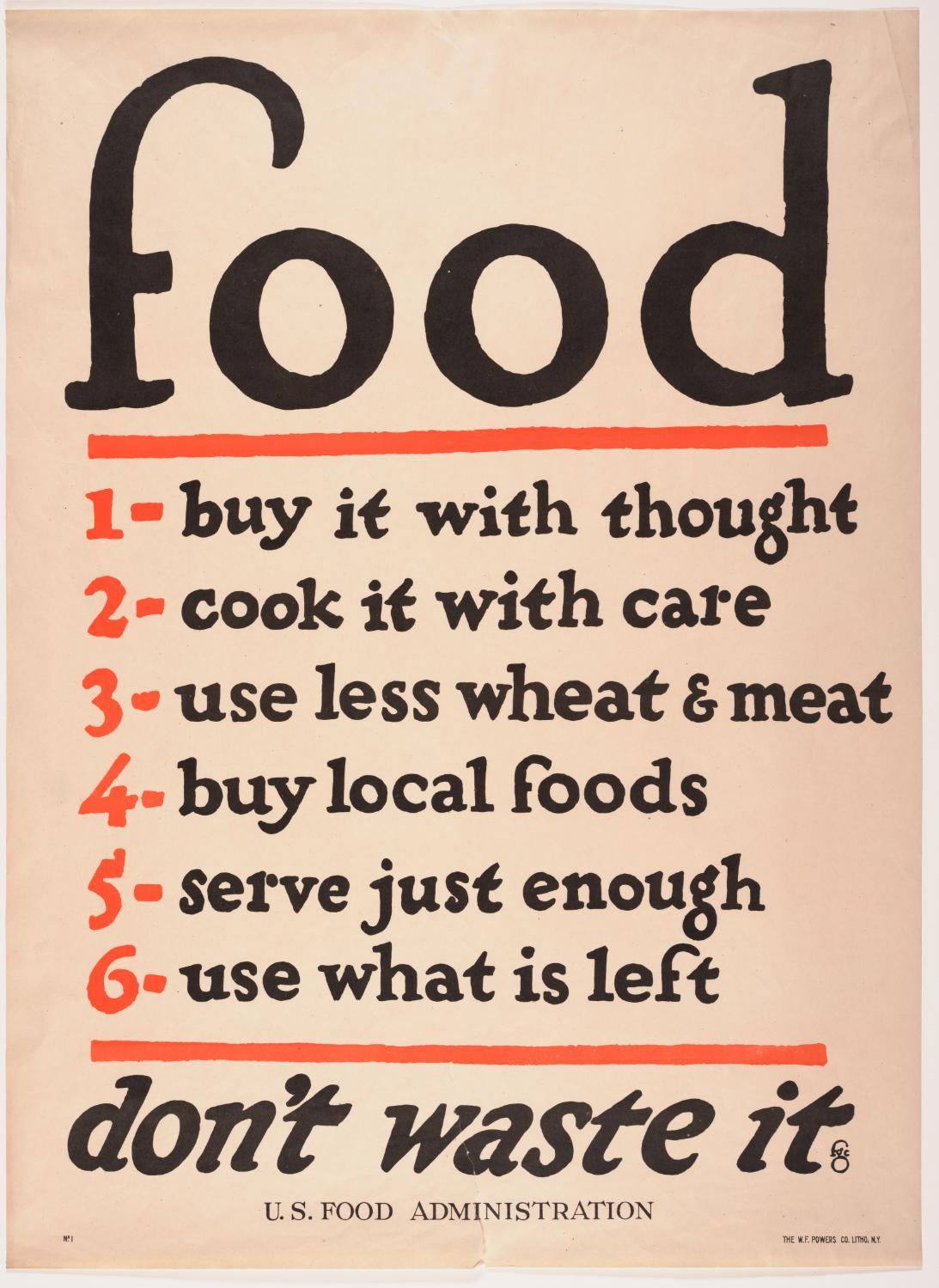
fooddontwasteit
“Food: Don’t Waste It” features sentiments that are familiar to us today. How often do we hear that we should shop carefully, cook certain ways, use less meat, buy locally, and eat less?

Like Fishes Swimming in the Air

May 9, 2013 by | 1 Comment

ribr000002md_banner

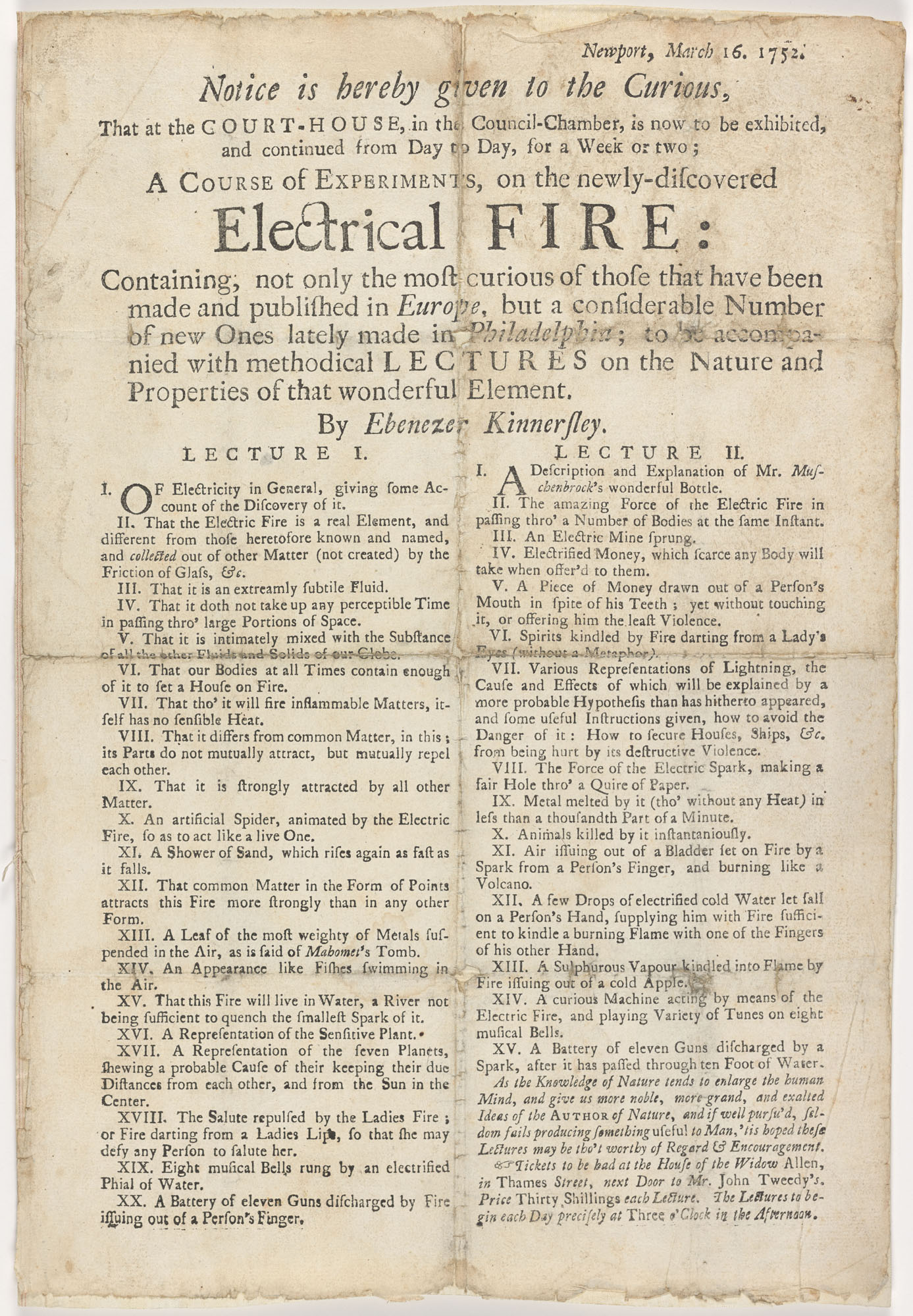
Digital Production Services recently began digitizing broadsides from the Sidney S. Rider Collection on Rhode Island History. Rider was a Providence bookseller, publisher, and antiquarian, who presented the library with his collection (the largest private collection of materials related to Rhode Island), in 1913. The broadsides are being chronologically digitized with our Aptus-II 12 camera back, after being registered in our internal tracking system by our student assistants. To introduce the registration process to a student, I pulled a broadside from a box of 18th century materials. The item was dated March 16, 1752 and was published in Newport. The single sheet is a public notice for a course of experiments and lectures on the “newly-discovered Electrical FIRE: containing, not only the most curious of those that have been made and published in Europe, but a number of new ones lately made in Philadelphia.” ribr000002md

The broadside states that the daily lectures, given by Ebenezer Kinnersley, would take place in the council chamber at the Newport courthouse, at 3pm over the the course of a week, or two, in March of 1752. Two columns list topics of the lectures, facts regarding the nature and properties of electricity (“that our Bodies at all Times contain enough of it to set a house on Fire”, and that it has “An Appearance like fishes swimming in the Air.”) An explanation of Mr. Muschenbrock’s wonderful bottle (the Leyden jar), is also promised.

Ebenezer Kinnersley was a scientist, inventor and lecturer, involved with Benjamin Franklin’s electrical experiments in Philadelphia. In 1751, encouraged by Franklin, he traveled to New York, Boston, and Newport delivering lectures on “the Newly Discovered Electrical Fire”. It was during this series of lectures that Kinnersley first announced the effectiveness of the lightning rod, and made practical suggestions on how houses and barns might be protected from the “destructive violence” of lightning. The broadside indicates that the explanation of the cause and effects of various representations of lightening will prove to be “a more probable hypothesis than has hitherto appeared.” Kinnersly’s Newport lecture took place in March of 1752, a full three months before Franklin’s kite experiment.

Anyone sufficiently interested in enlarging their minds by attending the lectures, which were hoped to be “worthy of Regard & Encouragement”, could procure tickets “at the House of the Widow Allen, in Thames Street, next Door to Mr. John Tweedy’s.”  Newport residents could not satisfy their interest in electrical fire for free, however. Tickets for the event would cost the curious thirty shillings.

ribr000002md_footer


A Great Gatsby; a poor speller

May 3, 2013 by | 5 Comments

Just in time for the release of the 2013 remake of the film, I came across this copy of The Great Gatsby.

This edition of F. Scott Fitzgerald’s The Great Gatsby is notable for several reasons. It is a first edition from 1925. However, what makes it truly unique is the inscription; Fitzgerald dedicated this copy to T.S. Eliot. Although an “enthusiastic worshipper” of the poet, Fitzgerald has misspelled Eliot’s last name:

Copy of the first edition of The great Gatsby inscribed by F. Scott Fitzgerald to T.S. Eliot. Donated to the Brown University Library by Daniel Siegel '57.

Copy of the first edition of The great Gatsby inscribed by F. Scott Fitzgerald to T.S. Eliot. Donated to the Brown University Library by Daniel Siegel ’57.

Eliot-1a

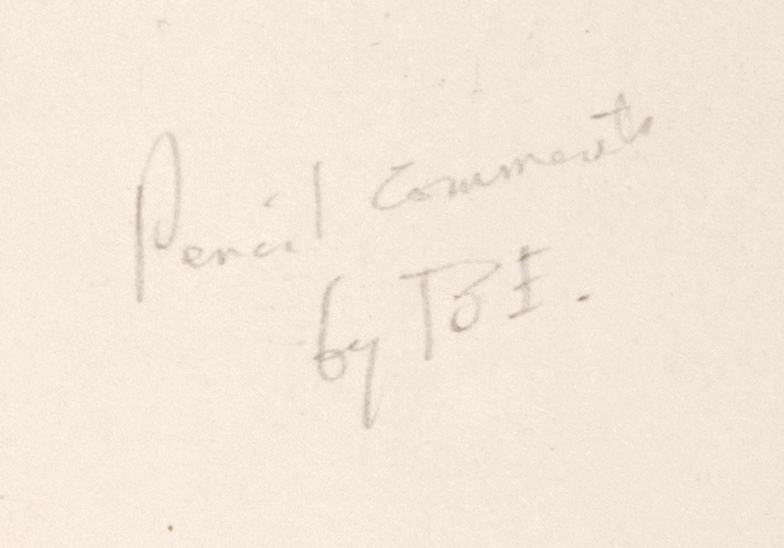
Detail showing the notation regarding T.S Eliot’s comments.

Written in pencil beneath the inscription is the barely discernible “Pencil comments by TSE.” Eliot read through the book, making comments in the margins in pencil throughout.

It should also be noted that I photographed this book differently than many of the items I digitize. In DPS, we often photograph books in a book cradle, page-by-page. However, this book was digitized for inclusion in the updated History & Guide, so I also provided photographs of the book as an object. I wanted to show the book as three-dimensionally as possible, and made a number of photographs showing it open in varying degrees, and from different angles.

A favorite shot is below, where you can see the front of the book. I had to use special lighting (a raking light from the right) to illuminate the blind-embossed title and author text.

View of spine, back and front of book.

View of spine, back and front of book.

Garibaldi Returns

April 26, 2013 by | Comments Off on Garibaldi Returns


In late-summer 2007, the Brown University Library contracted with Boston Photo to photograph both sides of a unique oversize panorama scroll depicting the life of Garibaldi. After the initial capture files were processed and digitally merged together by Digital Production Services staff in the Library, they were used to develop a website about the panorama. The process of reconstituting the panorama’s narrative scenes from the initial set of discrete digital photographs is described below:

Example from the end of side 2: Yellow line represents edges of initial digital files, which were then merged together in order to visually preserve the narrative continuity of scenes.

Example from the (supplementary) end of side 2: Yellow line represents edges of initial capture files (which included on average .5–1′ of overlap). Files were then digitally merged together in order to visually preserve the continuity of narrative scenes.

The sheer dimensions of the Garibaldi panorama — 4.75′ tall and 260′ wide on each side — presented unique digitization challenges. Boston Photo Imaging, a digital imaging company, was contracted to capture digital images of the panorama as it was unrolled across a custom-built wooden platform. Using a vertically mounted Better Light 4″ x 5″ digital scan back, capturing both sides of the panorama took three days and resulted in 91 digital image files, each file ~244 MB and representing ~6.5′ of horizontal width (including on average .5-1′ of overlap, in order to facilitate subsequent image merging). The scan back captured 300 dpi RGB TIF files; given the height of the device this resulted in an effective real-world resolution of ~137 dpi at the actual size of the panorama.

Because scenes within the panorama’s visual narrative do not correspond to the uniform width used in the capture process, sets of capture files were digitally merged together five at a time by the Brown Library’s Center for Digital Initiatives [now Digital Production Services] staff, at full capture resolution within Photoshop CS3/v10, and then individual scenes were isolated and saved from these roughly 30-feet merged sections. A continuous image of each side of the panorama was produced by subsequently merging sequences of these five-section composites at a reduced resolution. As part of this process the plastic-over-board background initially visible along the top and bottom edges was digitally removed, and each merged group of five was slightly rotated in order to compensate for some inevitable alignment drift produced during the unrolling process. Tonal levels and saturation values were slightly adjusted, and files were moderately sharpened for full-resolution and reduced-resolution delivery sizes. [Read more from “Behind the Scenes”]

In early 2013, the Center for Digital Scholarship and its student employees substantially upgraded the Web presentation of the Garibaldi scroll. In particular, one can now view the scroll’s narrative scenes directly alongside their accompanying descriptive texts. Flash-based animated views of the scroll are also still available on the site, which allow click-throughs into zoomable views of each narrative scene.

In addition to the redesigned website, the scroll has also been (briefly) mentioned in a new book from MIT Press, Illusions in Motion by Erkki Huhtamo, and has been featured as a teaching tool in the Patrick Ma Digital Scholarship Lab, by way of Massimo Riva’s Fall 2012 course on Garibaldi and the Risorgimento.

Photographs of Napoleon’s Veterans in Uniform

April 12, 2013 by | Comments Off on Photographs of Napoleon’s Veterans in Uniform

burg_full_length

Grenadier Burg of the 24th Regiment of the Guard of 1815

Digital Production Services has been digitizing Prints, Drawings & Watercolors from the Anne S.K. Brown Military Collection for over a decade. 25,000 Digital objects from this collection are currently available, with additional artwork being added all the time. Over the years, there have been some memorable moments of discovery during the digitization process. I am always extra intrigued when a box of photographs from this collection arrives in the department. Old tintypes, daguerreotypes, and carte d’visites offer a clear and detailed window into the past, and I open these boxes with more relish and anticipation than most. When reviewing the materials in a box of French photographs, I was fascinated to have in my hands twelve original sepia views of aging members of Napoleon’s army, wearing their original uniforms and insignia. I now know that the twelve Frenchmen are quite possibly the earliest uniformed soldiers ever caught on film. The dignity, swagger, and intensity of the poses and the expressions of the aged men, combined with the extravagant Napoleonic military costumes, including bearskins, plumed shakos, shapkas, and mameluke swords, make these images truly exceptional.

moret

Monsieur Moret of the Second Regiment, 1814/15.

It is not known at which studio the photographs were taken, or who the photographer was, but penciled on the back of each mounted print is the name of each veteran and his regiment.  They all wear the Saint Helene medal, which was issued on August 12, 1857 to all veterans of the wars of the French Revolution and the Napoleonic Empire, and it is possible that the men were in Paris the following year, for the annual May 5th anniversary of the death of Napoleon.

Peter Harrington, the curator of the Military Collection has written a detailed blog entry on the twelve men represented in the photographs, and made available a 2001 article entitled “Napoleon’s Veterans” he wrote for Military Heritage in which the photographs are featured.