
E-Newsletter
Recent Posts
Latest News
-
“A Pictorial Dragon: The Art of Fernando Birri” Exhibit
|
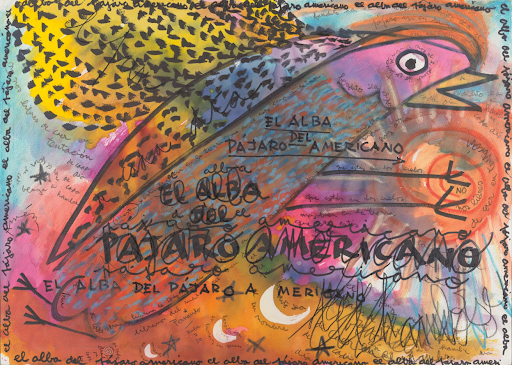
El Alba del Pájaro Americano [The Dawn of the American Bird]. Serie Espejismos del Karibe [Mirages of the Caribbean Series]. Cuba, May 1990. Watercolor and marker on paper. The exhibit A Pictorial Dragon: The Art of Fernando Birri is on view in the Harriette Hemmasi Exhibition Gallery at the John Hay Library at Brown University. The exhibition celebrates the centennial of Fernando Birri (1925–2017), the pioneering Argentine filmmaker, artist, and theorist of the New Latin American Cinema.
Viewing the Exhibit
In-Person
Dates: September 8, 2026 to March 5, 2027
Location: Harriette Hemmasi Exhibition Gallery, 1st floor, John Hay Library, 20 Prospect Street, Providence, RI 02912
Hours: Locations and HoursOnline
In addition to the physical exhibit, a bilingual digital exhibit is also available.
Items on View
Featuring a selection of drawings, paintings, collages, and writings from the personal archive Birri gifted to Brown University Library in 2008, the exhibition reveals how he used art as a means of reflection and reinvention in response to exile, identity, and the cultural and political urgencies of his time. The physical exhibition presents a small selection of materials featured in the accompanying digital exhibition, which is fully accessible in both English and Spanish.
Together, these materials offer new insight into Birri’s expansive artistic practice and his enduring commitment to experimentation, self-discovery, and transformation.
An Archive of Intimate History
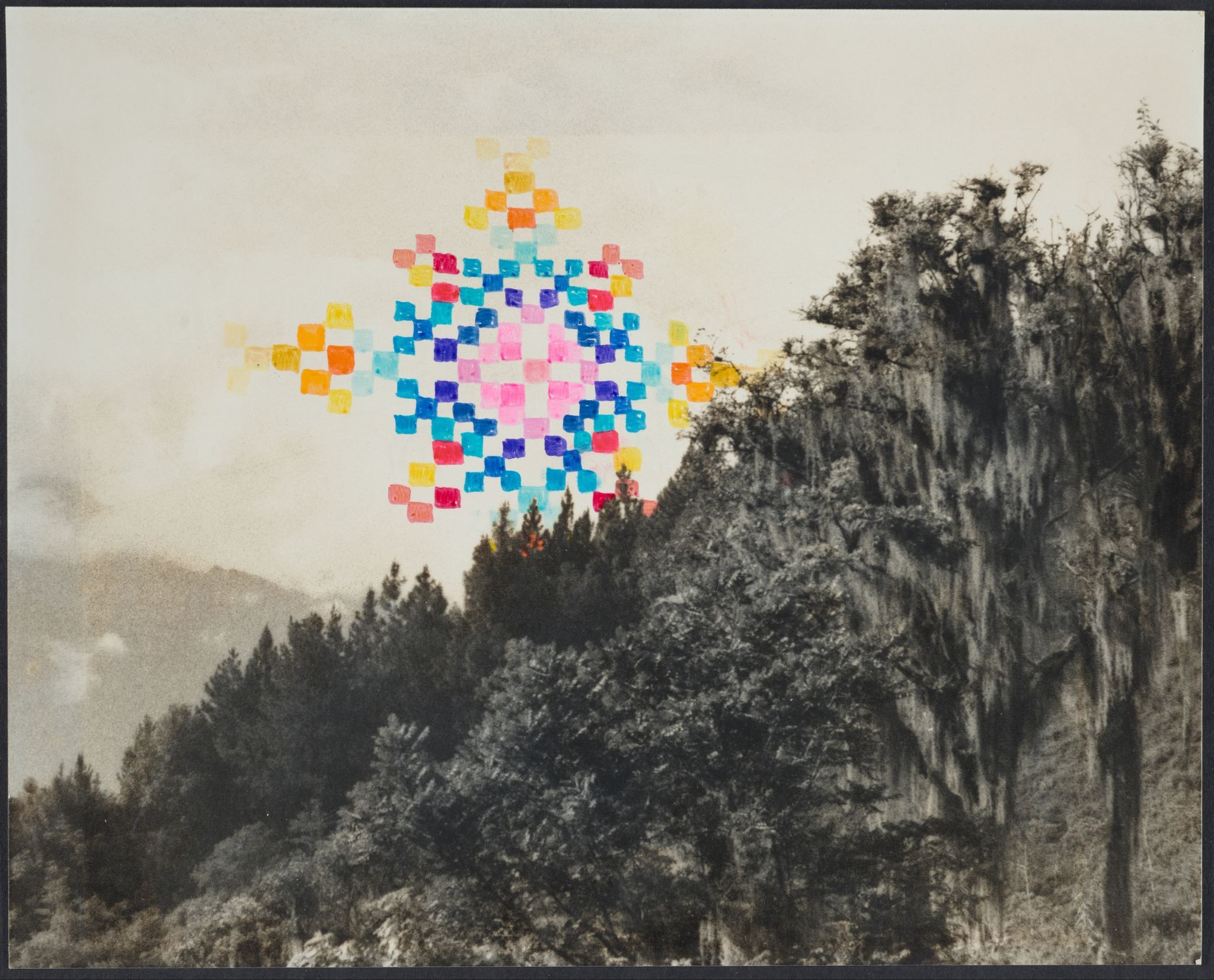
Ya viene [It’s Coming]. Trazos [Strokes] series, November 26, 1981. Photograph, marker. Widely recognized as the father of the New Latin American Cinema, Fernando Birri also produced an extensive body of visual art that has remained largely unknown to the public. Created during some of his most prolific years—spanning the 1960s to his final years in Cuba and Italy—his archive contains hundreds of paintings, drawings and collages in addition to films and written materials. These works appear both as independent pieces and as sketches on documents, napkins or travel notebooks. They reveal an artist driven by a persistent impulse to create images—what he called a dragón pictórico (pictorial dragon)—a practice that reached beyond what language or cinema could express.
Developed alongside his filmmaking, Birri’s visual practice offers insight into a broader intellectual framework concerned with critical reflection, inner exploration and the processing of personal and historical turmoil. Considered together, these works offer a more expansive understanding of Birri’s artistic and intellectual contributions, extending beyond the boundaries of the cinematic form.
The selection of works featured in this exhibit is drawn from the Fernando Birri Archive of Multimedia Arts 1925–2010, donated by the artist to Brown University Library in 2008 and accessible at the John Hay Library. It features pieces that Birri occasionally exhibited during his lifetime in Cuba, Italy and Germany and is organized around four key themes that reflect different facets of his pictorial practice. The first explores the intersection of the archive, exile, trauma and image-making. The second highlights his production during the 1970s, notably in Grottarossa outside Rome, his Studiolo in the Roman neighborhood of Trastevere, and during his travels to India. The third examines the relationship between painting and cinema, in particular in relation to his experimental film ORG, developed by Birri from 1968 to 1978 and released in 1979. The final section showcases his Caribbean work and two of his most significant series: the fotoglifos, paintings intended to be photographed and projected, and the glifotronics, developed using computer-based processes. Together, these sections offer insight into Birri’s visual language and the ways in which his art extended his ongoing engagement with experimentation, pedagogy and political imagination.
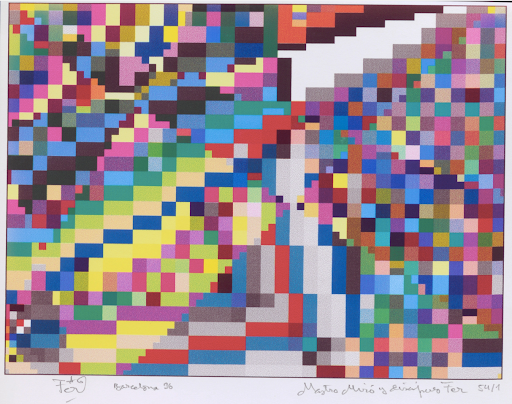
Ma[e]stro Miró y discípulo Fer. Glifotronic Series, 54/1. Barcelona 1996. Sponsors
A Pictorial Dragon: The Work of Fernando Birri was made possible through the generous support of the Center for Latin American and Caribbean Studies (CLACS), in partnership with the Brown University Library, whose combined funding and staff contributions were essential to the project.
Curators and Editor
- Co-Curator: Agustín Díez-Fischer, CLACS Visiting Professor 2023-2024, Senior Manager of Research and Archives at the Institute for Studies on Latin American Art (ISLAA)
- Co-Curator: Patricia Figueroa, Curator of Iberian and Latin American Collections, Brown University Library
- Researcher and Editor: Irene Rihuete-Varea, Ph.D .Hispanic Studies, Brown University
-
Ever Queer: A Coming Out Day Open House
|

Join the Library for a celebration of National Coming Out Day! We’re partnering with Stonewall House / the LGBTQ Center to showcase LGBTQ+ materials at the John Hay Library.
Friday, October 9, 2026 from 11:30 a.m. to 4 p.m. in the Primary Source Lab (321)
Score some adorable Coming Out Day stickers and enjoy snacks and boba tea.
Open to all! Pre-registration appreciated. On-site registration accommodated.
-
International Open Access Week
|
Celebrate International Open Access Week
“The Cost of Knowledge” is the theme for this year’s International Open Access Week (October 19-25). Learn more about Brown Library’s Open Access guides and resources.
Open Access Week Workshops
During International Open Access Week, the Brown Library’s Open Science Librarian will present two workshops:
Paths for Making a Journal Article Open Access
Monday, 10/19, noon to 1 p.m. (online only: register to receive the Zoom link)
This workshop introduces the Brown Faculty Open Access Policy, paths for making preprints and accepted author manuscripts open access, and current agreements that Brown has with publishers to waive fee for publishing open access in participating journals (will be recorded for those unable to attend).
Complying with the NIH Public Access Policy
Thursday, 10/22, noon to 1 p.m. (online only: register to receive the Zoom link)
This workshop introduces the NIH Public Access Policy and process of depositing an accepted manuscript in PubMed Central (PMC), journal-implemented barriers to embargo-free PMC deposit, and alternative options for NIH-funded authors. We will also review new authorship guidelines from the Brown Division of Research pertaining to federally-funded authors’ public access compliance.
New Sage Open Access Publishing Agreement

Brown University authors can now publish open access in many Sage journals without paying an article processing charge (APC). The participating hybrid journals (link downloads an Excel spreadsheet) include many titles in the health sciences and public health.
To be eligible for the fee waiver, the corresponding author must be affiliated with Brown and have an article accepted for publication in a participating journal that has entered or will enter production between January 1, 2026, and December 31, 2028.
More details on Brown’s open access fee waiver agreements and discounts with other publishers can be found on our guide to paying for open access publications.
Supporting the Sharing of Preprints

Did you know that Brown is among the institutions contributing to supporting ArXiv, the preprint server for the physical sciences, as well as BioRxiv and MedRxiv, for sharing preprints in the biological and health sciences?
Check out Brown’s dedicated channel of preprints shared via BioRxiv and MedRxiv.
Sharing Clinical Data

Brown currently is in the second year of its pilot membership with the open access data sharing repository Vivli. Vivli is a controlled-access repository for sharing anonymized data from clinical trials and other protocol-driven, prospective clinical studies, including Real World Data (RWD). This means that other researchers have to apply for access by providing details about their study and IRB approval/exemption and signing a Data Use Agreement (DUA).
Sunsetting of OSF Projects

The Center for Open Science (COS) is ending support for OSF Projects, the project management/data repository component of the Open Science Framework (OSF). Please note: this will not impact OSF Preprints, OSF Preregistrations, or OSF Registered Reports.
As of November 16, 2026, OSF Projects users will no longer be able to create new OSF Projects or child components within existing projects. On February 19, 2027, all existing OSF Projects will be read-only. You will continue to have access to all project materials, but no further changes or additions can be made. All public projects will remain persistent, discoverable, and accessible at the same URLs and DOIs. Private content will remain accessible to collaborators via an existing view-only-link.
COS has provided extensive information regarding the reasoning behind and logistics for sunsetting OSF Projects. If you are an active OSF Projects user, we strongly recommend you review their detailed transition guide, which includes recommendations of other file and data repositories. If you have questions about how to proceed, or would like to migrate copies of your OSF Projects materials to in-house platforms such as the Brown Digital Repository (BDR) or LabArchives@Brown, please contact data_management@brown.edu.