
E-Newsletter
Recent Posts
Latest News
-
Cultural Revolutions: A Study in Contrasts – On View at Orwig Music Library
|
PROVIDENCE, R.I. [Brown University] — In celebration of the Year of China, now through June, Orwig Music Library at 1 Young Orchard Avenue is hosting an exhibition of Chinese music: “Cultural Revolutions: A Study in Contrasts” curated by Senior Library Specialist, Nancy Jakubowski. The exhibit features Maoist propaganda songs, “model theatrical works” from The Great Proletarian Cultural Revolution, and samplings from concurrent works by Asian Pop artists of the ’60s, ’70s, and ’80s.
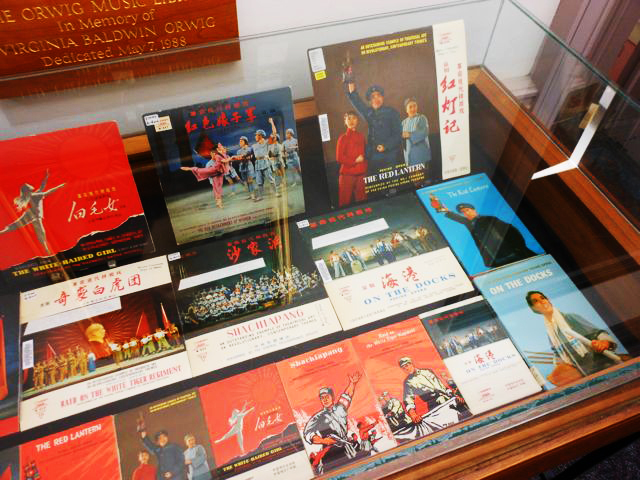
The ’60s and ’70s were turbulent decades around the world, and 1966 ushered in a period for China known as “The Great Proletarian Cultural Revolution” or in the West simply as “The Cultural Revolution.” The Revolution’s intent was to root out “the 4 olds”: outdated ideas, customs, culture, and habits. During Mao Zedong’s reign, music was used to support the aims of the Cultural Revolution and the Communist Party. As the Ministry of Culture, Mao’s third wife, Jiang Qing, oversaw the creation of eight “model revolutionary theatrical works” for the Peking Opera. These re-workings of existing pieces became the country’s primary sanctioned musical entertainment, and were translated into stage, radio, film, and television productions.
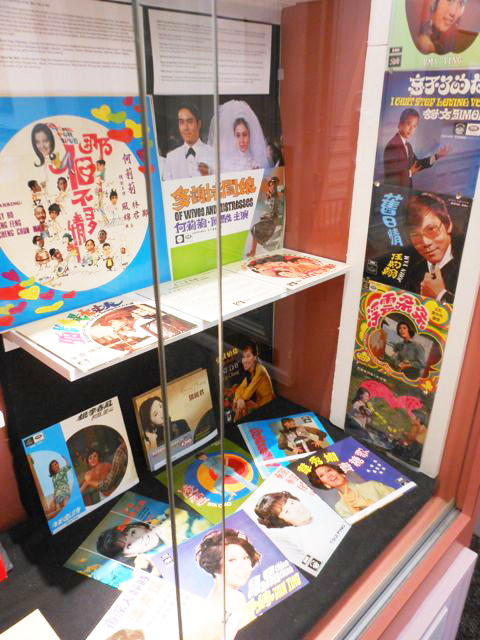
Meanwhile, outside of the People’s Republic of China, other Asian countries were developing thriving music industries. Singers traveled throughout the region (Singapore, Taiwan, Hong Kong, Japan, Indonesia, etc.) performing in whatever language was necessary. Pop divas like Teresa Teng and Rita Chao rose to fame, and Hong Kong film and television companies made use of their homegrown pop music.
Stop by the Orwig Music Library to see this exhibit!
The Year of China explores the rich culture, economy, and politics of Greater China, investigating its past, examining its present, and contemplating its future. Throughout the 2011-2012 academic year, Brown will host public lectures, cultural events, academic conferences, and exhibits in an integrated exploration of China. For more information about the program and upcoming events, please visit: Year of China in News from Brown.
The Brown University Library is home to more than 6.8 million print items, plus a multitude of electronic resources and expanding digital archives serving the teaching, research, and learning needs of Brown students and faculty, as well as scholars from around the country and the world.
Contact: Jennifer Braga | 401-863-6913
###
-
Traditional Tea Ceremony and Reception
|
PROVIDENCE, R.I. [Brown University] —
 On Monday, May 21 at 11am, Brown University Library will host a welcome reception for distinguished guests from the Cross-Straits Tea Exchanges Association in the Laura and David Finn Reading Room of the John D. Rockefeller Library.
The delegation of the association is led by Mr. Zhang Jiakun, former Executive Vice Governor of Fujian Province, China. Mr. Zhang will donate to Brown Library his calligraphic works and books, including Tie Guanyin da dian 铁观音大典 (Encyclopedia of Tie Guanyin, a representative type of oolong tea). Mr. Bing Ling, Chair of the Association for Chinese Writers in the U.S., will also contribute a number of new Chinese writers’ signature works. Two master tea performers will demonstrate briefly the traditional Chinese tea ceremony, chadao, the “Way of Tea.”
This event is free an open to the public, so take a moment to enjoy the Way of Tea!
The Year of China explores the rich culture, economy, and politics of Greater China, investigating its past, examining its present, and contemplating its future. Throughout the 2011-2012 academic year, Brown will host public lectures, cultural events, academic conferences, and exhibits in an integrated exploration of China. For more information about the program and upcoming events, please visit: www.brown.edu/yearofchina
The Brown University Library is home to more than 6.8 million print items, plus a multitude of electronic resources and expanding digital archives serving the teaching, research, and learning needs of Brown students and faculty, as well as scholars from around the country and the world.
Contact: Jennifer Braga | 401-863-6913
###
-
Library Acquires Broadside from Surrealist Riot
|
PROVIDENCE, R.I. [Brown University] — Sergei Diaghilev, director of the Ballets Russes, emigrated to France in 1911. Always in search of innovations, he created a surrealist version of Romeo and Juliet in 1926, for which he commissioned Max Ernst and Joan Miró to create the sets. The poets Louis Aragon and André Breton, who regarded themselves as the leaders of the surrealists, felt that deriving financial rewards from a surrealist creation was against the principles of the movement, and accused Ernst and Miró of selling out to the “international aristocracy.” At the première of the ballet at the Opéra in Paris, Aragon and Breton, seated in the balcony, started a riot by noisily showering the audience with this double-sided leaflet printed in flaming red.
In fall 2011, Thomas and Antonia Bryson (class of ’72 and ’74) donated one of these rare and historically significant leaflets to the Brown University Library, where it joins over two thousand books, programs, playbills, photos and documents in the Bryson Dance Collection. Detailed information about each item in the collection can be found in Josiah under the author Bryson Dance Collection (Brown University).

Original leaflet English translation by Stéphanie Ravillon’s translation course, FREN1510.1:
“PROTEST
It is unacceptable that thought be subservient to
money. And yet, not a year goes by without the
submission of a man considered to be indomitable to
the forces that he once opposed. Regardless of the
individuals who succumb in this manner to existing
social conditions, the idea that they claimed to support
before this abdication endures beyond them.
It is in this sense that the participation of the painters
Max Ernst and Joan Miró in the upcoming
production of the Ballets Russes would not implicate
the surrealist idea along with their degradation. It is an
essentially subversive idea, incompatible with
such enterprises, whose aim has always been to
domesticate, for the profit of the international
aristocracy, the reveries and the revolts born of
physical and intellectual famine.It may have seemed to Ernst and Miró that their
collaboration with Diaghilev, legitimized by
Picasso’s example, would not have such grave
consequences. Yet we are placed under the
obligation–we whose primary concern has always
been to keep progressive thought out of reach of slave
traders of all sorts–we are placed under the obligation
to denounce, without consideration of the individuals
involved, an attitude that gives arms to the worst
partisans of moral ambiguity.It is known that we make very little of our artistic
affinities with one person or another. Do us the honor
of believing that in 1926 we are more incapable than
ever of sacrificing to these affinities our sense of
revolutionary reality.Louis ARAGON – André BRETON”
###
The John Hay Library is open to the public and objects from Brown University’s Special Collections can be viewed by appointment.
The Brown University Library is home to more than 6.8 million print items, plus a multitude of electronic resources and expanding digital archives serving the teaching, research, and learning needs of Brown students and faculty, as well as scholars from around the country and the world. Gifts to the Brown University Library are welcome. For more information on Giving Opportunities visit http://library.brown.edu/alumni/gifts/.
Contact: Jennifer Braga | 401-863-6913