

In 1933, Howard Phillips (H.P.) Lovecraft published the story “At the Mountains of Madness,” creating a world that has captured imaginations. It is the looming ancient god of the story, Cthulhu, who gives the Cthulhu Mythos its name, both of which have spawned countless works (and nightmares) since.
Cthulhu Mythos
Stories, films, songs and more have been written within the Cthulhu Mythos, characterized by creeping dread, disgusting creatures and cosmic horror. Its abundant cultural presence lends the mythos the ubiquity of an inside joke among science fiction, fantasy and weird fiction aficionados, and resonance far beyond.
Charting the Cthulhu Mythos through time is akin to charting plant and animal evolution; environmental adaptation is necessary to survival — and cultural relevance. It is important to note that the constant appropriation of Lovecraft’s work has allowed the mythos to move away from its racist origins. As flora and fauna develop tougher bark and thicker coats to adapt to changes in climate, so too have the themes, places, figures and creatures of the Cthulhu Mythos taken new shapes to suit modern understanding and culture.
H.P. Lovecraft Collection
The Library’s extensive H.P. Lovecraft Collection includes holdings of manuscripts, letters, editions of Lovecraft’s works in all languages, periodicals, biographical and critical works, and many supportive collections of manuscript and printed materials of Lovecraft’s friends and associates. There are more than 1,000 books and magazines in 20 languages containing material by or about Lovecraft plus over 2,000 original letters and manuscripts of his essays, fiction and poetry. Many of the papers were given to the Library a few months after his death in 1937.
The Library holds array of materials related to weird fiction that may also be of interest to Lovecraft fans.
Evolution of Cthulhu in the Collection
In honor of NecronomiCon Providence, here is a sample of items held by the Library that demonstrate some of the ways that the Cthulhu Mythos has been adapted, remixed and changed from the mythos of Lovecraft’s time.
Shoggoths
A servile race known for its many eyes and underground travel, shoggoths were first seen in “In The Mountains of Madness.” They have evolved to portray anything from beloved pets to free creatures roaming the earth.
“I want you to learn to be free,” he told the shoggoth, “and I want you to teach your brothers.”
Elizabeth Bear, “Shoggoths in Bloom,” 2008
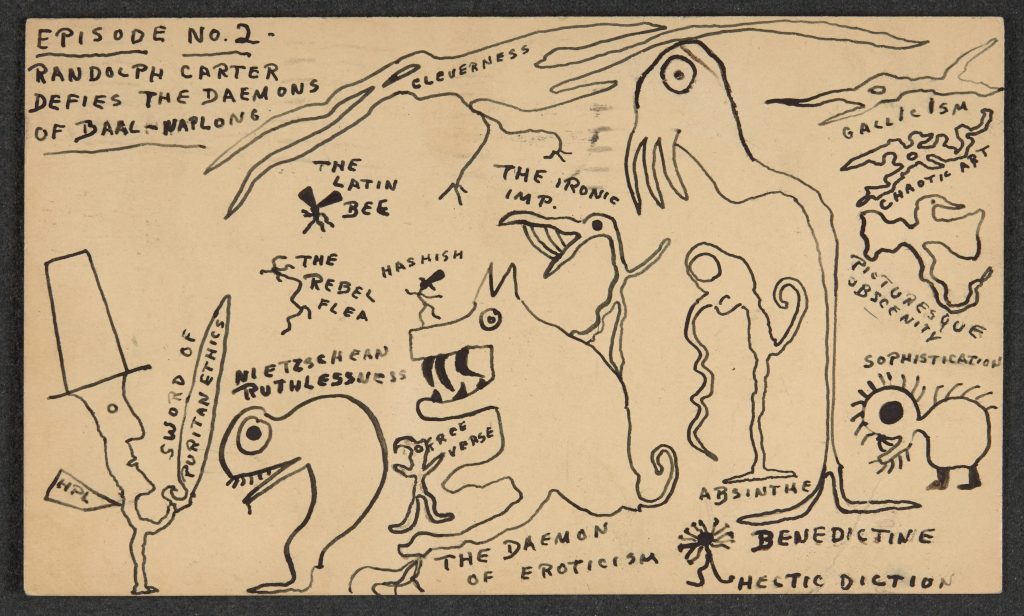
The King in Yellow
The King in Yellow, sometimes known as Hastur, first appeared in The King in Yellow by Robert W. Chambers in 1895, when H.P. Lovecraft was just five years old. The mysterious cosmic king haunts the minds of all who encounter the play written about him. More recently, the term “King in Yellow” has been used to describe cult leaders, elder gods, and unspeakable terrors.
“Something old and predatory and utterly terrible staring right back at me.”
China Mieville, “Details,” 2002
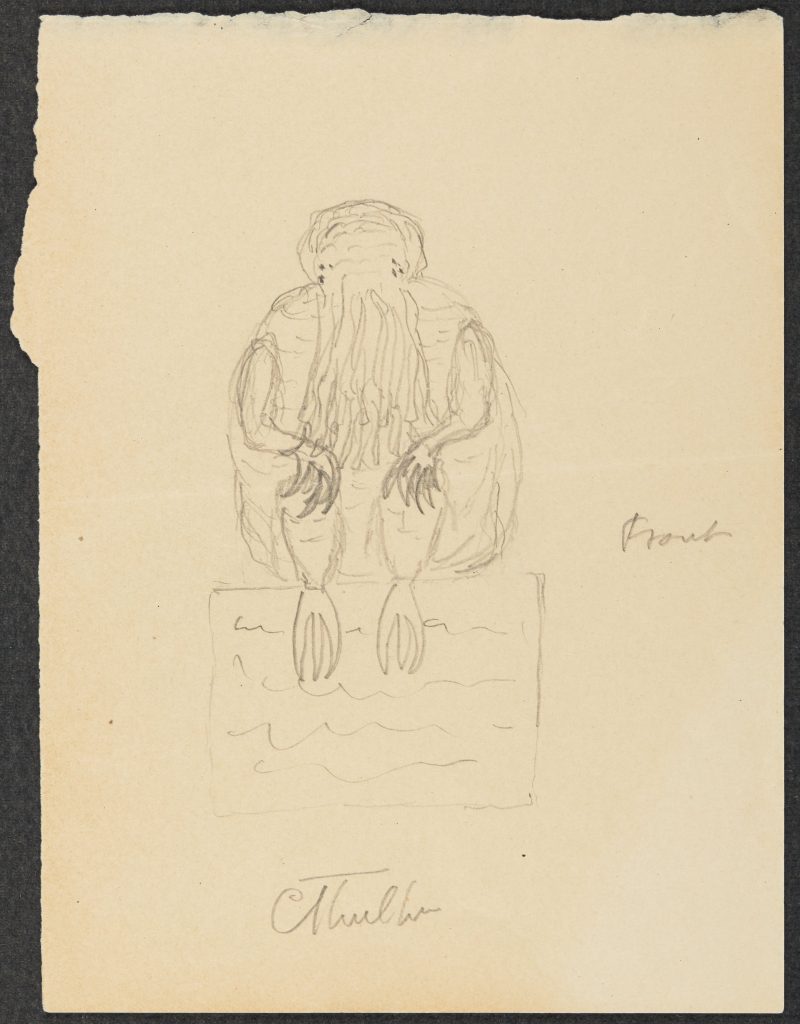
Cthulhu
Cthulhu, the central figure of the mythos, is an ancient god who appears half squid and half human. It is constantly intimated in the mythos that Cthulhu will end the world. Since his inception, Cthulhu has become everything from Davey Jones to cute plush toys.
“Guys. We are not going to destroy the world nor eat anyone in this room. Are we clear?”
Minions and Monsters, 2025
Necronomicon
The ultimate cursed book, the Necronomicon delivers a warning in Lovecraft’s story “The Hound.” It is said to hold spells to summon the dead (and worse). Over 100 years later, the accidental invoking of evil spells has become a trope and, at times,
a punchline.
“Told you you should’ve put the book back, Danny!”
Evil Dead Rise, 2023
 H.P. Lovecraft Papers" written at the bottom. "5¢" is in the middle of the paper with a small rocket ship under it.](https://library.brown.edu/create/libnews/wp-content/uploads/sites/44/2026/07/chemistry-619x1024.jpg)
The Racial Imaginaries of H.P. Lovecraft
The permanent online exhibit, “A Blind Horror Beyond All Rational Proportion”: The Racial Imaginaries of H.P. Lovecraft, examines Lovecraft’s correspondence for insight into his conceptualization of race and how it is reflected in his fiction. The exhibit was curated by the 2020 Brown University Library Exhibitions Proctor, Alberto Alcaraz Escarcega, Political Science Ph.D. candidate.
John Hay Library Renovation and Access
You can view Brown’s special collections in person! While the John Hay Library is renovating its exterior this summer, a temporary special collections reading room is available in the Absolute Quiet Room on level A of the Rockefeller Library. It is open on the following schedule by reservation only. Please see Visiting the Brown University Special Collections for information about scheduling a reading room appointment via Aeon. The Hay will reopen in September.
- Monday and Tuesday: 1 to 5 p.m.
- Wednesday and Thursday: 10 a.m. to 5 p.m.
- Friday: 10 a.m. to noon
The Call of Cthulhu
“Ph’nglui mglw’nafh Cthulhu R’lyeh wgah’nagl fhtagn.”
H.P. Lovecraft, “The Call of Cthulhu,” 1928