
E-Newsletter
Recent Posts
Latest News
-
On Seeing Series Launches with “Mortevivum”
|
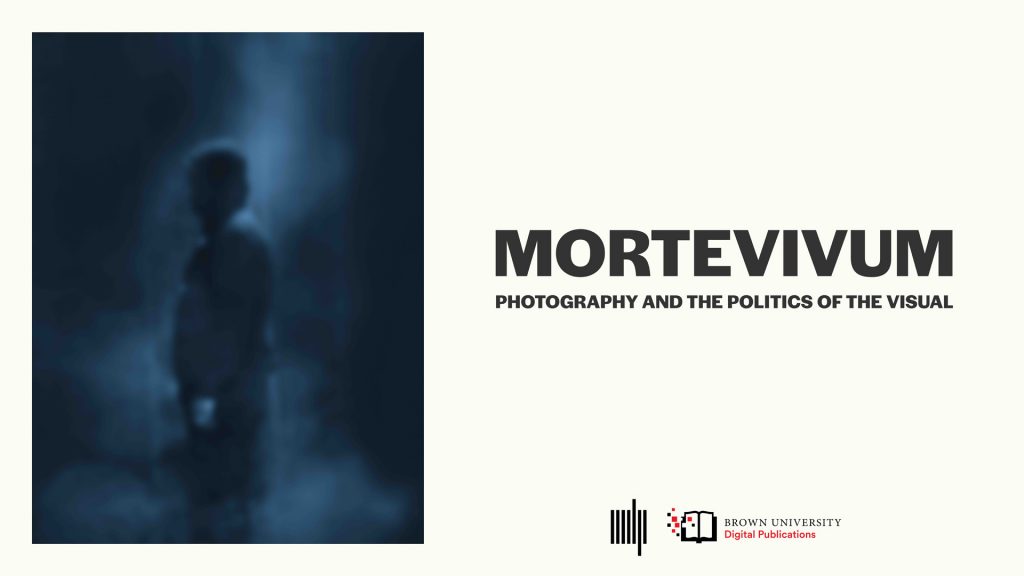
“Mortevivum” cover photo, above left, by Carrie Mae Weems, All the Boys (Profile 1), 2016. Courtesy of the artist. Join Brown University Library as we host a cross-disciplinary panel discussion centered on Kimberly Juanita Brown’s Mortevivum: Photography and the Politics of the Visual (Paperback from MIT Press, February 2024). Open access digital edition by Brown University Digital Publications; full digital release June 2024). Speakers include the author, Kimberly Juanita Brown, Associate Professor, Department of English and Creative Writing and Director of the Institute for Black Intellectual and Cultural Life at Dartmouth College; Kim Gallon, Brown University Associate Professor of Africana Studies; Juliet Hooker, Royce Family Professor of Teaching Excellence in Political Science; Kevin Quashie, Brown University Royce Family Professor of Teaching Excellence in English; and Avery Willis Hoffman, Artistic Director of the Brown Arts Institute and Professor of the Practice of Arts and Classics.
Hybrid event. Free and open to the public. Zoom link: https://brown.zoom.us/j/98925219331
- Date: Wednesday, April 3, 2024
- Location: Willis Reading Room at the John Hay Library, 20 Prospect St, Providence
- Program:
- 5 – 5:25 p.m.: Book sale and author signing
- 5:30 p.m.: Welcome remarks
- 5:45 p.m.: Reading by author Kimberly Juanita Brown
- 6 p.m.: Panel conversation
- 6:45 p.m.: Audience Q&A
- 7 p.m.: Reception
Sponsored by Brown University Library, Africana Studies, Brown Arts Institute, Center for the Study of Race and Ethnicity, Center for the Study of Slavery and Justice, Cogut Institute for the Humanities, Comparative Literature, History of Art and Architecture, Modern Culture and Media, and Watson Institute for International and Public Affairs.
On Seeing
Mortevivum is the inaugural title of On Seeing, a new multimodal book series published by The MIT Press and Brown University Digital Publications. Devoted to visual literacy, publications foreground the political agency, critical insight, and social impact inscribed in visuality and representation. Centering underrepresented perspectives and understudied questions, books in the series articulate complex ideas about how we see, comprehend, and participate in the visual world.
Mortevivum
Mortevivum is a powerful examination of the unsettling history of photography and its fraught relationship to global antiblackness. Since photography’s invention, black life has been presented as fraught, short, agonizingly filled with violence, and indifferent to intervention: living death—mortevivum—in a series of still frames that refuse a complex humanity. In Mortevivum, Kimberly Juanita Brown shows us how the visual logic of documentary photography and the cultural legacy of empire have come together to produce the understanding that blackness and suffering—and death—are inextricable. Brown traces this idea from the earliest images of the enslaved to the latest newspaper photographs of black bodies, from the United States and South Africa to Haiti and Rwanda, documenting the enduring, pernicious connection between photography and a global history of antiblackness.
Speakers
Kimberly Juanita Brown

Kimberly Juanita Brown Kimberly Juanita Brown is the inaugural director of the Institute for Black Intellectual and Cultural Life at Dartmouth College where she is also an Associate Professor of English and creative writing. Her research and teaching gather at the intersection of African American/African diaspora literature and visual culture studies. She is particularly interested in the relationship between visuality and black subjectivity. Her first book, The Repeating Body: Slavery’s Visual Resonance in the Contemporary (Duke University Press, 2015) examines slavery’s profound ocular construction and the presence and absence of seeing in relation to the plantation space. Her current book project, Mortevivum: Photography and the Politics of the Visual, was released by MIT Press in February 2024, with a full digital edition from Brown University Digital Publications slated for June 2024. Mortevivum explores the relationship between photography and histories of antiblackness on the cusp of the twenty-first century.
The URL for Mortevivum is https://on-seeing-mortevivum.org/.
Kim Gallon

Kim Gallon Kim Gallon is an Associate Professor of Africana Studies at Brown University. Her work investigates the cultural dimensions of the Black Press in the early twentieth century. Her first book, Pleasure in the News: African American Readership and Sexuality in the Black Press (University of Illinois Press, 2020) argues that African American newspapers fostered Black sexual expression, agency, and identity in the first half of the twentieth century.
Gallon is also the author of the field defining article, “Making a Case for the Black Digital Humanities.”
Her more recent work focuses on the spatial relationship between reading and residential segregation in Baltimore in the twentieth century. She is aso working on a book project on race, digital technology, and health equity.
Gallon is the founder and director of two black digital humanities projects, The Black Press Research Collective and COVID Black.
Her work has been supported by the American Council of Learned Societies, National Endowment for the Humanities, Social Science Research Council and Spencer Foundation.
Juliet Hooker

Juliet Hooker Juliet Hooker is Royce Family Professor of Teaching Excellence in Political Science. She is a political theorist specializing in racial justice, Black political thought, Latin American political thought, democratic theory, and contemporary political theory. She has also written on racism and Afro-descendant and indigenous politics in Latin America. Before coming to Brown, she was a faculty member at the University of Texas at Austin. She is the author of Black Grief/White Grievance: The Politics of Loss (Princeton University Press, 2023), Theorizing Race in the Americas: Douglass, Sarmiento, Du Bois, and Vasconcelos (Oxford, 2017), Race and the Politics of Solidarity (Oxford, 2009), and editor of Black and Indigenous Resistance in the Americas: From Multiculturalism to Racist Backlash (Lexington Books, 2020). Theorizing Race in the Americas was awarded the American Political Science Association’s 2018 Ralph Bunche Book Award for the best work in ethnic and cultural pluralism and the 2018 Best Book Award of the Race, Ethnicity, and Politics Section of the American Political Science Association. Prof. Hooker served as co-Chair of the American Political Science Association’s Presidential Task Force on Racial and Social Class Inequalities in the Americas (2014-2015), and as Associate Director of the Teresa Lozano Long Institute of Latin American Studies at the University of Texas at Austin (2009-2014). She has been the recipient of fellowships and awards from the National Endowment for the Humanities, the Woodrow Wilson International Center for Scholars, the DuBois Institute for African American Research at Harvard, and the Advanced Research Collaborative at the Graduate Center of the City University of New York.
Kevin Quashie

Kevin Quashie Kevin E. Quashie is Royce Family Professor of Teaching Excellence in English at Brown University. He teaches black cultural and literary studies and is a professor in the department of English. Primarily, he focuses on black feminism, queer studies, and aesthetics, especially poetics. He is the author or editor of four books, most recently The Sovereignty of Quiet: Beyond Resistance in Black Culture (2012) and Black Aliveness, or A Poetics of Being (2021). Black Aliveness has been awarded two prizes: the James Russell Lowell Prize from the Modern Language Association (2022) and the Pegasus Award for Poetry Criticism from the Poetry Foundation (2022). Currently, he is thinking about literary criticism as a form of estrangement and consolation or, said another way, he is thinking about the workings and potency of black sentences.
Avery Willis Hoffman

Avery Willis Hoffman A writer, artistic director, creative producer and curator of public programs, Avery Willis Hoffman joined Brown University in 2020 as the inaugural Artistic Director of the Brown Arts Institute and Professor of the Practice of Arts and Classics.
In her recent role as inaugural Program Director at Park Avenue Armory in New York, Avery curated and produced innovative and diverse public programming initiatives, including numerous large- and intimate-scale cultural events: Artist and Curatorial Talks, a Confrontational Comedy Series (2016-2019), the annual Culture in a Changing America Symposium (2017-2020), Carrie Mae Weems: Shape of Things Salon (2017), the United Lenape Nations’s first Manhattan-based Pow Wow (2018), Theaster Gates’s Black Artist Retreat 2019, the multi-partner digital initiative 100 Years | 100 Women, marking the centennial of the 19th Amendment (2020), the 12 episode podcast project, Helga: The Armory Conversations (2021), and Carrie Mae Weems: The Land of Broken Dreams Convening (2021).
Prior to the Armory, Avery was a senior Project Developer at Ralph Appelbaum Associates, a museum planning and design firm, where she conducted research and developed content for a number of special projects. Between 2010-2015, her primary project was the development of the Smithsonian’s National Museum of African American History and Culture, in Washington, D.C. Avery has also held positions at Focus Features, Clinton Global Initiative, and TED.
For nearly two decades, her professional career has included multiple projects with acclaimed director Peter Sellars, including on his international productions of Shakespeare’s Othello, Mozart’s opera Zaide, New Crowned Hope Festival, and Toni Morrison’s Desdemona. From 2016-2020, she produced the international tour of FLEXN, Sellars’s collaboration with choreographer Reggie Gray and the Brooklyn flex community, which premiered at the Armory in March 2015 and has since been presented at the Marseille Festival, Napoli Teatro Festival, Holland Festival, New Zealand Festival, Sao Paolo Brasil Sesc, La Villette Paris, Jacobs Pillow Dance Festival, with residencies at Dartmouth College and Princeton University, and The Kennedy Center.

Brown University Digital Publications — a collaboration between the University Library and the Dean of the Faculty, generously launched with support from the Mellon Foundation with additional support from the National Endowment for the Humanities and the Institute of Museum and Library Services — creates exciting new conditions for the production and sharing of knowledge. Widely recognized as accessible, intentional, and inclusive, Brown’s novel, university-based approach to digital content development is helping to set the standards for the future of scholarship in the digital age.
Established in 1962, the MIT Press is one of the largest and most distinguished university presses in the world and a leading publisher of books and journals at the intersection of science, technology, art, social science, and design. MIT Press books and journals are known for their intellectual daring, scholarly standards, interdisciplinary focus, and distinctive design.
-
DH Salons – Spring 2024
|
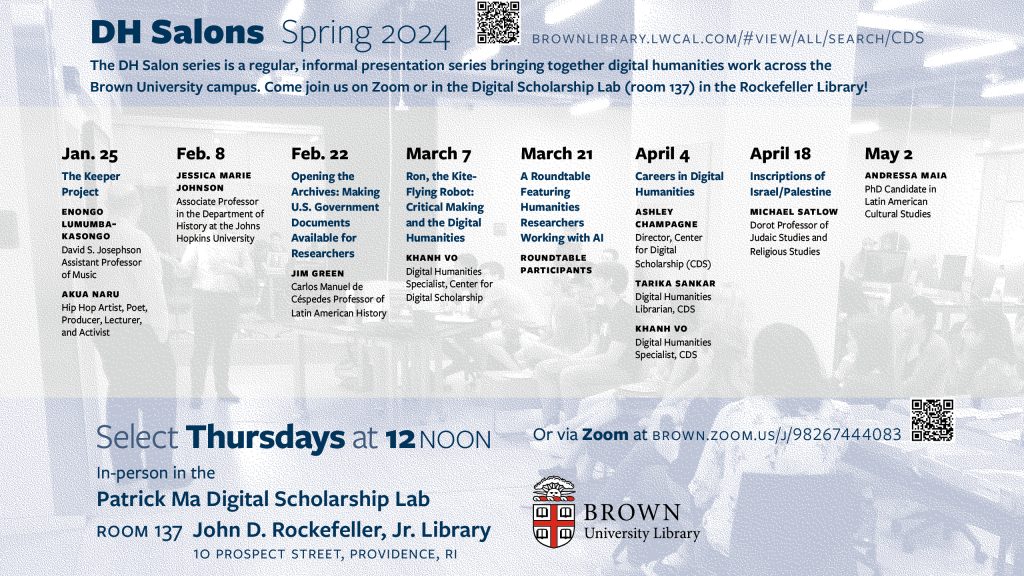
The DH Salon series is a regular, informal presentation series bringing together digital humanities work across the Brown University campus.
Spring 2024 Schedule
Select Tuesdays at noon on Zoom or in the Digital Scholarship Lab (room 137) at the Rockefeller Library. Lunch and refreshments are provided.
January 25 – Register here
“The Keeper Project” with Enongo Lumumba-Kasongo and akua naru
Artists Akua Naru and Dr. Enongo Lumumba-Kasongo will discuss the Keeper Project, the first online platform dedicated to bringing the 50-year history of women and girls in hip-hop to artists, scholars, and the public at large. The project highlights the significant contributions women and girls have made in hip hop music and culture by documenting thousands of artists, scholars, and influencers as well the albums, songs, texts, and other cultural contributions that they have produced, each catalogued by year. This resource will offer the public an educational and data-driven resource to celebrate the centrality of women and girls in the genre.
February 8 – Register here
“Surfacing LifexCode: Doing DH Against Enclosure” with Jessica Marie Johnson
This talk focuses on a collective of DH labs, projects, and initiatives that defy the enclosure of the university, the city, even the nation, that transgress imperial knowledge formations and roots itself in relationality, generosity, empathy, and an ethics of care.
February 22 – Register here
“Opening the Archives: Making U.S. government documents available for researchers” with Jim Green, Carlos Manuel de Cespedes Professor of Modern Latin American History, Professor of Portuguese and Brazilian Studies
The Opening the Archives Project, sponsored by the Brown University Libraries, has digitized, indexed, and made available 70,000 U.S. government documents about Brazil during the military dictatorship (1964-85) on an open-access website.
March 7 – Register here
“Ron, the Kite-Flying Robot: Critical Making and the Digital Humanities” with Khanh Vo, Digital Humanities Specialist
“Critical thinking” (an abstract and cognitive practice) with “making” (a tactile and hands-on practice) creates a method that allows us to do much more than generate answers to problems. Critical making allows us to ask new research questions, particularly when we work to move ideas from the material world to the digital world and vice versa. This session will explore themes of work and process, translation and interpretation, and success and failure in DH and in working with digital tools through the process of critical making.
March 21 – Register here
“AI Roundtable!”
A roundtable featuring humanities researchers working with AI:
- Amanda Anderson, Andrew W. Mellon Professor of Humanities and English, Professor of English and Humanities, Director of Humanities
- John Cayley, Professor of Literary Arts
- Kim Gallon, Associate Professor of Africana Studies
April 4 – Register here
“Careers in DH” with:
- Ashley Champagne, Director of the Center for Digital Scholarship
- Tarika Sankar, Digital Humanities Librarian
- Khanh Vo, Digital Humanities Specialist
April 18 – Register here
“Inscriptions of Israel/Palestine” with Michael Satlow, Dorot Professor of Judaic Studies and Religious Studies
The Inscriptions of Israel/Palestine Project (inscriptionsisraelpalestine.org) is digitizing, analyzing, and creating educational resources for a large corpus of ancient inscriptions in Hebrew, Greek, Aramaic, and Latin. It has been active at Brown for over two decades. The founder and project director will discuss the project, its history, and its future goals.
May 2 – CANCELED
“Digital Journalism, Futurity, and Hope: Latin American Perspectives on Anthropogenic Environmental Catastrophes” with Andressa Maia
-
Library Sound Levels
|
In response to patron feedback about concerning levels of noise and conversation in Library spaces, the Library is instituting a new sound level system. We ask that all visitors to the Library follow these guidelines to ensure a welcoming and inclusive experience for all members of our community.
See below for sound level descriptions and locations, followed by information about decibel levels and the Brown Code of Conduct and ways to report concerning behavior.
Sound Levels
Absolute Quiet: 0 – 25 decibels

This space is intended for those who need complete quiet for deep, focused work or restorative rest. There should be no conversation with as little noise generated by belongings/devices (on silent) as possible. Covered beverages are allowed*; no food please.
Locations
- Rockefeller Library
- Absolute Quiet Rooms on Level A
- John Hay Library
- Willis Reading Room, 1st floor
- *Gildor Family Special Collections Reading Room (NO FOOD OR BEVERAGES), 1st floor
- Sciences Library
- Absolute Quiet Room on Level 4
- Rooms A04, A6, A8, A9 on Level A
Considerate: 26 – 40 decibels

This is a quiet space best suited for individual or small group study. Hushed, brief conversation is OK. Silence phones, tablets, laptops, noisy headphones, etc. Covered drinks and quick snacks are allowed.*
Locations
- Rockefeller Library
- Sorensen Family Reading Room on Level 1
- Finn Reading Room on Level 1
- Sidney E. Frank Digital Studio on Level 1
- Racial Justice Resource Center on Level 2
- Gardner Room (East Asian Collections) on Level 3
- Study tables on Level 4
- Stacks
- Stairwells and hallways
- John Hay Library
- *Harriette Hemmasi Exhibition Gallery (NO FOOD OR BEVERAGES), 1st floor
- Rooms 303 and 321, 3rd floor
- Stairwells and hallways
- Sciences Library
- Rooms A01, A01A, A01B, A18, A21, A24 on Level A
- Mezzanine Level
- Stacks
- Stairwells and hallways
- Orwig Music Library
- Reading rooms
- Stacks
- Stairwells and hallways
Conversational: 41 – 60 decibels

This space is intended for teaching, group work, and Library events. Please maintain conversation at a moderate noise level, similar to a coffee shop. Enjoy covered drinks and quick snacks. Please visit the lobby for meals and noisy or fragrant snacks. Events and classes may include catering only with pre-authorization by Library administration and a Facilities Management custodial clean. Email library@brown.edu for more information about hosting events at the Library.
Locations
- Rockefeller Library
- Circulation area
- Lobby and café area
- Closed group study spaces
- Classrooms (as directed by instructor)
- Spaces hosting events or while the building is closed
- John Hay Library
- Research Services area
- Student lounge
- Sciences Library
- Lobby
- Circulation area on Level A
- Rooms A17, A17A, A22, A23, A25, A26, A27, A28, A29 (reservable study rooms) on Level A
- Map Collection area on Level 11
- Rooms 1218, 1220, 1221 on Level 12
Decibel Levels
You may have seen decibel level guides displayed in Friedman Study Center at the Sciences Library, which are meant to denote the level of acceptable noise in each zone, moving from conversational around the reader services desk, to absolute quiet in the back of the room.
Examples of sounds with corresponding decibel levels:
- 20 rustling leaves
- 30 whispering
- 40 quiet office, hum of a computer, light rain
- 50 light traffic, a quiet office
- 60 hum of an air conditioner or refrigerator, normal conversation, moderate rain
- 70 a noisy restaurant (too loud for any library space)
- 80 alarm clock (beginning of hearing damage range)
Code of Conduct and Reporting Concerns
If you have concerns about behavior in violation of the Student Code of Conduct, please email student-conduct@brown.edu. Violations of the University Code of Conduct can be reported through the Anonymous Reporting Hotline by phone at 877-318-9184 or online.
For safety concerns, contact DPS immediately at 4111 (campus phone) or 401-863-4111 or 911. Calls to 911 will be directed to the DPS call center.
- Rockefeller Library