
E-Newsletter
Recent Posts
Latest News
-
Exhibit l Ordinary Circumstances, Extraordinary Conflict
|

John Hay Library Exhibit Reflects on Two Centuries of Debate over Abortion
Created in response to the Dobbs decision, Ordinary Circumstances, Extraordinary Conflict draws on Brown’s special collections to present open-ended observations on the commonality, history, and debate surrounding abortion in the United States and Rhode Island.
Whether in a court of law, at a protest, or over the kitchen table, abortion rivals any other subject for its capacity to elicit intense emotions and fervent arguments on both sides of the issue. Contemporary society’s shorthand terms for each side — “pro-life” and “pro-choice” — are themselves loaded with the political and moral beliefs that have fueled two centuries of debate over a procedure that dates back millennia.
Ordinary Circumstances, Extraordinary Conflict
In the John Hay Library’s exhibit, Ordinary Circumstances, Extraordinary Conflict, a curatorial team consisting of Brown faculty, graduate students, and medical practitioners of different genders, backgrounds, religions, and ages, as well as different ideological beliefs on abortion, offer original scholarly commentary on artifacts drawn from the Hay Library’s outstanding trove of special collections. With particularly strong holdings in the history of medicine, feminism, political extremism, and collections specific to Rhode Island, the Hay Library is well suited to produce an exhibit on the topic of abortion. According to Amanda E. Strauss, Associate University Librarian and Director of the John Hay Library:
Our strong history of medicine collections and our collecting focus on the interplay between ideology and social and political power provide unique insight into this universal topic. Exhibitions like this are one of the ways in which the Hay Library’s extraordinary collections can be drawn upon to contextualize and deepen understanding of history and current events as well as to put forth new knowledge that we hope will lead to further scholarship.
On June 24, 2022, the Supreme Court ruled in Dobbs v. Jackson Women’s Health Organization to overturn nearly five decades of the constitutional right to obtain an abortion, previously protected by law through the 1973 court decision Roe v. Wade. A vast number of people have been deeply impacted by the decision and its subsequent, ongoing outcomes. Many Brown students and faculty members immersed themselves in thought, conversation, and research about reproductive rights and the widespread role abortion has played in the human experience, including academic exploration of the topic in the Hay Library’s special collections. In response to this interest, the curatorial staff altered its exhibition schedule to make room for an installation in the main gallery that would provide space for scholarly considerations of abortion’s history, controversy, and, in particular, its role in the lives of countless ordinary people, especially women.
Exhibit Artifacts
Exhibit viewers will see artifacts like a set of wrought iron forceps made in Rhode Island in the early 1800s when cesarean section was generally too risky to consider; photographs of pro-life and pro-choice protestors at public rallies; documents from organizations like “Guidelines for Picketing” by Citizens Concerned For Human Life and a Planned Parenthood flier entitled, “A Closer Look at the Violent Opposition”; poetry, editorial letters, and newspaper articles; the 1868 influential publication, Criminal Abortion; Its Nature, Its Evidence, and Its Law by Dr. Horatio R. Storer; and the 1970s booklet Women vs. Rhode Island: Repeal Abortion Laws from the Rhode Island Coalition to Repeal Abortion Laws, a Brown University feminist group.
All of the objects on display are part of the historical record from two centuries of the lived experiences of both prominent and ordinary people in the U.S. and Rhode Island, who were associated with abortion in myriad ways, and who held differing beliefs. While the curatorial team’s focus has been to objectively present the issue of abortion legalization, they acknowledge that with a subject that impacts the lives of so many, complete objectivity is a difficult task. By foregrounding the long and often unacknowledged history of abortion that led up to the Dobbs ruling and the diverse, powerful emotions that fueled this history, the team’s intention with Ordinary Circumstances, Extraordinary Conflict is to provoke thought, discussion, and inquiry rather than present definitive truths.
Content Warning and Support
Please note: This exhibit includes information and images related to birthing and abortion.
For Brown University Students who need support, please contact Counseling & Psychological Services (CAPS) at 401-863-3476; help is available 24/7 and 365 days/year.
Exhibit Dates
Ordinary Circumstances, Extraordinary Conflict will run in the John Hay Library’s main exhibition gallery from May 11 to August 16, 2023.
Accessing the Exhibit
Building hours and more information about Brown University Special Collections can be found on the John Hay Library’s website.
Related Events
Exhibit Opening Reception
Date and Time: Thursday, May 11, 2023 from 4 – 5:30 p.m.
Location: John Hay LibraryCommencement Forum: “Ordinary Circumstances, Extraordinary Conflict” Exhibition Panel Discussion
Date & Time: Saturday, May 27, 12:30 – 1:30 p.m.
Location: John Hay Library, Willis Reading Room -
Exhibit l Contextualizing Taíno Collections
|

Left: Carved stone amulet in a human-like form, ca. 1200–1500 CE (Haffenreffer Museum of Anthropology 2012-31-1). Right: Cover of Directorio comercial, industrial y turístico, ca. 1970 (John Hay Library HF3336 .D57). In this exhibit, student curators share their work to put a new donation of ancient Caribbean artifacts into cultural, historical, political, and contemporary contexts. First peoples of many Caribbean islands developed shared beliefs and practices, which today we call Taíno culture. People practicing this culture were historically erased from Caribbean stories. To make sense of Taíno artifacts recently donated to the Haffenreffer Museum, the exhibit focuses on them instead. The exhibit shares collections from the Haffenreffer Museum of Anthropology and John Hay Library.
Opening reception: Thursday, May 4th, 6 – 7:30 PM
Speaker: Amanda Guzman, P.h.D., Assistant Professor of Anthropology, Trinity CollegeDates: May 4, 2023 – May 3, 2024
Time: John Hay Library Hours
Location: Willis Reading Room, John Hay Library, 20 Prospect Street, Providence -
Contextualizing Taíno Collections | Opening of Student-Curated Exhibition
|
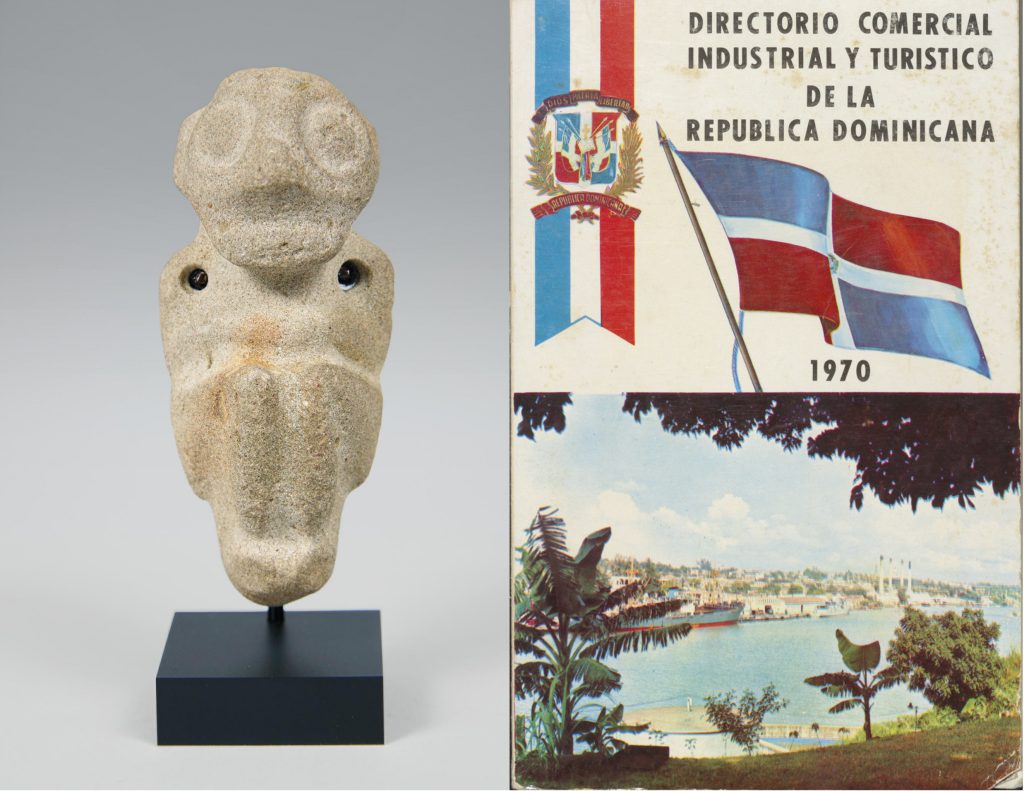
Left: Carved stone amulet in a human-like form, ca. 1200–1500 CE (Haffenreffer Museum of Anthropology 2012-31-1). Right: Cover of Directorio comercial, industrial y turístico, ca. 1970 (John Hay Library HF3336 .D57). Join the John Hay Library and Haffenreffer Museum of Anthropology for the opening of the student-curated exhibit, Contextualizing Taíno Collections, on Thursday, May 4 from 6 – 7:30 p.m. in the Willis Reading Room of the John Hay Library.
Free and open to the public. Light refreshments will be served after the speaking program.
The event will feature a keynote presentation by Amanda Guzmán, Assistant Professor of Anthropology at Trinity College.
Amanda Guzmán
Amanda Guzmán is an anthropological archaeologist with a Ph.D. in Anthropology from the University of California, Berkeley. She specializes in the field of museum anthropology with a focus on the history of collecting and exhibiting Puerto Rico at the intersection of issues of intercultural representation and national identity formation. In the context of Puerto Rico’s current environmental and economic uncertainty, her research traces understudied museum acquisition narratives documenting the island’s historical material relations of belonging and exclusion with the U.S. mainland.
Amanda has a demonstrated background handling and interpreting object and archival material in diverse collection-holding cultural institutions. She applies her collections experience as well as her commitment to working with and for multiple publics to her object-based inquiry teaching practice that privileges a more equitable, co-production of knowledge in the classroom through accessible engagement in cultural work. She serves on the Board of Directors for the Pre-Columbian Society of New York, as an Innovative Cultural Advocacy Fellowship Mentor for the Caribbean Cultural Center African Diaspora Institute, and a Bronx Council on the Arts grant panelist.
Contextualizing Taíno Collections Exhibit
In this exhibit, student curators share their work to put a new donation of ancient Caribbean artifacts into cultural, historical, political, and contemporary contexts. First peoples of many Caribbean islands developed shared beliefs and practices, which today we call Taíno culture. People practicing this culture were historically erased from Caribbean stories. To make sense of Taíno artifacts recently donated to Brown University, the exhibit focuses on them instead. The exhibit shares collections from the Haffenreffer Museum of Anthropology and John Hay Library.
The exhibit is installed in the Willis Reading Room at the John Hay Library and will run from May 4, 2023 – May 26, 2024.