E-Newsletter
Recent Posts
Latest News
-
Reserve Library Lockers and Carrels Online
|
Your Brown University Library now offers an online option for reserving lockers and carrels at the Rockefeller Library.
How do I reserve lockers and carrels online?
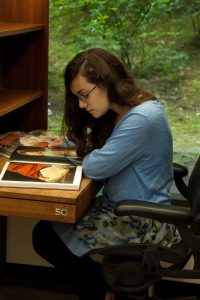
Student working at a carrel in the Rock Find all of the Rockefeller Library’s lockers and carrels in BruKnow, the online library catalog. They are organized by floor and location, making it easy to browse and find a space that works for you.
View available lockers and carrels, or search the terms “library locker” or “library carrel” in BruKnow.
Faculty, graduate students, and medical students: Select a record from the search results. Once you are in the record, click “request item” to place your request. A library staff member will then reach out via email to confirm your locker or carrel reservation.
Undergraduate thesis writers must visit the service desk at the Rock for a carrel application. The completed application must be signed by your thesis advisor and returned to the Rock service desk.
Who can reserve lockers and carrels?
Lockers: Faculty, graduate students, and medical students, and undergraduate students working on a senior thesis and may reserve lockers. You must have a carrel to reserve a locker.
Carrels: Brown graduate students and faculty members, and undergraduate students writing a senior thesis are eligible to receive a carrel.
What are library lockers and carrels?
Lockers are reservable spaces where you can securely store items that you don’t want to leave at your carrel.
Carrels are reservable study spaces that include a desk, shelving for library books, and power outlets.
Where are library lockers and carrels?
Rockefeller Library
There are lockers and carrels at the Rock.
Lockers are located on every level except for the main level. Graduate students also have access to lockers in the Wernig Graduate Student Reading Room.
Carrels are located on the perimeter of the stacks on every level except for the main level.
Orwig Music Library
Orwig Music Library also has carrels available for reservation. They are located in the Upper Reading Room and the Lower Reading Room. Orwig’s carrels can be reserved by Brown faculty members, graduate students writing a dissertation or thesis, and undergraduate students writing a thesis.
All applicants must visit the Orwig circulation desk to inquire about a carrel. Orwig’s carrels are not in BruKnow.
More Information
To learn more about library spaces and guidelines, visit Reserve Rooms, Lockers & Carrels. If you have any questions, please contact the Library at rock@brown.edu.
-
Virgil Ortiz: Pueblo Revolt 1680/2180
|
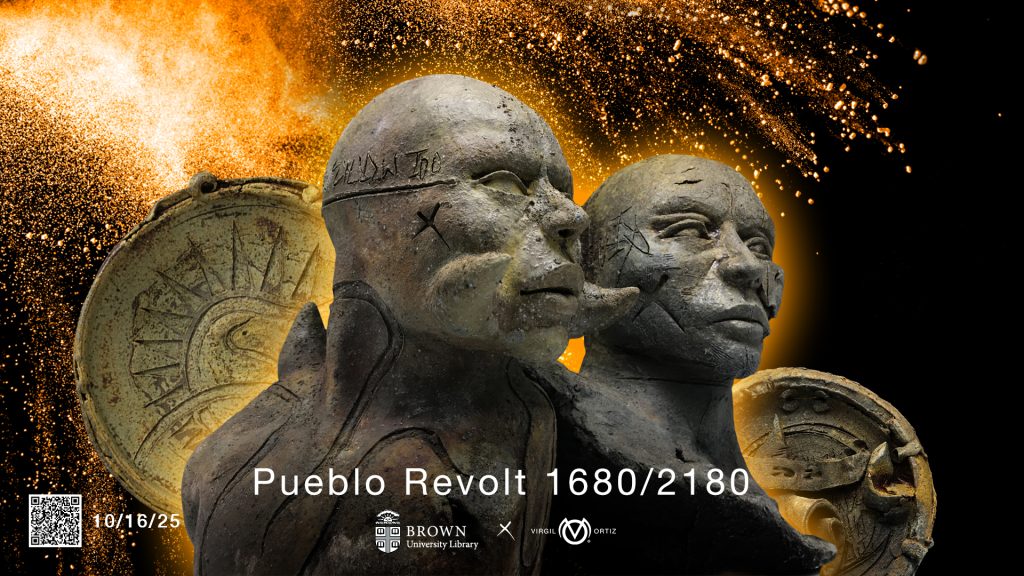
Join the Brown University Library, the Haffenreffer Museum of Anthropology, and the RISD Ceramics Department for an artist’s talk with Virgil Ortiz, the award-winning Pueblo artist whose work combines innovative pottery, art, décor, fashion, video, and film, on Thursday, October 16 at 6 p.m. at the John Hay Library (321).
Free and open to the public. In-person event.
Virgil Ortiz
Virgil Ortiz (born 1969) is a Pueblo artist, known for his pottery and fashion design from Cochiti Pueblo, New Mexico. Although Ortiz has projects in varying mediums, Ortiz is first and foremost a potter. Ortiz says, “Clay is the core of all my creations. My work centers on preserving traditional Cochiti culture and art forms. It’s important to recognize that Pueblo communities are very much alive and have a level of vitality that speaks to generations of strength, persistence, brilliance, and thriving energy.” Ortiz makes a variety of pottery, including traditional Cochiti figurative pottery, experimental figurative pottery, traditional pottery vessels.
Pueblo Revolt 1680/2180
In this artist’s talk, Ortiz keeps Cochiti pottery traditions alive but transforms them into a contemporary vision that embraces his Pueblo history and culture and merges it with apocalyptic themes, science fiction, and his own storytelling. Historic events like the 1680 Pueblo Revolt may not immediately spring to mind when you think of science fiction, but blending the two have occupied Ortiz for nearly two decades. The storyline transports the viewer back more than three hundred years to the historical events of the 1680 Pueblo Revolt and then hurtles forward through time to the year of 2180, introducing a cast of characters along the way. As Ortiz’s saga unfolds, history mingles with the future in a bold new chapter of resistance and revolution in his art and installations. Inspired by the 1680 Pueblo Revolt, the most successful uprising in history, Ortiz reimagines the rebellion through a futuristic lens where tradition and innovation collide.
Clay Revolution at RISD
This talk is the second of two joint events organized with RISD’s Ceramics Department. The first event, Clay Revolution, is a public lecture the day prior (Oct. 15) at RISD Museum, 2 to 3 p.m.
-
Jennifer Betts Appointed Director of the John Hay Library and University Archivist
|
The University Library is pleased to announce that Jennifer Betts has been appointed Director of the John Hay Library and University Archivist. In this senior leadership role at the University Library, she will oversee all staff, programs, and services at the John Hay Library and serve as the chief steward of the University’s priceless assemblage of rare books, manuscripts, archives, printed matter, and other rare and unique materials.
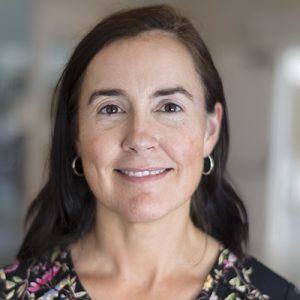
Jennifer Betts Jennifer has led or anchored a wide range of transformative initiatives that have elevated the visibility and impact of the John Hay Library as a leading center for special collections research and instruction. These include a strategy to identify and build upon the Hay’s distinctive collection strengths, major renovations to improve the quality and academic utility of the Hay building’s spaces, the groundbreaking exhibit “Mumia Abu-Jamal: A Portrait of Mass Incarceration,” and external funding totaling nearly $2 million from the National Historical Publications and Records Commission, the Arcadia Fund, the Council on Library and Information Resources, and the National Endowment for the Humanities to increase digital access to Hay materials.
Jennifer is well known to many on campus. As University Archivist, Jennifer has spearheaded the acquisition of the papers of noted faculty and historically significant campus units such as Rites and Reason Theatre, LGBTQ Center, Brown Students of Color, U-FLi Center, and the John Nicholas Brown Center for Public Humanities and Cultural Heritage. She has also provided extensive support for the Corporation office, the President’s Office, the Office of the General Counsel, and University Advancement, and collaborative partnership on a wide range of campus projects.
Jennifer holds undergraduate and MLS degrees from the University at Albany. She first came to Brown in 2003 for an internship as part of her degree program. In 2008, she was selected as the project director for the two-year National Endowment for the Humanities grant that established Rhode Island Archival and Manuscript Collections Online (RIAMCO), a statewide database of archival collections. In 2010, she was appointed University Archivist. The growth of her leadership at the Hay was recognized by promotion to Assistant Director in 2016 and Associate Director in 2024. As Director, Jennifer will lead the John Hay Library forward to be an ever more vital part of Brown’s academic mission and distinction as a research university.