
E-Newsletter
Recent Posts
Latest News
-
DH Salons – Spring 2023
|

The DH Salon series is a regular, informal presentation series bringing together digital humanities work across the Brown University campus.
Spring 2023 Schedule
Select Tuesdays at 3 p.m. on Zoom or in the Digital Scholarship Lab at the Rockefeller Library.
February 14 – Register here
“Using Scalar to Illuminate the Fragments Controversy”
- Jonathan Fine, Lecturer in German Studies
The Fragments Controversy was the most significant theological conflagration of the German Enlightenment. This Scalar project is the first introduction to the controversy that pairs commentary with digital copies of the main texts. It features texts digitalized previously by European libraries as well as digitalizations especially commissioned for this project. It takes advantage of numerous features available to users of Scalar to display the many intertextual networks in operation. It additionally includes visualizations such as timelines and maps that show the longevity and wide dissemination of Lessing’s polemics.
Jonathan Fine is a lecturer in the German Studies Department at Brown. He studied German, comparative literature, and critical theory at New York University and the University of California, Irvine. He previously taught at Gettysburg College and Pacific Lutheran University and held a postdoctoral fellowship at the Freie Universität Berlin.
February 28 – Register here
“Digital Herbarium Project (HerbUX)”
- Patrick Rashleigh, Head of Digital Scholarship Technology Services
- Rebecca Kartzinel, Lecturer in Biology, Interim Director of the Plant Environmental Center, Director of the Brown University Herbarium
The Herbarium User Experience (HerbUX) project is designing an interface to critical digitized herbarium collections with non-expert audiences (such as students, museum visitors, and the general public) in mind, for use in classrooms, museums, and other public spaces. This interface will be easy to use, encourage non-directed exploratory browsing, directly support pedagogical methodologies and learning outcomes, and be aesthetically engaging.
March 14 – Register here
“Unsettling Boundaries: Envisioning a Database for Caribbean Feminist Creative Writing from the 1990s”
- Warren Harding, Diversity in Digital Publishing Postdoctoral Research Associate (2022–2023)
In this discussion, Warren Harding will share insights and progress on creating a digital database of Caribbean feminist creative writing from the 1990s. He will reflect on the central questions, structure, scope, and challenges to coordinating this collaborative project.
Warren Harding (he, him) is currently the Diversity in Digital Publishing Postdoctoral Research Associate at Brown University Digital Publications. He holds a Ph.D. in Africana Studies from Brown, and is working on his manuscript tentatively titled, “Migratorial Reading: Black Caribbean Women Writers and the Work of Literary Cultures.” In Fall 2023, Dr. Harding will begin his appointment as an Assistant Professor in the Department of English, General Literature, and Rhetoric at Binghamton University.
March 21 – Register here
“Interpretive Frameworks and Visualizations of Historical Vietnamese Texts and Drawings”
- Cindy Nguyen, David Laidlaw, and Kailiang Fu
How do digital humanities and computational methods open up alternative interpretive frameworks for historical texts? This will be a conversation sharing how collaborative humanities visualization contributes towards critical and transparent research analysis and communication. As a case study, Nguyen, Fu, and Laidlaw examine a 1909-1910 multilingual visual encyclopedia of Vietnamese crafts, cultural practices, and technologies using a hybrid methodology of close reading, content analysis, and vector space models. As a focused case study, we conducted a layered analysis of visual-textual representations of gender and labor, with a focus on childbirth and female childcare. This project envisions decolonial interpretive frameworks that center historically marginalized agency, invisible authorship, and non-linear narrative forms.
Cindy Nguyen is a Chancellor’s Postdoctoral Fellow at the University of California, San Diego in the departments of Literature and History. She specializes in the history of Southeast Asian print culture, digital humanities, and libraries. She was a Brown University Cogut International Humanities Fellow from 2019 – 2021. To learn more about her historical scholarship, teaching, and digital humanities work, see her website cindyanguyen.com.
David H. Laidlaw is a professor of computer science at Brown University. His research interests revolve around visualization and modeling applications of computer graphics and computer science to other scientific disciplines. He is working with researchers in, for example, archaeology, developmental neurobiology, evolutionary biology, medical imaging, neuropathology, orthopedics, art, cognitive science, remote sensing, and fluid mechanics to develop new computational applications and to understand their strengths and weaknesses.
Kailiang (Kail) Fu is a senior at Brown studying Applied Math – CS and History. He is interested in Asian culture, data visualization, and virtual reality.
April 18 – Register here
“New Frameworks to Preserve and Present on Born-Digital Multimedia Art”
- Ashley Champagne, Director of CDS
- Patrick Rashleigh, Head of Digital Scholarship Technology Services
- Cody Carvel, Digital Scholarship Technologist
- John Cayley, Professor of Literary Arts
- Hilary Wang, Digital Archivist
- Andrew Majcher, Head of Digital Services and Records Management
This project is developing new frameworks for the long-term preservation and presentation of born-digital art with funding from the National Endowment for the Arts. Preserving born-digital work can be challenging because platforms, hardware, and software are often updated or replaced, changing and even degrading how the original art is displayed. Through “containerization” — a portable, low-cost method of preserving and presenting the code, operating system, and text for experimental, born-digital art — future readers will still be able to view, distribute, collaborate on, and experiment with the original work even if its infrastructure has been altered or discontinued. In this presentation, we’ll share a project update on the models we’re drafting to preserve innovative, experimental born-digital and born-computational art.
April 25 – RESCHEDULED – Register here
“Building GeoPACHA, A Collaborative Digital Platform for “Virtual” Survey in Archaeology”
- Parker VanValkenburgh, Associate Professor of Anthropology
The Geospatial Platform for Andean Culture, History and Archaeology (GeoPACHA) — see geopacha.org — is a tool developed in collaboration with Dr. Steven Wernke of Vanderbilt, designed to facilitate the identification of archaeological sites and features over extensive areas of South America through “virtual survey” of satellite and historical aerial imagery. In this presentation, I will briefly discuss the project’s problem orientation and design, before moving on to reflect on how its implementation during the global pandemic created both new challenges and opportunities for collaborative research and pedagogy. While virtual archaeological survey is no replacement for conventional field-based methodologies, it offers new possibilities for collecting data at scale, while also scaling up international collaboration and student learning in ways that are nearly impossible to emulate in the excavation trench and the laboratory.
Parker VanValkenburg is an Associate Professor of Anthropology at Brown. His research and publications employ archaeological methods to address anthropological research questions, with a particular focus on the long-term impacts of colonialism and imperialism on Indigenous people and environments in Andean Peru. In this work, he draws amply on digital methodologies, including the tools of geographic information systems (GIS), to map and analyze social, political, and environmental change in space and time. He also applies a critical lens to the study of digital media and methodologies, asking not just how these techniques facilitate archaeological scholarship, but how digital mediation transforms the ways we work with collaborators, research subjects, students, and public audiences.
May 9 – Register here
Roundtable: “Artificial Intelligence in Humanities Research”
- Lindsey Caplan, Assistant Professor of History of Art and Architecture
- Holly Case, Professor of History
- Kiri Miller, Professor of American Studies
- Sydney Skybetter, Senior Lecturer in Theater and Performance Studies
New AI tools hold out the promise of new techniques for research, writing and presentations in the humanities, as well as new challenges to originality and ethics. A group of Brown faculty will consider some of the history and future of AI in the humanities.
-
Fall 2022 Library Operations
|
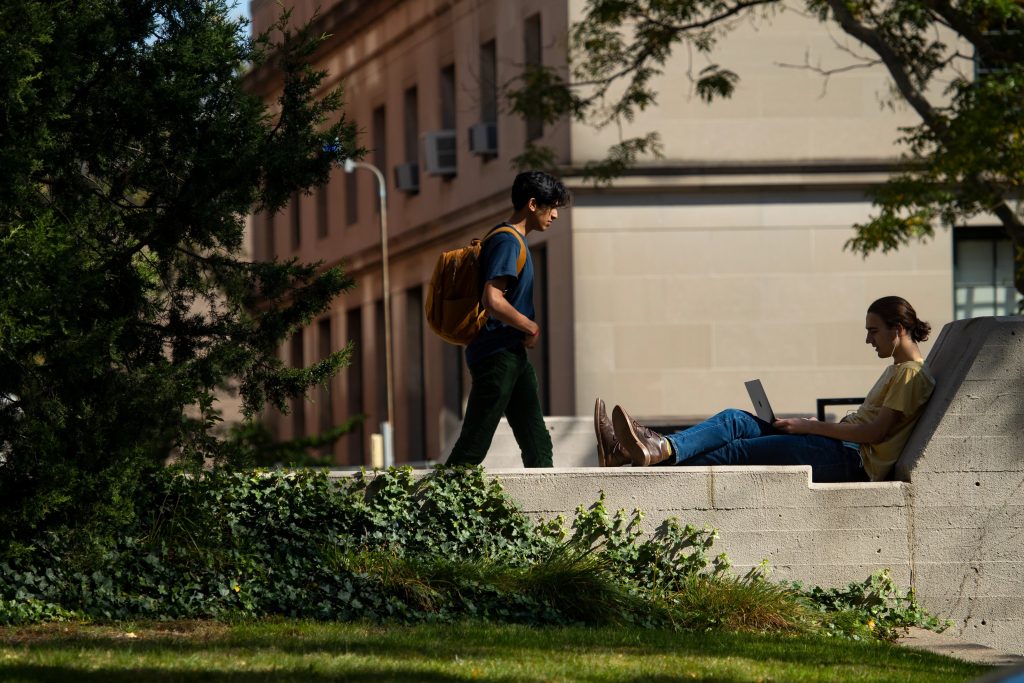
Welcome back to your Brown University Library!
Health and Safety
Operations are founded on the most up-to-date, reliable safety protocols to ensure a healthy environment for our patrons and staff. Please follow all Healthy Brown steps to keep yourself and our community well. If you aren’t feeling well, please make use of the Library’s robust slate of digital resources.
Masking is optional in all University spaces, including the Library. For information on when masking may be required, see “Approach to Academic Instruction for Fall 2022,” a message to the Brown community from Provost Richard M. Locke.
Locations, Hours, and Access
Visit Library Hours for the full, updated list of locations and hours.
Please note that reservations are required for the Gildor Family Special Collections Reading Room at the John Hay Library. Email hay@brown.edu to make a reservation. You must also request materials through Aeon one week (5 full business days) in advance of your reservation. The Hay’s visiting webpage has more information. A Carnegie Library, the Hay is open to the public Monday through Friday.
Alumni and Other Visitors
Visitors must abide by the policies on the Healthy Brown website.
Obtaining a Library Card
Visitors who anticipate using the Rockefeller, Sciences, or Orwig Libraries on an ongoing basis must obtain a Brown University Library card. Cards will be issued upon receipt and approval of a completed Brown University Library Visitors request form. The Library must approve requests for visitors, excluding those with IDs sponsored by a department or program at Brown, Brown alumni, and visitors attending a Library public event. More information.
Library Support
In-person
Patrons can schedule in-person (and online) consultation appointments with a Library expert by contacting the relevant library expert directly. Not sure who to contact? Email rock@brown.edu for general inquiries and hay@brown.edu for Special Collections inquiries.
Online
Please continue to request materials online through BruKnow. Requested materials will be held at the service desks. Patrons will be notified when the item is available and where it should be picked up. The Library is providing document delivery through the ILLiad system.
Graduate and Medical Student Carrels
Study carrels are available to graduate and medical students. Interested persons should inquire at the Rockefeller Library service desk.
Graduate Teaching Assistant Rooms
Graduate TAs may also access a limited number of small study/collaboration rooms to conduct online sections. Registration is required through 25Live.
Library Tutorials
Guides and videos with information about how to use the Library, conduct various aspects of research, and more are available online.
Feedback
Your Brown University Library is committed to providing all patrons with the best possible academic library experience. Throughout your engagement with Library collections, physical spaces, patron services, instruction, and web-based tools and content, you should be welcomed, valued, and respected, and be provided with equal opportunities to pursue scholarship in a spirit of free and open inquiry.
We encourage your feedback about any aspect of Library services, resources, and facilities. Feedback can be made through this anonymous form, which has an option for inputting your contact information, or you can email WelcomeToYourLibrary@brown.edu.
This Is Your Library
You belong here.
-
Library Services During Winter Break 2022 – 2023
|

Extended Winter Break
Brown University administration has generously planned an extended Winter Break from the close of business on Thursday, December 22, 2022 through Sunday, January 8, 2023. In order to maintain support of students, faculty, and researchers during this time, while giving dedicated library staff members well-deserved time off, the University Library will be offering limited building hours and services. Please take note of the time-sensitive services listed below so that you can plan ahead and obtain the materials you will need in advance of the break.
Please consult Library Hours for up-to-date hours for each location.
Place orders for Annex, Borrow Direct, and Holds by Dec. 20
Please place orders for materials from the Library Annex and through Borrow Direct by 5 p.m. on Tuesday, December 20 for pickup on Thursday, December 22. We will be unable to place items on hold during the break. Note that delivery of Borrow Direct materials may vary depending on the operations of our partner libraries.
Which locations will be open? Who can use the buildings?
The Rockefeller Library will be open (without services) from 9 a.m. to 5 p.m. daily (see exceptions below) with swipe card access for current Brown ID holders only. Visitors without a current Brown ID will not be able to access the buildings. Please see the Library Hours and Locations page for details.
The John Hay Library, Sciences Library, and Orwig Music Library will be closed during the break.
Will you close completely for some days?
All University Library locations will be closed with no on-site or online services on Friday, December 23, Christmas Eve (Saturday, December 24), Christmas Day (Sunday, December 25), and New Year’s Day (Sunday, January 1).
Self-checkout
Self-checkout of circulating materials will be available at the Rockefeller Library and Sciences Library during break and continuing with regular operations.
How can I get help from a library expert?
Limited support for the Brown community and researchers working on time-sensitive projects will be available on the days when we are not fully closed via email at rock@brown.edu. Please allow 12 – 24 hours for a response.
Will Interlibrary Loan be available?
You may continue to place orders through Interlibrary Loan for electronic journal articles. Note that delivery dates and times will vary depending on the operations of our partner libraries.
Can I view special collections material?
Requests for special collections material can be made at any time through Aeon. John Hay Library staff will respond to requests that come in over break beginning the week of January 9. Thousands of items have been digitized and are available for view at any time through the Brown Digital Repository.
Who will be on-site when the buildings are open?
The Library will have security guards in the buildings when they are open by card swipe access. Please note that security guards are not Library employees. They are not able to answer research questions and cannot retrieve library materials.
Happy Holidays!
Best wishes for a happy, healthy, and restful winter break from your Brown University Library!