

By Michael Acevedo
Paintings of Latin America during the Age of Revolution frequently promote the idea of racial harmony and equality among the Creoles, Mulattoes, and Free Blacks. In his painting, Bolívar and Sucre at Junin, Polish painter Arthur Syzk reinforces this myth of racial equality, fraternity, and harmony by depicting pardos (mulattos and free blacks), mestizos, and creoles fighting in a unified front against Spanish forces for the common cause of independence.[1] However, Syzk’s portrayal romanticizes the role of the creole liberators while largely ignoring or belittling the contributions of nonwhite patriots, who constituted an estimated 90 percent of the population and formed the core of Bolívar’s forces. The narrative depicted in Syzk’s illustration was disseminated by the creole elites that held control over the government, press, and institutions of education in order to help legitimize creole claims to power, wealth, and social status while disadvantaging the pardos.
- The creole liberators who consume most of the space on the canvas are fighting more vehemently and with better equipment than their pardo counterparts, and are thus portrayed as making the more substantial sacrifice for independence.
- The creoles wear ornate army uniforms while the mestizos appear in white linen shirts, bandanas, and hats. The single pardo depicted in the bottom right hand corner of the canvas may be well dressed, but unlike his creole companions he is not fearlessly attacking but rather appears concerned and withdrawn.
- Among all the soldiers—Spanish and American; nonwhite as well as white—Simón Bolívar appears the most regal. He sports an embroidered chest piece elegant enough for a ball. Moreover, Bolivar valiantly rides into battle on a militant, bucking white horse. The whiteness of the horse conveys a notion of benevolence and purity, setting Bolívar apart as a leader. After all—as art historian James Warren comments— “the white horse is the horse of heroes, history, art, and fiction.”[2]
- Bolívar and Sucre at Junin also visually reaffirms the racial hierarchy of Latin American society in which the free blacks and mulattos are at the bottom, mestizos in the middle, and creoles at the top. The pardo solider is at the bottom far right edge on the periphery of the canvas and is the furthest from Bolivar; the mestizos are below Bolivar and the other creole leaders who stand prominently in the center of the frame. Szyk ensures that the center of focus is the creole officers, not the troops of color.
Race and the idea of racial equality have long affected events in Latin America. The promise of racial equality started with the independence movement. However this promise remains unfilled; racism in Latin American still persists and is largely ignored due the powerful illusion of equality crafted long ago. It is important to study the independence movement, its imagery, and its promises of racial equality not only to understand Latin America’s unwillingness to discuss race (Cuba’s census has no data by race and in Brazil census “respondents used 100 different words to describe their race”) but also in order to finally address the problem of racial inequality and injustice in Latin America.[3]
[1] Marixa Lasso, Myths of Harmony: Race and Republicanism during the Age of Revolution, Columbia, 1795-1831, 1st ed. (University of Pittsburgh Press, 2007), 2.
[2] James Warren Evans,The Horses. (Macmillan, 1990), 53.
[3] Kelly Hoffamn and Miguel Centeno, “The Lopsided Continent: Inequality in Latin America”. Annual Review of Sociology (2003) 29: 378.
ABOUT THE PAINTER:
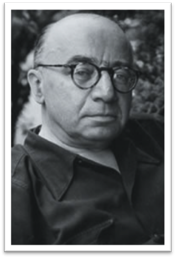
Arthur Szyk was born on 16 June 1894 to Jewish parents in Lodz, Poland. Although Szyk’s family did not practice Orthodox Judaism, his art was heavily influenced by the religious painting and illustrated manuscripts of the middle ages. He continued painting religious and politically themed miniatures and caricatures in a classical style that resembled the manuscripts of the middle ages even after attending the Academie Julian in Paris and being exposed to avant-garde modern art practices. This gives his work a dated yet charming quality. Arthur Szyk is best known for his critique of fascism, Nazism, and anti-Semitism. While residing in the United States in 1951, Szyk completed Simón Bolívar and his time: 51 miniatures by Arthur Szyk, a collection that includes Bolívar and Sucre at Junin. This collection is meant to mirror his previous work, George Washington and His Time, containing 38 paintings. Arthur Szyk never traveled to Latin American, yet he greatly admired Simón Bolívar as the founding father of Latin America and often compared him to George Washington.