
Protest Art Before and After Pinochet
By Ana Hodess-Fox
In 1970, Dr. Salvador Allende was elected the President of a deeply divided Chilean Republic. Allende’s commitment to democracy cultivated an atmosphere in which various forms of cultural expression thrived. As early as his unsuccessful Presidential bid in 1964, members of the Chilean artistic community, from folk singers to mural artists, journalists and poets staunchly voiced their support for him. His coalition government, the Unidad Popular, brought together both socialist and communist factions of the Chilean Left in order to pursue “The Peaceful Road to Socialism”. The government sought an alternative to the violent revolutionary tactics of Castro, Guevara, and other leaders of the 26th of July movement in Cuba. Instead, the Unidad Popular opted for a series of legislative reforms including nationalization of the copper mines, moderate land reforms, and the expansion of social services specifically in healthcare and education. Allende’s refusal to resort to undemocratic means and his attempts to appease divergent political interests ultimately left his coalition government exposed to criticism from both poles of the political spectrum. Within the global context of highly polarized Cold War politics, militant Marxist revolutionary groups and others on the Left were critical of Allende’s reformism, while Conservative Right wing forces in Chile and the United States found their interests threatened by his redistributive measures.
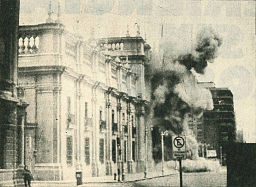
Photograph from the coup led by General Pinochet on September 11, 1973, courtesy of Biblioteca del Congreso Nacional de Chile
Following a period of civil unrest, General Augusto Pinochet staged a military coup on September 11, 1973 and suspended all civil and political rights. Under the dictatorship, freedom of expression was severely curtailed, and thousands of political dissenters were detained, tortured and killed. As a result of severe political repression, many artists and intellectuals went into exile and continued protesting the dictatorship, while others remained in Chile clandestinely in order to pursue novel forms of cultural resistance at home. Filmmakers, journalists and writers in exile upheld their commitment to re-establishing a democratic government in Chile. At the same time, muralists, musicians, arpilleristas and avant-garde artists in Chile and abroad used a variety of media to produce spaces of resistance and memory in opposition to the “cultural blackout” and “cultural amnesia” produced by the repressive measures of the authoritarian state. These various forms of cultural production sought to reopen the spaces of discourse that had been closed and silenced by the state. Prominent Chilean cultural critic Nelly Richard describes these various responses as the naming of “fragments of experience that were no longer speakable in the language that survived the catastrophe of meaning” [1] produced by the coup and the physical and rhetorical violence of the dictatorship.
Through innovative tactics developed in response to the repressive apparatus of the state and the reworking and reappropriation of media used by and associated with the pre-Pinochet liberal democratic state, these cultural and political actors contributed to the reconstruction of collective identities and practices and the preservation of memory. Additionally, on the level of aesthetics, the need to get past censors resulted in the production of nuanced works, in which the audience had to engage with the metaphors of the piece, requiring that the “viewer, listener or reader have a true dialogue with the work,” (el espectador, el auditor o el lector tengan un verdadero diálogo con una obra)[2]opening up a space for dissidence and discourse. Counter-hegemonic cultural projects by muralists, arpilleristas, musicians and avant-garde artists (not to mention similarly oriented works in the realm of theater and literature) successfully challenged the program of the military regime and laid the groundwork for the popular dissidence movement resulting in Pinochet’s exit from power in 1989.
On the other hand, despite the efforts by Chilean artists working during the dictatorship to challenge the hegemonic discourse of the neoliberal capitalist state and the highly unequal consumer society that it produces, the end of the dictatorship has not resulted in the dismantling of the cultural apparatus of the authoritarian state. While mass torture and disappearances have ended, foreign programming still dominates in television (controlled by a small group of wealthy Chileans, the Catholic church and foreign corporations), Hollywood-produced films dominate in the megaplexes housed in US-style malls, American and European music fills the radio waves, and the neoliberal economic policies enacted under Pinochet remain in place. In this context, old forms of art-making (such as muralism and the performance of Nueva Canción songs) continue to struggle to occupy public space as part of the project of collective memory consolidation. At the same time, while new forms of cultural resistance (for instance the politically radical hip-hop group Makiza or the proliferation in urban spaces of stencil art that critically reappropriates icons of mass media) have arisen to respond to the realities of the neoliberal democratic state and the massive pressure exerted by imported mass media participating in the ongoing struggle for the democratization of the public sphere.
Muralism and the Evolution of Art in Public Spaces
The rich cultural sphere that existed in Chile prior to September 11, 1973 and the can be illustrated through the phenomenon of mural art. The first major mural project in Chile occurred between 1941 and1942, when renowned Mexican muralist David Alfaro Siqueiros fled to exile in Chile following his involvement in the assassination of Leon Trotsky. While in Chile, he painted the mural series titled “Death to the Invader” in the walls of the library of the School of the Mexican Republic in Chillán. The Marxist mural series relates the colonial and post-colonial struggles of Mexico and Chile. Through this early major mural project, Chilean muralism became associated, from its inception, with leftist politics.
A decade later a group of Chilean artists trained within the official art academy, frustrated by a perceived formal and political conservatism in the Chilean art establishment, issued a manifesto proposing a new form of nationalistic art that could capture and inspire the character of the Chilean pueblo[3]. The political commitment of artists trained in the national academy would continue into 1964, when formally trained artists seeking new ways to enact the goals stated in the 1954 manifesto began to paint Mexican School style murals with social content in the streets of Santiago. Following the completion of a large-scale mural on the banks of the Rio Mapocho, in the center of Santiago, the phenomenon of mural painting appeared in barrios populares of the city, as residents of working class neighborhoods appropriated the medium for their own purposes[4].
At the same time, in the port city of Valparaíso, leaders of the Allende campaign were looking for cheap, effective strategies to counteract the well financed and well-organized propaganda campaign of the opposition candidate, Christian Democrat Eduardo Frei. The campaign decided to send out volunteers, including trained artists, at night to paint a poster-style campaign slogan on one of the main thoroughfares of the city[5]. The style, which in its early incarnation was primarily text-based, proliferated. Despite these artistic efforts, Frei eventually won the election.[6]
A massive several day march from Valparaiso to Santiago five years later marked another turning point in the history of Chilean muralism. A group of youths from a local high school was organized by the Communist Party to march ahead of the crowds, painting slogans along the route; this was the birth of the Chilean mural brigade.[7] The most influential of these brigades, the Brigadas Ramona Parra, were organized by chapters of the Young Communists throughout Chile. Each brigade typically consisted of six to eight adolescents, from twelve to eighteen years old, who would go out, often at night, to clandestinely paint slogans and murals on public walls[8]. Stylistically, the murals exemplified the values of the Unidad Popular. Overtime, the murals began to develop a distinctive style, characterized by bright flat areas of color surrounded by thick black lines. The murals contained a series of easily readable figures representing the Chilean pueblo. The exuberant use of color coupled with symbols of hope and solidarity (such as the dove and raised fist) provided a hopeful imagining of an imminent socialist utopia.
Immediately following the coup, the military government whitewashed existing murals. For several years, mural art ceased to be produced in Chile, and city streets filled instead with the products of an ever more pervasive advertising culture that served the neoliberal capitalist state. The mural—a product of collective effort and a symbol of the path to collective social emancipation—was erased to make room for advertisement, a key ingredient in the propagation of individual-oriented consumer culture.
A number of exiled Chilean muralists carried on the tradition abroad, painting murals in the style of the Brigada Ramona Parra in various European cities. In the context of the repressive dictatorship, the political meaning of muralism changed, and the formerly utopian character of muralism was replaced by a call for resistance and the rescue of memory. Despite the exclusion of new murals from public spaces within Chile, mural art remained part of the cultural patrimony of the Left, and pamphlets, banners and posters were produced and passed around clandestinely during the dictatorship[9].
Muralism resurfaced in 1979 during a series of strikes, which marked the first moment of significant dissention to the regime.[10] The resurgence of mural art also speaks to the extent to which muralism as a phenomenon existed autonomously from political parties and official propaganda, serving as a vehicle for the articulation of social demands by the Chilean subaltern groups. In the face of growing discontent at the severe economic recession and alarmingly high unemployment rate of 1983.[11] the opposition movement organized the first National Day of Protest,[12] and on “the walls which up to now had been painted with casual slogans…we see the poor’s dreams, accusations, feelings, cries, poems, watchwords and honors—represented with an unprecedented power of expression.”[13]
Rather than a pure recycling of the iconography of the pre-1973 murals, these newer works responded to a new Chilean social reality and the increasing influence of imported products of the culture industry, incorporating influences from, among other areas, international graffiti and comic art, and reinventing and subverting them in visually hybridized forms[14]. Since the end of the dictatorship, mural art has also played an important role in the maintenance of memory and denunciation of the dictatorship, with memorial murals, often painted in the style of the Brigadas Ramona Parra, occupying public space, and forcing engagement with the atrocities committed in Chile’s recent past.
From Nueva Canción to Canto Nuevo
The Chilean Nueva Canción (New Song movement) was a politicized form of popular art that emerged and flourished in the years leading up to and during the Unidad Popular government, as a growing number of musicians sought to “bring about political change through a recuperation of national identity through populist music.”[15]
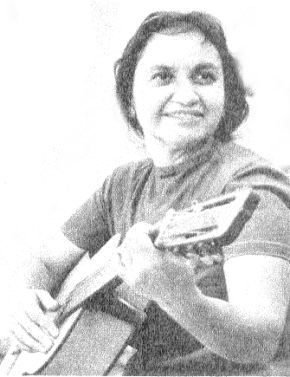
Violeta Parra (1973), originally published in “Panorama”
The singer-songwriter Violeta Parra is credited as the mother of the movement. Parra traveled around Chile, collecting folk songs from various regions, and then wrote songs that conveyed “current reality and social problems in a meaningful style.”[16] From the outset, the music of the Nueva Canción was political, using folk music forms to counter cultural imperialism during a time when the importation of escapist foreign (especially U.S.) music was on the rise. While some of Parra’s songs were explicitly political in content, even those without socially critical lyrics represented a form of resistance against dominant forms of entertainment to the extent that they employed decidedly non-cosmopolitan styles associated with the Chilean and the rural (in contrast to the dominance of the international and urban). Other musicians who began to play music in the Nueva Canción style also incorporated Andean instruments, such as the quena and charango and indigenous dress, specifically the poncho, into their performances[17].
Victor Jara, the prominent Nueva Canción performer who was killed in the early days of the dictatorship, described the work of the movement in explicitly political terms:
“Our duty is to give our people weapons to fight against this (the North American commercial monopoly in music); to give our people its own identity with a folklore which is, after all, the most authentic language a country has, to make our people understand their reality through the protest song, to understand the reality of their friends as well as their enemies, and through music-without labels of “classic” or “popular”-to help our people unmask the world around them, to transform it not with paternalistic prophecies, but together with the people”[18]
The language of Jara’s explanation of the political project of the Nueva Canción reveals a movement that actively struggles against cultural imperialism, valorizes the contributions of the most marginalized groups in Chile (the rural and indigenous poor) and that seeks to develop class consciousness and emancipatory social movements through song.
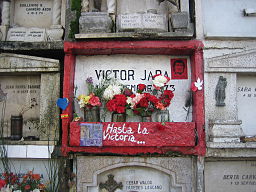
Burial site of Victor Jarra decorated with flowers (2006), courtesy of Lion Hirth
The lyrics of many Nueva Canción songs represented the experiences of the Chilean subaltern classes. For example, the lyrics of Jara’s “Cuando voy al trabajo” (When I go to work) speak of the daily life of an urban worker, while songs like Violeta Parra’s “Arauco tiene una pena” (Arauco suffers) represents the historic and continued marginalization of the Mapuche, the indigenous group native to Chile. These artists were concerned with bringing representations of marginalized groups into the cultural sphere and with preserving the lived history of these groups. For instance, Quilapayún’s epic album Cantata de Santa María de Iquique recounts the Matanza of Santa Maria de Iquique in northern Chile in the early 20th century, when hundreds of striking miners and their families were violently repressed by military forces. Such works recognized the importance of history and memory in the construction of public discourse.
Allende appropriated the popularity and populist messages of the movement, appearing at campaign events under a banner declaring, “No hay revolución sin canciones (there is no revolution without songs).”[19] Following the election in 1970, musicians produced songs that promoted the reforms of the Unidad Popular and modeled forms of popular participation. For instance, Jara’s “Lindo es ser voluntario” (It is lovely to be a volunteer) encouraged citizens to contribute to the creation of a Socialist Chile through volunteering in their communities.
After the coup, the government outlawed the music of the Nueva Canción [20] and prohibited the use of certain indigenous instruments perceived as too closely associated with the emancipatory songs of the Canción Nueva [21]. Victor Jara was tortured and killed, while members of Inti-Illimani and Quilapayún (two prominent musical groups) went into exile. Under the military regime Nueva Canción evolved from “a populist movement that was supporting the emergence of a new Chilean version of socialism (via the symbolic recovery of Chilean roots)…[to] a post-coup cry of protest from exile” [22] working to garner international support and solidarity with Chile.[23] Additionally, the already extant anti-imperialist undertones of the Nueva Canción were amplified in the context of the dictatorship and its enactment of neoliberal economic policies that repressed popular cultural production and promoted the imported mass media of the international culture industry.
Within Chile, folk-inspired music did not disappear but its overtly political overtones were curbed in order to get past state censors. For instance, in the years right after the coup, Andean baroque (baroco andino) music, classically inspired instrumental compositions, lacked politically-charged lyrics, but “the choice of instruments added political overtones.”[24] By the mid-seventies, music in the style of the Nueva Canción had reemerged under the name Canto Nuevo (New Song), a name that spoke to the need to “recall and regenerate”[25] spaces of opposition closed by the regime. In order to get past censors, these musicians, who operated primarily at the amateur level[26] (given the government’s control of the circuits of macromedia), developed lyrics composed of “highly poetic texts and complex metaphors”[27] that attempted to “communicate the reality of a people whose outlets for group expression and social interaction have been intentionally and systematically restricted.”[28] In response to the new political and social realities, new musical groups appeared who, without alluding directly to the Pinochet regime, “by singing about what [was] wrong with Chile (unemployment, pollution, a generation of alienated youths, etc.)… undercut the dictatorship’s official discourse that all was in order in the patria.”[29] In the context of the dictatorship, musical forms were produced that preserved the memory of the Unidad Popular government, counteracted the “mind-numbing commercial music that dominated the market,”[30] and appropriated imported forms of music (such as punk rock) to level veiled criticisms against the government.
[1] Richard, Nelly. The insubordination of signs: political change, cultural transformation and poetics of the crisis. Durham: Duke University Press, 2004: 5.
[2] Bianchi, Soledad. “La política cultural oficialista y el movimiento artístico.” Arauacaria de Chile 17 (1987): 139.
[3] Marcos, Fernando y Osvaldo Reyes. Manifiesto del movimiento de integración plástica chilena. Santiago (1953).
za, 69.
[5] Ibid 64.
[6] Comíte de Defensa de la Cultura Chilena. Muralismo: Arte en la cultura popular chilena. St. Gallen: Edition Día, 1990.
[7] Castillo Espinoza 78
[8] Castillo Espinoza 79-81
[9] Castillo Espinoza 139
[10] Comite de Defensa de la Cultura Chilena
[11] Adams, Jacqueline. “When art loses its sting: the evolution of protest art in authoritarian contexts” Sociological Perspectives 48 no.4 (2005): 535.
[12] Morris 131
[13] Comite de Defensa de la Cultura Chilena
[14] Castillo Espinoza 150
[15] Tumas-Serna 144
[16] Morris 117
[17] Fairly, Jan. “Annotated bibliography of Latin-American popular music with particular reference to Chile and to nueva cancion” Popular Music 5 (1985): 309.
[18] Tumas-Serna 146
[19] Fairley 307
[20] Morris 118
[21] Ibid. 124
[22] Neustadt 129
[23] Morris 147
[24] Morris 125
[25] Neustadt 129
[26] Alcides Jofre, Manuel. “Culture, art, and literature in Chile: 1973-1985” Latin American Perspectives 16 no. 2, 1989: 147.
[27] Morris 126
[28] Ibid 118
[29] Ibid 135
[30] Morris 127