
By Daniel Gonon
Following the proscription of Peronism in 1955, several filmmakers dedicated themselves to uncover a more inclusive national cultural integration, one that would provide the working and lower classes with a voice that was muted during the 1960s and 1970s. Like individuals in other countries that also formed part of the New Latin American Cinema movement, Argentine filmmakers sought to review the values, histories, and hegemonic culture of the nation in a movement that became known as Third Cinema. In doing so, the camera transformed from an instrument of entertainment into a weapon, “a gun that can shoot 24 frames per second” (Solanas 1970). With filmmakers like Fernando Solanas and Octavio Getino producing works such as La hora de los hornos (The Hour of the Furnaces), this new trend in making films, though for the most part censored, created a foundation for a future radical push for change. This paper will explore the sociohistorical context of the time period, the filmmakers who jump-started and propelled Third Cinema forward, the goals of the movement, and how these goals were accomplished in Third Cinema films.
Sociohistorical Context
Several Latin American countries saw the emergence of new sorts of nationalism during the 1960s. The nature of these new sorts of nationalism was not solely cultural, as in the 1920s and the 1930s, or economic as in the 1940s and 1950s. Rather, the nature of nationalism in the 1960s and 1970s was undeniably holistic—cultural, economic, and sociopolitical. As Ana Del Sarto expresses, “[o]ne of the most salient characteristics of the predominant leftist movements of this period was precisely their complex ideological combination between Marxism-Leninism, Mao Tse-Tung’s cultural nationalism, Che Guevara’s voluntarism, Franz Fanon’s thirdworldism and national-popular liberation and anticolonialism” (80). By the 1970s, the social, economic, political, and cultural contradictions reached new levels, resulting in tense social confrontations within Latin American countries. Under these conditions, New Latin American Cinema movements such as Third Cinema in Argentina and Cinema Novo in Brazil shared an impulse of radicalization: “aesthetic experimentation, political intervention, cultural reconfiguration and social transformation” (Sarto 80).
The instability of Latin American countries during this time period can be seen through the downfall of developmentalist governments and the takeover by military dictatorships; Argentina was no different. The beginning of Argentine radicalization is often linked to the downfall of Arturo Frondizi in 1962. With the installation of new governing bodies in Argentina, state censorship increased, leading Third Cinema to become clandestine and, ultimately, become used for political agitation.
Filmmakers: The Catalysts for Third Cinema
Despite the fact that the first names that come to mind when one thinks of Third Cinema are those of Fernando Solanas and Octavio Getino, these men are in debt to a fellow Argentine. As Julianne Burton claims, if there is any one person who can be called the founder of the New Latin American Cinema, it is Fernando Birri. He had an absolute commitment to a realistic aesthetic, which often materialized itself in the mode of documentary. He recognized the innovative potential of unsophisticated technology, the sort of technology that the clandestine films of Third Cinema filmmakers used. In her paper, “The Camera as a ‘Gun,’” Burton writes:
Writing fifteen years ago, Birri made frequent use of the term “underdevelopment,” using it to characterize the deformation of national reality and culture as defined by neo-colonial bourgeoisie, ever zealous to ape foreign models. The aim of the realist film movement which he initiated was “to deny, negate, pass judgment on, criticize, and deconstruct that false reality upon presenting the true one.” (58)
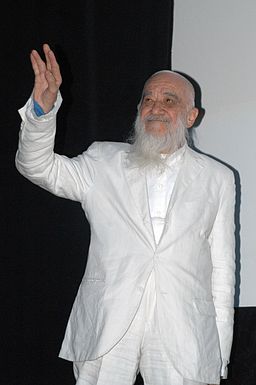
Fernando Birri at the International Film Festival of Guadalajara (2008)
Subsequent filmmakers would heed Birri’s words, using the films they would produce to challenge the Argentine neocolonialism of the present time as well as its false hegemonic culture history.
Two of these filmmakers were Solanas and Getino, who were members of the Grupo Cine Liberación and coined the term “Third Cinema” in their manifesto “Towards a Third Cinema.” In this document, the filmmakers align First, Second, and Third Cinemas with three social strata: the bourgeoisie, the petit bourgeoisie, and the people. They denounce neocolonialism, the capitalist system and Hollywood cinema, which they consider to merely be an institution of entertainment to make money. James Roy Macbean writes how Solanas and Getino presented an alternative to the societal issues of Argentina—revolutionary struggle.
And precisely because neocolonialism—unlike direct colonial rule by a single “mother country”—is such an amorphous, many-headed monster, the revolutionary struggle has to be waged not against a foreign aggressor, but rather on class terms against the Argentine bourgeois ruling class and the capitalist system and ideology which…perpetuate the exploitation and repression of the proletarian masses of Argentina. The struggle, then, is a class struggle for a socialist revolution in Argentina. (33)
Beatriz Sarlo points out that for Birri and Solanas and Getino, anything that was not sociopolitical documentary was a concession to the class-enemy (230). Therefore, Third Cinema, at the moment, was the essentially only critical option that Argentine filmmakers had. They had an ideological obligation to produce these types of films.
Teshome H. Gabriel has commented that the actions of Solanas and Getino illustrated the transition of the mentality of Third World films into Phase III. Phase I is that of the unqualified assimilation, in which the film industry of the Latin America, and the rest of Third World, identifies with the Western Hollywood model and attempts to emulate it. Phase II is that of the remembrance phase, in which there is a romanticisation of the past culture and past of Latin America. Solanas and Getino allowed for the Third World film industry to truly reach Phase III: the combative phase. In this phase, filmmaking becomes a public service institution, managed, operated, and run for and by the people, producing films that illustrated the lives and struggles of Third World peoples (Gabriel 33).
The film that had one of the greatest impacts on the Third Cinema movement was Solanas and Getino’s chef d’oeuvre, a four-hour marathon documentary entitled La hora de los hornos (The Hour of the Furnaces). Burton comments, “[t]he three part film essay on colonialism and neocolonialism, Peronism, and the post-Perón period, violence and repression and the need for liberation…has had a tremendous impact on subsequent documentary film production all over Latin America” (1975 385).
The documentary propelled the Third Cinema Movement and led to the subsequent production of militant films, which were not only limited to documentaries. As Solanas and Getino wrote in their manifesto, “[p]amphlet films, didactic films, report films, essay films, witness-bearing films – any militant form of expression is valid” (1971).
The Goals of the Films of the Movement
In an interview with James Roy Macbean, Fernando Solanas said, “our goal was to create a cinema not conditioned by the system, a free cinema, a decolonized cinema, a class cinema, a militant cinema involved ideologically and politically in and for the revolution” (37). Deeply rooted in the needs and aspirations of their own people, the filmmakers of the Third Cinema were determined to preserve and cultivate Argentina’s cultural heritage and to reinforce it against deforming cultural exports from the developed world (Burton 1976 33). For this reason, Third Cinema sought to shed light on the truth, elucidating causes rather than documenting effects. Genuine national reality, according to Solanas and Getino, was the national or people’s truth and that any form of expression which tried to express that reality was automatically received as subversive by the dominant sector (Burton 1978 58).
Ana del Sarto points out that the fundamental purpose of elucidating this truth in Third Cinema films was in order to “promote a level of consciousness-raising, which allow the audience to critically reflect upon their own situation” (83). Teshome H. Gabriel reiterates the goal of consciousness-raising in Third Cinema, even stating that a film cannot be revolutionary if it does not aim towards greater consciousness (Ramsey 269).
Another goal of the films of this movement was to present the reality of drama rather than the drama of reality, a characteristic of Hollywood films that the Latin American movement decried during this time period. In the manifesto, “Towards a Third Cinema,” the Argentine directors comment, “[i]mperialism and capitalism, whether in the consumer society or in the neocolonised country, veil everything behind a screen of images and appearances. The image of reality is more important than reality itself” (Solanas 1971). The movies of Hollywood, consequently, are typified by dramatic stories that appear real, or the drama of reality. However, Third Cinema films sought to show on screen the reality of drama, the reality of the current situation of Argentina for the workers and the lower classes. Solanas and Getino state, “[e]very image that documents, bears witness to, refutes or deepens the truth of a situation is something more than a film image or purely artistic fact; it becomes something which the System finds indigestible” (1971).
What is the ultimate purpose of all this illuminating of the truth and consciousness-raising? The galvanization of people into action. About certain images in La hora de los hornos that represent the first appearance on the stage of history of the Argentine masses as masses, Macbean mentions:
In other words, the film’s authors are simply saying “look…those are masses, Argentine masses…rallied together as a political force. Anyone who wishes to understand the political reality of Argentina—and especially anyone who seeks to formulate a political program in accord with the needs and will of the Argentine proletariat—must necessarily confront the existence of this phenomenon, analyze its constituent parts, and see which, if any, are usable in the political situation in Argentina today. (34)
As can be seen from this example, the films of the Third Cinema occasionally show the Argentine people what could be, subtly asking them to fight for it. In general, the films of Third Cinema directly incite the Argentine people. As Macbean points out, at one point in La hora de los hornos, the audience reads on the screen, in huge letters: Every spectator is a coward or a traitor (34). The coward is the individual who does not do anything to fight for the cause of liberation of the oppression of the dominant sector. If one does rise up and takes action, he or she will be a traitor of “The System,” the institution that must be brought down. Thus, the film presents that audience member with a challenge to overcome and a decision to make.
Through showing the Argentine masses the miserable working conditions and dismal situation in which the country finds itself, Third Cinema films arm them in virulence, nonconformism, plan rebelliousness and discontent so as to get them to take action (Solanas 1971). As a result, the spectator becomes an accomplice and a member of the revolution. Burton reveals, “[i]t became clear that in a particular socio-political context, when the mere viewing of a militant film is a clandestine activity punishable by incarceration or worse, each spectator becomes an accomplice, a co-participant” (1978 59). In this manner, the film becomes a detonator and the camera, a gun. Solanas and Getino make reference to this concept throughout their manifesto: “the camera as our rifle” and “the inexhaustible expropriator of image-weapons” (1971). Burton shows that “[t]his cinema of decolonization implies a process of ‘turning the guns around’: using the arms of the dominant system in order to destroy or subvert it” (1978 60). The camera transformed into a gun, the filmmaker into the guerilla warrior, the spectator as the accomplice, all united for a revolution of liberation and definitive emancipation from the dominant sector.
The Third Cinema Style: The Mean to An End
The middle sector of society was the target audience of Third Cinema. In “Towards a Third Cinema,” Fernando Solanas and Octavio Getino mention, “[t]he middle sectors were and are the best recipients of cultural neocolonialism. Their ambivalent class condition, their buffer position between social polarities, and their broader possibilities of access to civilisation offer imperialism a base of social support which has attained considerable importance” (1971). It was to these individuals in Argentine society during the 1960s and 1970s that the films of the Third Cinema movement were directed, to whom their style attempted to influence and galvanize into action.
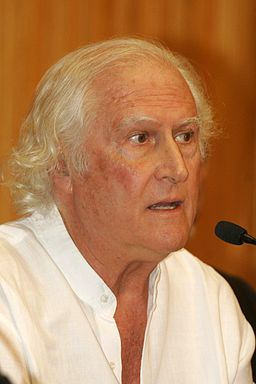
Fernando Solanas at the Film Festival of Guadalajara (2008)
Rejecting both the Hollywood and auteurist models, Third Cinema sought its own themes and styles adequate to the liberation process of the Third World (Burton 1976 40). One of the important characteristics of the Third is the concept of the collective masses as the “protagonist” of the film as opposed to the “hero” of Hollywood. As Teshome H. Gabriel points out, identification with an individual “hero” is not the primary objective of these films. “Rather, it is the importance of the collective engagement and action that matters. The individual ‘hero’ in the Third World context does not make history, he/she only serves historical necessities” (Gabriel 48). The image of the masses was included in Third Cinema films to fuel the notion of collective uprising and action in the minds of the Argentine working class.
In terms of stylistic techniques, Third Cinema was characterized by fragmentation, close-up shots, and open-endedness. José Piedra writes, “[the] awareness of fragmentation alters…the notion of the public and its habits, leading some filmmakers to challenge the notion of audience passivity by cultivating film techniques that provoke in the public deliberate forms of repulsive reaction” (119). This stylistic technique, primarily executed through editing choices in the film, was one utilized to rile up the public, seeking to get a response from each spectator. The notions of fragmentation, collage, and bricolage result in a sense of “impure” urgency in these films. The fragmentation of the carefully edited film and images the hand-held camera produce a “perfectly imperfect image” (Piedra 123), one that effectively illustrates the problems of Argentine society in a fashion that incites the people into action.
Unlike films that follow the Hollywood model, Third Cinema films use relatively few close-up shots. Teshome H. Gabriel explains that contrary to Hollywood films that examine and study psychological realism, Third World films serve more of an informational purpose. Tight close-up shots, which isolate an individual, seem “unnatural to the Third World film-maker because (i) it calls attention to itself; (ii) it eliminates social considerations; and (iii) it diminishes spatial integrity” (Gabriel 45). The image of a single individual detracts from the notion of the collective mass, which tends to be the focus of Third Cinema. Nevertheless, for this same reason, whenever a close-up shot is indeed used, it is for a specific reason, one that ultimately serves to move the Argentine people to action. An example of this is Solanas’ 1971 film Perón: La Revolución Justicialista, which contains numerous close-up shots of Juan Perón, in an attempt to constantly remind the Argentine people of the man who the director considers should be aided to return to power. Still, since most films within the Third Cinema movement seek to highlight the importance of the collective mass, these films are not typified by many close-up shots.
Arguably the most important stylistic characteristic of Third Cinema is that of the open-endedness of films. As Solanas and Getino write, “[o]ur time is one of hypothesis rather than of thesis, a time of works in progress—unfinished, unordered, violent works made with the camera in one hand and a rock in the other.” The filmmaker makes the film while holding the rock in his other hand. However, the rock cannot be thrown at the System until the spectator watches the film and decides to take action. Macbean comments that “this film-act is open-ended…it remains to be completed by the revolutionary praxis of every one of us…new material will be added to the film as new chapters of the revolutionary liberation of Argentina make their entry into history” (36) Leaving the film open-ended provides catalyzes a discussion among the spectators who, potentially and desirably, decide to take action and fight for the total liberation from the oppressive dominant sector. In order to encourage such discussion, some Third Cinema films would be broken into sections, including La hora de los hornos. This film is divided into three sections. After each section comes to a close, the audience is invited to pause for a few minutes to discuss the issues that have been presented before the film continues. By doing this, the spectators begin to develop thoughts, organize ideas, and, possibly begin to make decisions. The spectators take away from the films what they will, advancing the history that has been presented to them, not according to the will of the government, but on their own terms. According to Burton, “[o]pen ended and intentionally unfinished, [the] film challenges its viewers to action so that they evolve its continuation, if not conclusion, through their own political practice and impact on events” (1978 59).
Conclusion
During a period of time when Argentina was characterized by chaotic politics, an unstable economy, and an oppressed working class, Third Cinema showed how the medium of film itself could be an effective tool in catalyzing and signaling social change in the country. “The man of the third cinema…above all counters the film industry of a cinema of characters with one of themes, that of individuals with that of masses, that of the author with that of the operative group, one of neocolonial misinformation with one of information, one of escape with one that recaptures the truth, that of passivity with that of aggression” (Solanas 1971). Third World filmmakers adopted a commitment with reality, a commitment to their people, and a commitment to instigate change. Utilizing specific stylistic techniques to attain its main goal of galvanizing action and emancipating itself from the upper classes, Third Cinema sought to bring the Argentine people to collectively rise up and make their voices heard. The words of Solanas and Getino in their manifesto serve to illustrate the mentality of the time: “[t]here is no knowledge of a reality as long as that reality is not acted upon, as long as its transformation is not begun on all fronts of struggle. The well-known quote from Marx deserves constant repetition: it is not sufficient to interpret the world; it is now a question of transforming it” (1971).
*****
Works Cited:
Burton, Julianne. “Book Reviews.” The Hispanic American Historical Review 55.2 (1975): 382-386. JSTOR Archive. Web. 29 Apr. 2010.
—. “The Hour of the Embers: In The Current Situation of Latin American Cinema.” Film Quarterly 30.1 (1976): 33-44. JSTOR Archive. Web. 29 Apr. 2010.
—. “The Camera As “Gun”: Two Decades of Culture and Resistance in Latin America.” Latin American Perspectives 5.1 (1978): 49-76. JSTOR Archive. Web. 29 Apr. 2010.
Gabriel, Teshome H. “Towards a Critical Theory of Third World Films.” Questions of Third Cinema. Ed. Jim Pines and Paul Willemen. London: British Film Institute, 1989. 30-52. Print.
—. “Third Cinema as Guardian of Popular Memory: Towards a Third Aesthetics.” Questions of Third Cinema. Ed. Jim Pines and Paul Willemen. London: British Film Institute, 1989. 53-64. Print.
Macbean, James Roy. “La Hora de los Hornos.” Film Quarterly 24.1 (1970): 31-37. JSTOR Archive. Web. 29 Apr. 2010.
Piedra, José. “Review: Cameras in Arms.” Transition 53 (1991): 116-123. JSTOR Archive. Web. 29 Apr. 2010.
Ramsey, Cynthia. “Review: Third Cinema in Latin America: Critical Theory in Recent Works.” Latin American Research Review 23.1 (1988): 266-275. JSTOR Archive. Web. 29 Apr. 2010.
Sarlo, Beatriz. “La noche de las cámaras despiertas.” La máquina cultural. Buenos Aires: Ariel, 2000. 195-269.
Sarto, Ana del. “Cinema Novo and New/Third Cinema Revisited: Aesthetics, Culture and Politics.” Chasqui Spring 2005: 78-89. JSTOR Archive. Web. 29 Apr. 2010.
Solanas, Fernando, and Octavio Getino. “Towards a Third Cinema.” Documentary Is Never Neutral: A political documentary helping hand. (1971) Web. 29 Apr. 2010. <http://www.documentaryisneverneutral.com/words/camasgun.html>.
Solanas, Fernando, and James Roy Macbean. “Fernando Solanas: An Interview.” Film Quarterly 24.1 (1970): 37-43. JSTOR Archive. Web. 29 Apr. 2010.
*****
Annotated Filmography:
Ya es tiempo de violencia. Dir. Enrique Juárez. 1969. Film.
In 1969, Enrique Juárez filmed Ya es tiempo de violencia about a conflict that took place in the city of Córdoba on May 12, 1969 between the working class and the city authorities, which led to the death of many civilians. The film opens with the sound of gunshots being fired, a clear indication of the purpose of the film, which as a Third Cinema, attempts to encourage its audience to take action against the dominant sector. Therefore, the gunshots serve to either/both reference the oppressed state in which the Argentine people live in at the hands of the authorities and/or to signal to this audience what it must do to rid itself of this condition.
Throughout the movie, quotes such as the following are narrated over the images on the screen, each trying to trigger the minds of the spectators and unify them into a powerful force: “the government uses means of communication ‘to misinform, to lie,’” and “all [of us] together…that indeed has strength.” At one point, there is a voice recording of a man who took part in the conflict, explaining the situation in Córdoba and how he set himself up as a sniper on the roof of a building to deal with the violent nature of the army that was “calming down” the revolting Argentine crowd. The director includes this voice recording so as to tell the Argentine people watch the film, “This is your voice.” After the sniper finishes telling his story and how many of the authorities he took down, the narrator states, “[this is an] indication of what the popular masses can attain through violence…[it is] more important that the consequences it can yield.” The film accomplishes the goal of Third Cinema of consciousness-raising by juxtaposing images of the poor condition of the Argentine lower working classes with images of the prosperity of other nations and the happiness of people elsewhere. In turn, this fills the spectators mind with thoughts of how these images of prosperity can become a reality in Argentina. The narrator concludes the movie with a true message from those of the movement of Third Cinema: “[the dominant sector] say[s] that we are all Argentine…but the truth is there is a privileged faction. Our liberty has relative importance. We must reconquer our rights. In our actions to achieve this, we will make it through. We will defeat the tyrants.”
Perón: La revolución justicialista. Dir. Octavio Getino and Fernando Solanas. 1971. Film.
Perón: La revolución justicialista was released in 1971, two years before he returned to power, somewhat demonstrating the future impact of this film. The documentary was divided into two parts, with a brief intermission, to allow the audience to discuss concepts that were presented in the film, as was typical of Third Cinema films. The film opens with the narrated words: “The war for the definitive Argentine independence is a war that has still not ended.” The film mainly consists of an interview with Juan Domingo Perón before his first term as ruler. Though close-ups are not usually included in Third Cinema films, there are numerous close-up shots of Perón in this film, which serves the ultimate purpose of affecting the masses and encouraging them to bring about the leader’s return to power.
Throughout the film there are images of protests, of masses of Argentine people shouting out and cheering for Perón and his ideology of justicialismo which, as the narrator states, “started in the 1940s, and can propel us into the future today.” At one point there is an image of “Perón or Death!” written on a wall, revealing the desire of the people unify under the leader and their willingness to fight for that cause.
During the interview, Perón talks about the horrible working conditions in Argentina. He also mentions how the government is a lying institution, how the economy is horrible, and how the people have few social rights. Due to the fact that the conditions that he mentions are those that were present when this film was released, it is intended to make the audience feel as if Perón is indeed the only man who can fix the issues of the nation. He, of course, is on the side of the people. In his famous speech on October 17, 1945, a segment of which is included in the film, he shouts to the people, “Workers are the only one who can make the nationhood grand and immortal.” Later on in the interview, the leader comments, “The enemies of the state are the enemies of the people,” a statement that the filmmakers clearly want to resound and remain in the audiences mind. The documentary ends with two great statements. First, the narrator says that the Peronist Movement is the most strong and effective to lead Argentina to liberation and that Argentina must, in 1971, seek the return of Perón in order to return power to the people. Then, to ultimately conclude the documentary, a voice-clip of Perón in 1955 is heard: “Remember the word now is ‘fight’ and we will fight at all times and everywhere.”
Los hijos de Fierro. Dir. Fernando Solanas. 1972. Film
Three years after releasing La hora de los hornos, Solanas filmed Los hijos de Fierro, a story about the syndicalist movement in Argentina and an allegorization of history, presenting the symbolic return of Perón to power. Divided into segments to enable discussion among the audience members who are influence by the consciousness-raising aspects of the film, Los hijos de Fierro is another great example of Third Cinema. The film opens with a narrator voiceover that says, “the story for [Martín] Fierro and his separation from his family…is held in the hearts of the Argentine people. May the memory of his struggle serve us to conquer our destiny.” The film indeed tells the story of Fierro shares his ideology with his oldest and youngest sons, as well as a close friend. To his oldest son, who wanted to build up an army, he gives the flag of independence; to his youngest son, who wanted to raise up the barrios, the flag of sovereignty; to his close friend, who wanted to mobilize the factory workers, the flag of justice. Throughout the film, the spectator rarely gets the opportunity to see Fierro’s face. Rather, he is mostly seen from the back, from afar, or riding his horse, making him appear as the prophet or intellectual author of the workers’ movement that is to come. The workers are, after all, as the narrator claims early on, “the workers…the sons of Fierro.”
After Fierro is forced to leave his sons and his friend, the film screens images of the bad working conditions of the people and the daily struggles of the Argentine people. Despite the miserable conditions of the people, there is in each town an older son, a younger son, and a close friend resisting the system. “Our problem is organization. We must act as though we are at war.” Once the people find organization, the film implies, triumph will follow. Blood will be shed, but sacrifices must be made in order to attain the liberation from the dominant sector that the Argentine people desire.
In the end, after over an hour of conflict, the movement succeeds and Martín Fierro returns triumphantly, as the workers and his friends celebrates. Accompanying the image of Fierro are images of Juan Domingo Perón, completing the allegory. Perón is Fierro, the father of workers, the only man who can undo the damages that are present in the 1970s Argentina. Solanas understood how powerful a tool the camera was and, thus, he knew that presenting the people with an illustration of what the future could hold could, in fact, make it come true, something which happened in 1973 with Perón’s return to the head of the government.
La patagonia rebelde. Dir. Héctor Olivera. 1974. Film
Released in 1974, La patagonia rebelde screens another example of the allegorization of history. The film tells the story of a workers’ strike for better working conditions in the Patagonia region of Argentina in the 1920s. Despite the fact that it had initially signed an agreement with the workers, the government eventually disregards said agreement, resulting in a brutal conflict between the separate sectors of society. The film was initially censored when it was released for its depiction of the undermining of authority by the working class, a concept that troubled the upper social stratum during the 1960s and 1970s.
Like other films of Third Cinema, the film opens with gunshots, reminding or pleading the audience to rise up and fight. La Patagonia rebelde greatly emphasizes the concept of the collective mass, one of the main characteristics of the content of Third Cinema films. The group of workers in the film unites to take matters in its own hands. At one instance, there is singing among the workers, representing the camaraderie and feeling of unity that must be present in order to succeed in the quest for liberation. A song that they sing includes the lyrics, “Rise up brothers to the shouts of social revolution.” Their collective decision to strike is, as one of the workers comment, “the fundamental arm to defeat the oppressors.”
When the government goes back on its word and does not comply with the requests of the people, it sets out to combat the workers, capturing hostages in the process. The workers gather to stand up against the authorities, claiming “[our struggle is] no more just a strike. This is for our people.” The workers in the film show how the only way to win is to fight, to fight for one’s brothers, in spite of the brutal murders that the government will commit along the way. Using stylistic techniques of Third Cinema, such as fragmentation, the film effectively stirs the mind of the spectator in its attempt to reach its goal of galvanization into action of the Argentine people. The film concludes in an open-ended fashion, leaving the rest of history to be written by the audience members, who, with their actions, determine what picture the fate of their country will paint. The filmmaker clearly essays to push the spectator in the right direction, with one character towards the end saying to his fellow workers, “Do not give up…[in order] to reach a country where there are no rich or poor, no arms, where there is happiness and respect for human beings!”