

Montage of photographs of Brasilia, Brazil (2009), courtesy of Heitor Carvalho Jorge
By Cos Tollerson
With his slogan of “Fifty years (of development) in five,”[1] former Brazilian President Juescelino Kubitschek embarked on the ambitious plan to build a new, ultramodern capital that would showcase Brazil to the world. The city provided Brazil with a chance to make over its reputation by exporting Brazilian culture and showing off its recent industrial advances, while domestically, it promised to answer unresolved questions of national identity and unequal growth that had long divided the country.
The great desire to create a monument identifiable as purely Brazilian sprung from Brazil’s history of cultural reliance, which originated in the first century after independence, when the nation struggled to construct a coherent national identity. Confused by their racial diversity and overcome by a tendency to appropriate European styles, Brazil’s national character remained ambiguous, and for nationalists, problematic. Though it also originated in Europe, the modernist movement of the twentieth century offered Brazilians a style they could make their own, which would eventually allow Brasilia to stand as a national symbol of cultural autonomy and creativity. As Christopher Dunn explains in his book, Brutality Garden: Tropicalia and the Emergence of a Brazilian Counterculture, the Brazilian modernist movement
Appropriated avant-garde practices and techniques from European movements such as futurism, cubism, surrealism, and Dada. At the same time, they denounced the uncritical imitation of metropolitan forms and the use of continental Portuguese as stylistically removed from Brazilian reality.[2]
Brasilia became a national declaration of cultural independence, a protest against colonial Portuguese and French architectural style which had manifested itself in the theaters, libraries, government buildings, and boulevards of the former capital, Rio De Janeiro.[3] The arrival of modern architecture in Brazil—associated with urbanism and industrial advancement—allowed for new improvisation and creativity amongst Brazilian designers, and projected the sense of a future which could be grasped at once.[4]
Furthermore, in order to be a projection of Brazilian identity, the plan demanded that the city’s architects, engineers, planners, and resources be almost exclusively Brazilian.[5] Commenting on the purely Brazilian contribution, Brazilian Journalist Tad Szulc noted:
“When Dr. Kubitschek stood in Brasilia greeting the motorcades moving in from the south, north, east, and west, he was seeing Brazilian-built trucks, buses, and jeeps, driving on Brazilian-made tires and burning Brazilian-refined fuel. In Dr. Kubitschek’s four years in office, this nation has undergone a transformation—both material and psychological—that has no parallel in Latin America.”[6][7]
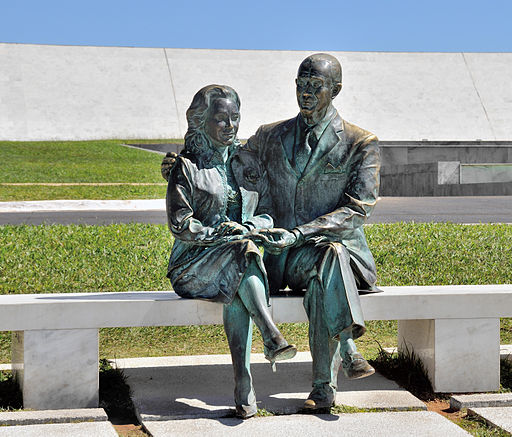
Statue of Juscelino Kubitschek and his wife at the Kubitschek Memorial in Brasilia (2009), courtesy of User Cayambe
The decision to use Brazilian professionals and materials showed the international audience not only Brazil’s cultural freedom, but also its continuing transition from a crop-based, dependent economy to becoming a rising industrial power.
Indeed, the transformation in the national attitude was so profound that the New York Times reported, “Dr. Kubitschek has given Brazilians a national pride that never existed before”[8]At the time of Brasilia’s construction, this new national optimism was viewed abroad as legitimate and justifiable. The capital, “Was contributing to the respect in which Brazil was held abroad,”[9] and one report claimed that, “Brasilia has had a sensational effect on public opinion in Europe, the USA, and our South American neighbors.”[10] By creating such a spectacle and maintaining complete Brazilian control, Costa, Niemeyer, and Kubitschek managed, in just a few years, to positively alter foreign and domestic notions of Brazilian culture, and showed the world Brazil was a nation capable of great things.
Still, creating and touting a state cultural production and national might was pointless in a divided country. And so, throughout the construction of Brasilia, Kubitscheck’s second goal was to eliminate the view, mostly amongst Brazilians, but also in the international public, that Brazil was a conglomeration of rivaling, unequal, disconnected, and sometimes, unpopulated states. As the nation transitioned to a republic in the twentieth century, regional rivalries continued to grow amongst the country’s regions. Rio De Janeiro, Minas Gerais, and São Paulo asserted themselves as the main political and economic authorities, while the crop dependent northeast and the largely unexplored Amazon region were left out of the equation. With the decision to place his new capital in the center of the nation, Kubitschek sought to level the power of different states, renew interest in Amazonian exploration, and allow for a massive expanse of highway, which would, four and a half centuries after Brazil’s discovery, finally integrate a giant and largely unexplored nation. Brasilia promised to promote a sense of equality and connection between the north and south, the coast and the interior.
Kubitschek’s presidency and the construction of Brasilia represent a distinct moment in Brazilian history when the national spirit was lifted and the international public mesmerized by a gargantuan project in city-planning without parallel in modern civilization. The country was filled with optimism and expectation as Brazil projected its culture and growing might. It seemed for a moment the nation would realize its potential. However, unfortunately, Brasilia’s completion did not provoke the desired rise in national power or increase in regional equilibrium. Instead, following Kubitschek the nation fell into political and economic turmoil, largely due to the spiraling deficit accumulated by Kubitschek’s spending on Brasilia. Eventually, the nation’s uncertainty resulted in a military coup that transformed Brasilia’s symbolism from a bastion of popular democracy into a depiction of tragic irony, at the same time furthering inequality throughout the country and discrediting the Brazilian government’s international legitimacy. Now, a half-century later, as Brazil prepares for the World Cup in 2014 and the Olympics in 2016, the nation is gripped by a similar sense of optimism. However, this time, one can hope the government and the populous understand the difference between romanticism and reality, and take progress in steps rather than grand leaps.
[1] Thomas Skidmore, Brazil: Five Centuries of Change, (New York: Oxford UP, 2010), 143.
[2] Christopher Dunn, Brutality Garden: Tropicalia and the Emergence of a Brazilian Counterculture, (Chapel Hill, NC: University of North Carolina, 2001), 13.
[3] see powerpoint.
[4] Norma Evenson, 79.
[5] Ernesto Silva, Historia de brasilia, (Coordenada, 1961), 153-4.
[6] Tad Szulc, “Brazil’s Juscelino And the City He Built,” (The New York Times, 3 Apr. 1960)
[8] Tad Szulc, “Brazil’s Juscelino and the City He Built,” The New York Times.
[9] Norma Evenson, 161.
[10] Norma Evenson, 161-2.