
-

An East German stamp commemorating Salvadore Allende
Salvador Allende: A medical doctor by trade, Dr. Salvador Allende led the Communists and Socialists under the rubir of Unidad Popular (UP or Popular Unity) to the presidency in 1970. His camapaign called for a “peaceful road to socialism” by which he would use constitutional and congressional means to reform Chilean society. Though his reforms were moderate, Allende’s brand of communism represented a threat to U.S. Cold War Policy and extensive economic interests in Chile. Corporate executives from prominent U.S. corporations such as Ford, ITT, and Ralston Purina voiced their concern to the White House about Allende’s vows for nationalization. Nixon and Kissinger, fearing that Allende’s moderate communism might spread, immediately set about bringing down the Allende government through an “invisible blockade” of the Chilean economy. Allende’s presidency lasted no more than three years as Nixon put a stranglehold on the Chilean economy. Allende was ousted on September 11, 1973 by a military coup led by General Augusto Pinochet.
-
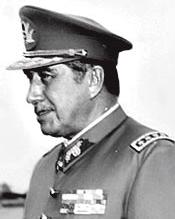
Augusto Pinochet (1971)
Augusto Pinochet: A career officer who joined the Chilean army at the age of eighteen, Augusto Pinochet (b. November 25, 1915) led the military coup against Dr. Salvador Allende in 1973 and proceeded to orchestrate one of the most brutal dictatorships in the Southern Cone. His regime never hesitated to use repression and torture as he sought to right Chile’s economy and bring stability to fractured Chilean political and social spheres.His legacy in Chile remains divided. His neo-liberal economic reforms (led by the economists from the University of Chicago) led to such a reversal of economic fortune that it became known worldwide as the “Miracle of Chile.” (These reforms, however, also led to a decline in wages, shortages of many staple goods, and a spike in unemployment.) Furthermore, more than 30 years later, it is still unknown how many were killed or disappeared by the Chilean secret police known as DINA (dirección Nacional) as Pinochet systematically violated human rights norms to fight leftists, subversives, and guerilla movements in Chile. Pinochet was denied another term as President via nationwide referendum in 1988, though as an ex-president he remained a Senator-for-Life and retained post as commander-in-chief of the armed forces. In October of 1998, he was charged in Spanish court with several counts of murder, torture, and unlawful kidnapping of Spanish nationals. The charges were dismissed in 2002 for health-related reasons. He was charged once again in 2006; however the General—then in his late seventies—died before proceedings could begin.
-

Michelle Bachelet (2009)
Michelle Bachelet: Born in Santiago in 1951, Michelle Bachelet became Chile’s first woman president in 2006. Her father was tortured and killed by the Pinochet regime, while Michelle—then a medical student—was likewise tortured, though later released into exile in 1975. She returned to Chile and entered politics shortly after Pinochet’s ouster. She served for four years, and gained notoriety for skilled handling of the 2008 financial crisis.