
The Dictatorship’s Effects on Literature
By Ivan Tomic
Argentines have had many encounters with dictatorships, some short, others long. To an extent, Argentine society and culture were shaped by dictatorships, but Argentines were unprepared for the 1976 coup, which was the first time a junta sought to reshape culture and society through terror. This development was dubbed the Proceso de Reorganización Nacional and its goals were to reaffirm the “the validity of Christian moral values, national tradition and the honor of being an Argentinean” (Torres 2). In the minds of the junta members, the cure-all for the nation’s problems was a national cleansing, which would return the nation to its true values and ideals. Anything that deviated from these values would be destroyed or disappeared. Literature has always been an important medium in Argentina due its highly literate and cosmopolitan population. The dictatorship thus took special care in identifying literature as a key subversive element that must be made subservient to the regime. Literature was a key front of the “cultural war” (Torres 3) in which, as the chief of the Army General Roberto Viola believed, “the final objective of the operations being carried out is the human mind, [and] the inner system of convictions of each human being” (Torres 3). The dictatorship thus saw writers as potential adversaries and pursued them with all its barbarity.
Argentine writer and critic Noë Jitrik has argued, “there is something in literature that needs to be repressed and destroyed, subdued and calmed. [When] the forces in power understand and sense this secret [they] have two ways of dealing with it: by removing books and/or by removing writers” (Jitrik 1977). The junta did both. It developed a complex bureaucracy to govern cultural production, developing a “strategy for culture [that] was functional and necessary for full compliance [with] state terrorism as a strategy to control and discipline” (Invernizzi, Gociol 3) society.” As a consequence, writers such as Rodolfo Walsh gave their lives for their beliefs and became an inspiration for those in exile. The best way to understand the “dialogue” between the military regime and the writers is to examine their texts, which respond to the military’s brutal attempt at national reorganization.
Rodolfo Walsh:
Rodolfo Walsh was an accomplished journalist and outspoken critic of authoritarianism. Walsh emerged as a figure in Argentine society after “he exposed the secret massacres which followed an attempted uprising against the dictatorship of General Pedro Eugenio Aramburu” (Walsh, Roper 3). He fought against martial law and even “brought a civil suit for murder against the then chief of police” (Walsh, Roper 3). Operación Massacre was great testimony to this and Walsh’s ability to challenge “the government at its most sensitive points” (Walsh, Roper 3), which was brought to its final fruition with the Open Letter. Walsh’s Open Letter was ground breaking, because it was the first direct response to the dictatorship. He deftly questions the military’s mandate knowing that he may be persecuted. It is the Open Letter’s “piling up of evidence to a devastating conclusion, minutely documented, detailed [and] so instantly recognizable” (Walsh, Roper 3) that inspired many Argentines, writers and alarmed the junta.
Walsh is indeed “faithful to the commitment…to bear witness in difficult times,” (Walsh, Roper 7) and the day he published his letter he disappeared. His letter initiated the “dialogue” with the military. The questioning of its basic tenets such as the supposed “virtue” of its goals and its legitimacy heralded the way for other Argentine writers to examine the material. They did this in exile, which allowed them to keep up with the regime’s activities and provide a rebuttal to its crimes.
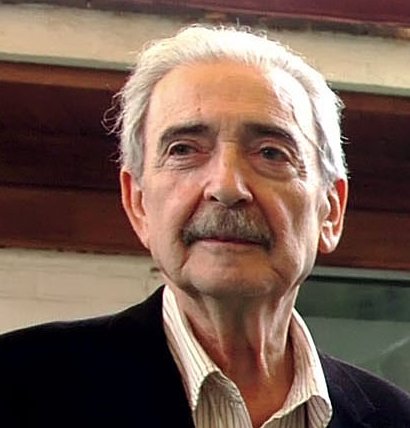
Juan Gelman (2007)
Juan Gelman:
Juan Gelman was an “outlaw poet” (Gelman xi), and once the dictatorship “caught up” (Gelman xiii) with him he was expelled from Argentina. Though exiled, the “notion of patria, or homeland, denotes so much more than geographical parameters” (Gelman 3) in Gelman’s poetry, as it responds to the crimes of the regime. In the poet’s own words, his writing contains such “reality…which is none other than the exact and literal reality of the horror and death, but also the hope that defines the Argentina of our times” (Gelman 4). His poetry is a chilling and startling representation of the human toil of the Proceso de Reorganización Nacional that often focuses on the disappearances of writers such as Rodolfo Walsh. Gelman writes “Rodolfo is silent for the first time/ in his death before the assembly of compañeros exiled/ desolate (Gelman 40). He pays homage to Walsh as he continues to “ask questions” (5) that Walsh could not, continues to question, and defy the regime. Gelman too saw himself as a victim for “military dictatorships came… took my books from me, my bread, my son…threw me out of the country”(Gelman 60). Yet, Gelman retained his words. He made it his cause to “fight the language that fights exile” (Gelman 62) and to respond to the dictatorship. His writing preserves the memory of his compañeros and contributed to the struggle against the regime
Conclusion: Lasting Consequences and the Wider Implications of Repression
Today Argentina is slowly recovering its disappeared culture through exhibitions and projects such as Golpe a los Libros that demonstrate the lingering consequences of the Proceso de Reorganización Nacional. Literature was and remains a subversive force—a tool for questioning the status quo. Not only are these writers and their works important in trying to understand the past, but they are also a source of hope for the future, because they show the strength of the human spirit. Argentine literature resisted the national reorganization, and today as the nation comes to grips with its past it will be a source of reinvention, healing and explanation. There are still many stories to be written in Argentina.
****************
Bibliography:
Foster, David. Violence in Argentina Literature: Cultural Responses to Tyranny. University of Missouri Press, 1995. Print.
Gelman, Juan. Unthinkable Tenderness. University of California Press, 1997. Print.
Invernizzi, Hernán and Gociol, Judith. ‘Un Golpe a Los Libros’
Jitrik, Noé. Las Armas y las Razones. Editorial Sudamericana, 1984. Print.
Jitrik, Noé. The Noé Jitrik Reader. Duke University Press, 2005. Print.
Torres, Ernesto. ‘Under the Shadow of the Dictatorship: Comics and Culture During the Process of National Reorganization’.
Walsh, Rodolfo and Roper, Christopher. ‘Witness in Difficult Times’, Index on Censorship, 6: 5, 3-7 (1977)
*****************
Partial List of Books Banned in 1976:
· Dependencias e industrias multinacionales, de Salvador María Lozada.Dependence and Global Industries, by Salvador María Lozada.
· Argentina 1875-1975, de Segio Bagú. Argentina 1875-1975, Sergio Bagú.
· Cuba, nuestra América y los Estados Unidos, de José Martí. Our America, by José Martí.
· De Sarmiento a Cortázar, de David Viñas. Of Sarmiento a Cortázar, David Viñas.
· Dios y el Estado y la Libertad, de Bakunin. God and the State, Mikhail Bakunin.
· La madre, de Máximo Gorki. The Mother, Maxim Gorky.
· La sagrada familia, de Karl Marx. The Holy Family, Karl Marx.
· De la economía social justicialista al régimen liberal, de Antonio Cafiero. In the social economy Justicialist the liberal regime, by Antonio Cafiero.
· Obras completas, Ernesto Guevara. Complete Works, Ernesto Guevara.
· Obras completas, Vladimir Lenin. Complete Works, Vladimir Lenin.
· Obras completas, José Stalin. Complete Works, Joseph Stalin.
· Obras completas, León Trotsky. Complete Works, Leon Trotsky.
· Neocapitalismo y comunicación de masas, de Heriberto Muraro. Neo-capitalism and Mass Communication, Heriberto Muraro.
· Del socialismo utópico al socialismo científico, de Frederich Engels. Socialism: Utopian and Scientific, by Frederich Engels.
· La dominación imperialista en la historia Argentina, de Carlos M. Vilas. The Imperialist Domination in the History of Argentina, Carlos M. Vilas.
· Montoneros y caudillos, de García Mellid. Montoneros and Warlords, Garcia de Mello.
· Bases históricas de la Doctrina Nacional, de Eduardo Artesano. Bases of Historical National Doctrine, by Eduardo Artesano.
· Los derechos constitucionales del trabajador, de Daniel Rudi. The Constitutional Rights of the Worker, Daniel Rudi.
· Los peores enemigos de nuestro pueblo, de Juan Beyer. The Worst Enemies of Our People, John Beyer.
· Reflexiones sobre el terrorismo, de Fernando Nadra. Reflections on Terrorism, Fernando Nadra.
· La Patagonia trágica, de Osvaldo Bayer. The Patagonia Tragic, Osvaldo Bayer.
· España, el destape, de Ted C. Claure. Spain, the Unveiling, Ted C. Claure.
· Introducción a la sociología, de Duilio Biancucci. Introduction to Sociology, Duilio Biancuccio
· Las edades Media y Contemporánea, de Juan Bustinza-Gabriel Rivas. The Middle Ages and Modern, John Bustinza-Gabriel Rivas.
· Humanismo socialista, de Erich Fromm. Socialist Humanism, by Erich Fromm.
· Tradición, revuelta y conciencia de clase, de E. Thompson. Tradition, Revolt and Class Consciousness, by E. Thompson.
· Sexualidad y autoritarismo, de Frank Hinkelammert. Sexuality and Authoritarianism, Franz Hinkelammert.
· El marxismo y la historia, de Pierre P. Reymar. Marxism and History, Pierre P. Reymar
· América Latina: democracia y revolución, de V. Chertjin. Latin America: Democracy and Revolution, V. Chertjin.
· Dossier Wallon Piaget, de Claude Gianet. Dossier Wallon Piaget, Claude Gianet.
· El fracaso y el desinterés escolar en la escuela primaria, de Liliana Lurcat.· La revolución en la vida cotidiana, de Agnes Heller.The Revolution in Everyday Life, Agnes Heller.
· Revolución y contrarevolución en España, de Joaquin Maurin. Revolution and counterrevolution in Spain, Joaquin Maurin.
· Escritos sobre la guerra civil en España, de Manuel Azaña. Writings on Civil War in Spain, Manuel Ana.
· La ideología alemana, de Marx-Engels. The German Ideology, Marx-Engels.
· La misión Ponsomby, de Luis A. Herrera. The Ponsomby Mission, Luis A. Herrera.
· Sobre la teoría de la planificación socialista, de G. Zielinsky. About the Theory of Socialist Planning, in G. Zielinsky.
· Diagnóstico de nuestro tiempo, de Karl Mannheim. Diagnosis of Our Time, Karl Mannheim.
· La historia me absolverá, de Fidel Castro. History Will Absolve Me, Fidel Castro.
· Lógica formal y lógica dialéctica, de Henri Lefevbre. Logic and Dialectical logic, Henri Lefebvre.
· Las venas abiertas de América Latina, de Eduardo Galeano. The Open Veins of Latin America, Eduardo Galeano.
· Gramsci y la revolución de Occidente, de María A. Macchiochi. Gramsci and the Revolution in the West, Mary A. Macchiochi.
· Sociología de la explotación, de Pablo González Casanova. Sociology of Exploitation, Pablo Gonzalez Casanova.
· Estudios sobre los orígenes del peronismo, de Juan C. Portantiero. Studies on the Origins of Peronism, Juan C. Portantiero.
· El poder negro, de S. Carmichael. The Black Power, S. Carmichael.
· China, antecedentes de la revolución cultural. Comité Central del Partido Comunista de China Popular. China, history of the Cultural Revolution, Communist Party Central Committee of the PRC.
· El libro verde, de M. Gadhafi. The Green Book, M. Gadhafi.
· La educación como práctica de la libertad, de Paulo Freire. The Education as the Practice of Freedom, Paulo Freire.
· Pedagogía del oprimido, de Paulo Freire. Pedagogy of the Oppressed, by Paulo Freire.
· Acción cultural para la libertad; Concientización, teoría y práctica de la liberación; Las iglesias, la educación y el proceso de liberación humana, de Paulo Freire. Cultural Action for Freedom, Awareness, Theory and Practice of Liberation Churches, Education and the Process of Human Liberation, Paulo Freire.
· De los montoneros a los anarquistas, de David Viñas. From Montoeros to Anarchists, David Viñas.
· Antología poética, de Ernesto Cardenal. Anthology of Poetry, Ernesto Cardenal.
· El mayo francés o el comunismo utópico, de Alain Touraine. The French Utopian Communism, Alain Touraine.
· Poesía política y combativa de Argentina, de Andrés Sorel. Poetry and Combative Politics of Argentina, Andrés Sorel.
· Almanaque Mundial – 1979. World Almanac
· Universitas-gran enciclopedia del saber (tomos dos y nueve). Universitas Encyclopedia
· La tía Julia y el escribidor, de Marío Vargas Llosa. The Aunt Julia and the Scriptwriter, Mario Vargas Llosa.
· Pantaleón y las visitadoras, de Mario Vargas Llosa. Pantaleón and the Visitors, Mario Vargas Llosa.
· Nuestro muchachos, de Alvaro Yunque. Our Boys, Alvaro Yunque.
· Niños de hoy, de Alvaro Yunque. Children of Today, Alvaro Yunque.
· La muerte de la familia, de David Cooper. The Death of the Family, David Cooper.
· Desde el jardín, de Jerzy Kosinsky. From the Garden, Jerzy Kosinski.
· Gracias por el fuego y El cumpleaños de Juan Angel, de Mario Benedetti. Thanks for the Fire and The Birthday of Juan Angel, Mario Benedetti.
· El Principito, de Antoine de Saint-Exupéry. The Little Prince, by Antoine de Saint-Exupéry.