
 Antonio Lopez de Santa Anna (1794-1876): Perhaps Mexico’s most well known caudillo, Santa Anna rose to prominence during the Mexican War of Independence—first as a soldier for the Spanish army and then later as a general in Augustín de Iturbide’s Army of Three Guarantees. Never afraid to switch allegiance, Santa Anna eventually supported the coup to overthrow the Emperor and establish a republic in Mexico. In 1833, Santa Anna was elected President of Mexico, a position that he held on eleven separate occasions throughout his life. When American settlers in Texas sparked a revolution in 1835, Santa Anna led the Mexican army in its failed attempt to reclaim the colony. His last major military position was Supreme Commander of the Mexican forces during the Mexican-American War (1846-1848). Santa Anna was once again defeated and Mexico was forced to accept the Treaty of Guadalupe Hidalgo, which ceded nearly half of Mexico’s territory to the United States in exchange for $15 million. After this failure, Santa Anna was exiled from Mexico and lived the rest of his life in various countries throughout Latin America.
- Benito Juárez (1806-1872):
 Benito Juárez was a liberal politician and leader of La Reforma in Mexico. Born in Oaxaca to Zapotec Indian parents, Juárez overcame poverty to become a leading lawyer and judge. In 1854, he helped write the Plan of Ayala, which called for the overthrow of Santa Anna and the establishment of a liberal government. When the liberals came to power in 1855, Juárez and his colleagues instituted La Reforma, a series of liberal reforms that included restricting the power of the Church, breaking up large land holdings by the Church and indigenous communities, and abolishing fueros, special courts for soldiers and clergy. The conservative coalition in Mexico responded to La Reforma by launching the War of the Reform (1857-1861). Juárez led the liberal forces during the war and claimed victory in 1861, becoming President of Mexico in the process. The following year, French forces invaded Mexico under Napoleon III and installed Maximilian, an Austrian, as Emperor. Juárez once again led the rebel forces against Maximilian, eventually deposing and executing the foreign ruler. Juárez returned to the Mexican presidency in 1867 and died in office in 1872.
- Porfirio Díaz (1830-1915):
 Díaz ruled Mexico as a President/dictator from 1876 to 1911, with only one break in the form of a puppet government under Manuel González from 1880 to 1884. Díaz rose to prominence in Mexico as a leading military figure in the liberal movement and he played an instrumental role in repelling the French invasion. After Juárez died in 1972, Díaz became the most important liberal in Mexico, leading to his being elected President in 1876. Once in power, Díaz ensured his continued presence in the government by any means necessary, be it amending the Constitution or developing rural police forces known as guardias rurales. To set government policy, Díaz relied on the científicos, a group of Mexican intellectuals influenced by the positivist movement. The científicos encouraged Díaz to open the Mexican economy to foreign investment, and the result was unprecedented economic development across Mexico. Unfortunately, this development did little to improve the lives of Mexico’s masses, who continued to live in poverty and despair. After a controversial election in 1910, Francisco Madero overthrew Díaz, sparking the Mexican Revolution.
- Emiliano Zapata (1879-1919):
 Emiliano Zapata was a caudillo from the state of Morelos who played a key role in the Mexican Revolution. Born in a peasant family, Zapata was closely attuned to the plight of Mexico’s landless poor. Zapata quickly became an enemy of Díaz due to the dictator’s policy of breaking up communal lands and confiscating individual holdings. When Francisco Madero called for a revolution against Díaz, Zapata joined Madero and raised an army in the south. Zapata turned against Madero soon after as Madero did not seem committed to land reform, and in 1911, Zapata issued the Plan of Ayala, which called for nationalization of large holdings and a return of confiscated lands to their original owners. Zapata continued to be a major figure in the Mexican Revolution after the overthrow of Madero, siding with Villa and Carranza against Huerta and later challenging Carranza’s claim to the presidency. In 1919, Carranza’s troops ambushed Zapata and murdered him.
- Francisco Madero (1873-1913):
 Francisco Madero was born into one of the wealthiest families in Mexico in 1873. His family’s wealth allowed Madero to receive the best education possible, studying in the United States, Austria, and France at various times in his life. When he returned to Mexico, Madero tried his hand at local politics, but found it very difficult to command a large following because he was considered by many to lack the machismo that was so integral to the Mexican political system. In 1910, Mexican dictator Porfirio Díaz promised to hold free and fair elections. Madero jumped at the opportunity and formed the Anti-Reelectionist Party to challenge Díaz’s rule. Madero steadily gained a cult following as Mexicans began to exercise their political power and push for an end to the porfiriato. Sensing danger, Díaz responded by jailing Madero. Without a candidate running against him, the dictator won the 1910 elections easily. Madero fled from Mexico to the United States after being released from jail, and from San Antonio he published his “Plan de San Luís Potosí,” the document that sparked the Mexican Revolution. Madero’s Plan declared the election a sham. Further, it called on the Mexican people to rally around the slogan of “effective suffrage and no re-election” and to revolt against Díaz.[1] The revolution was to begin on November 20th, 1910, but errors in planning forced Madero to postpone his attack until the following February. Entering Mexico, Madero found that he was not alone in his calls for rebellion. Emiliano Zapata, Pascual Orozco, and Pancho Villa joined forces with Madero, and together they were able to force Díaz to flee the country in May 1911. Madero rode into Mexico City in June and was quickly elected President of Mexico. As President, however, Madero revealed himself to be less of a revolutionary than was thought by his followers. After a series of political decisions that led the public to question his commitment to the Revolutionary Spirit, Madero fell victim to a conspiracy orchestrated by the General of his army, Victoriano Huerta, and the American ambassador to Mexico, Henry Lane Wilson. On February 13, 1913, Huerta arrested Madero. Several days later, Madero was executed and the Mexican Revolution passed into its second stage.
- Pancho Villa (1878-1923):
 Francisco “Pancho” Villa was born to peasant parents in Durango in 1878. When Villa was fifteen, his father died and he was forced to work as a sharecropper to take care of his large family. In 1894, Villa shot the owner of the hacienda where he worked to protect his younger sister. Now a fugitive from the law, Villa escaped to the mountains where he joined and later became the leader of a group of bandits. Much of the bandits’ activity was directed at the rich, thus causing the public to see Villa as a sort of modern-day Robin Hood. When the Mexican Revolution began with Madero’s Plan de San Luís Potosí, Villa volunteered himself and his men to the cause because he blamed Díaz for the poor living conditions of Mexico’s peasant classes. Villa played a key role in the Revolution, helping Madero take Mexico City and then later siding with Venustiano Carranza to oust Madero’s killer Victoriano Huerta. Starting in 1914, Villa and long-time ally Venustiano Carranza became enemies and fought for control of the country. When the United States sided with Carranza in 1916, Villa led a raid on Columbus, New Mexico. The U.S. government responded by sending Army General John Pershing to capture Villa in Mexico. A year later Villa was still on the loose and American troops gave up the pursuit. In 1920, Villa officially retired from the revolution but he was not able to remove himself from the political machinations of the time. He was gunned down in 1923 in Chihuahua.
- Lázaro Cárdenas (1895-1970):
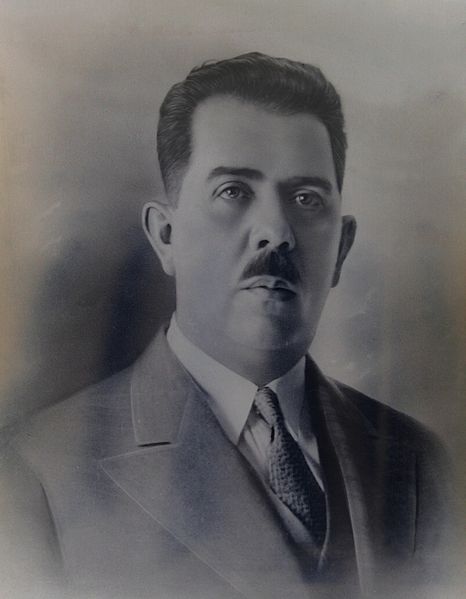 Lázaro Cárdenas was a Mexican revolutionary leader and politician. Cárdenas first gained national prestige when President Plutarco Elías Calles appointed him head of the Partido Nacional Revolucionario (PNR) in 1929. As president of the party, Cárdenas was responsible for consolidating it into a stable, national political presence. He then went on to serve as Minister of the Interior and Minister of War and Marine. In the 1934 elections, Càrdenas was chosen as the candidate for the PNR and, although his success was virtually guaranteed, he launched a massive campaign in which he traveled across the country meeting everyday Mexicans and building support. As expected, Cárdenas won the 1934 election. Unexpectedly, however, he did not follow the trend set by his predecessors of allowing Calles to run the country from behind the scenes. Instead, Cárdenas closed the government to Calles and forced him into exile. He then launched a sweeping program of economic reform with two policies of special importance. First, Cárdenas initiated agrarian reform at a rate not seen before. Over 44 million acres of land were expropriated to poor Mexicans during his presidency, many in the form of communal land holdings, or ejidos, that had been dismantled by La Reforma. Second, after a wage dispute between American oil companies and their Mexican workers, Cárdenas promptly used the 1917 Constitution, which gave the Mexican government control over subsoil resources, to nationalize Mexico’s oil industry under the state monopoly Petróleos Mexicanos (PEMEX). In the political sphere, Cárdenas further transformed the PNR by restructuring it around four social groups: labor, peasant, military, and “popular.” The newly improved party was renamed the Partido de la Revolución Mexicana. In 1940, at the end of his term, Cárdenas helped ensure the longevity of the revolutionary party by nominating the moderate conservative Manuel Ávila Camacho for President, thus satisfying the liberals and conservatives. After briefly serving as Secretary of Defense, Cárdenas retired from political life. He died on October 19, 1970 of cancer.
- Frida Kahlo (1907-1954):
 Frida Kahlo was born in Mexico City in 1907, but to Kahlo her true birth year was 1910, the beginning of so-called “Modern Mexico.” Kahlo grew up in Mexico City and attended the National Preparatory School, where she was known as a rebel who often played pranks on the professors and other students. It was also there where Kahlo first met Diego Rivera, her future husband, as Rivera had been hired to paint a mural in the school’s auditorium. In 1925, Kahlo was involved in a horrible streetcar accident that left her with serious spine and pelvis injuries. During her long and difficult recovery, Kahlo began to paint. Many of her paintings were self-portraits because, as Kahlo said, it was the subject she knew best.[2]Additionally, the paintings often portrayed the pain and suffering inflicted by her accident, as well as the bright colors and scenes of Amerindian cultural works. As she aged, Kahlo became more politically active, eventually joining the Mexican Communist Party. She was a close friend of Leon Trotsky. In 1928, Kahlo and Rivera met again and by 1929 they were married. Their marriage was difficult, with extramarital affairs common for both husband and wife. The two divorced but later remarried in 1940. In 1954, Kahlo died of what was reported as a pulmonary embolism but is widely believed to have been an overdose. In one of her final diary entries, she wrote, “I hope the exit is joyful – and I hope I never return – Frida.”[3]
- Diego Rivera (1886-1957):
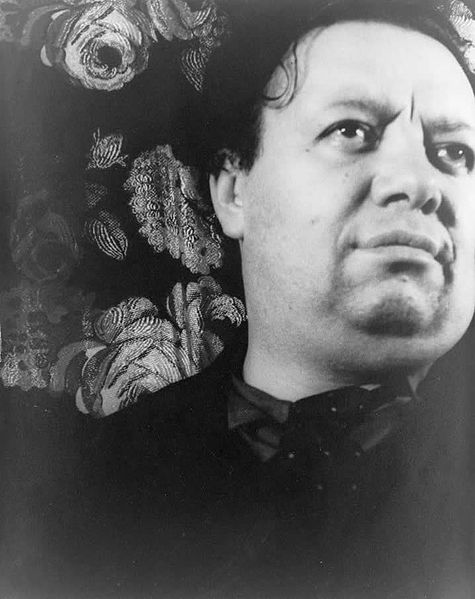 Diego Rivera is perhaps Mexico’s best-known artist. Born in 1886, Rivera started painting at a young age and later traveled to Europe to study art. Rivera was initially interested in the cubist movement, but world events, most notably the Mexican Revolution in 1910 and the Russian Revolution in 1917, led him to reject cubism for a new artistic perspective that focused on portraying the lives of everyday Mexicans. In addition, Rivera was heavily influenced by indigenismo, a growing movement in Latin America that sought to reverse the trend of exploitation of indigenous peoples by those with European ancestry while at the same time integrating indigenous culture and customs into mainstream society. In 1921, the Mexican government commissioned Rivera to paint public murals as part of its effort to consolidate and visualize the Mexican Revolution as a process initiated and orchestrated by the people. Many of these murals depicted specific events from Mexican history, including the arrival of Cortés and execution of Emperor Maximilian. Others were illustrations of daily life for Mexico’s masses. Rivera’s murals gained him international prestige and led him to be hired for work in the United States. He painted a series of murals at the Detroit Institute of Arts, but his most controversial piece of artwork was a mural for the Rockefeller Center in New York City called Man at the Crossroads. Rivera’s employers grew upset over his inclusion of Vladimir Lenin in the mural, and as a result future mural projects in the United States were canceled. During the 1920s, Rivera also became involved with the Mexican Communist Party and married fellow member Frida Kahlo, a young artist he met while painting a mural at her school. Their marriage was extremely turbulent as Rivera and Kahlo had numerous extramarital affairs. After they divorced, Kahlo and Rivera remarried in 1940, although their marriage was no better the second time around. Diego Rivera died on November 27, 1957.
___________________________________________________________________________
Sources:
[1] “Francisco Madero: The Plan of San Luís Potosí, October 5, 1910.” History of the Americas 1. Retrieved from http://staff.4j.lane.edu/~hamill/americas/ayala.htm.