
-

Juan Manuel de Rosas
Juan Manuel de Rosas (March 30, 1793 – March 14, 1877) A politically ambitious cattle rancher from the province of Buenos Aires, he won the governorship of his province in 1829 and later extended his rule over all of Argentina. He built a powerful government machine, with an enforcement squad (mazorcas) that terrorized all who dared oppose him. His eventual undoing was his effort to apply his dictatorial tactics to Argentina’s foreign policy. He provoked a powerful opposition alliance that included Brazil, Uruguay, as well as the Argentine General Justo José de Urquiza (r. 1853-1859) who deposed Rosas in 1852.
-

Eva Perón
Eva Perón (May 7, 1919 – July 26, 1952) The second wife of President Juan Perón, and First Lady of Argentina from 1946 until her death in 1952, Eva (commonly known as Evita) was a political power in her own right. She established a popular base by setting up her own foundation and dispersing cash and benefits personally. Her charisma and generosity won her a fanatical following that gave both her and her husband tremendous political influence.
-

Juan Domingo Perón
Juan Domingo Perón (1895-1974) A man of middle class origins, Juan Domingo Perón rose to the rank of colonel in the Argentine Army and took a significant role in the military coup by the United Officers’ Group (GOU) against the conservative civilian government of President Ramón Castillo. Perón became secretary of labor, using the position to court the support of industrial workers. He later became minister of war and vice president, but was jailed by rivals among the military officers who feared his growing popularity. After a massive demonstration prompted his release in October 1945, he entered the presidential contest of 1946. He won the elections with 54% of the vote. Once in office, Perón organized Argentinean society on strict corporatist lines, enacted a Five Year Economic Plan, and created a state monopoly over the export of key agricultural crops. Urban workers became his most important political ally as he prompted his brand of social justice and public welfare known as Justicialismo. With Evita at his side, Juan Domingo Perón built an imposing political machine that would endure in Argentina even after his ouster by military conspirators in 1955. He continued to exercise political influence even while in exile (1955-1973). He returned in 1973, and was elected president after a brief presidency by Héctor Cámpora. Perón died, however, after only a year back in power, and his vice-president and third wife, Isabel, took the reigns of government. His legacy in Argentina is mixed: he increased basic rights for workers, vastly improved the infrastructure and modernized the economy. However, the economy eventually stagnated under his rule, he doubled the size of the state bureaucracy, and had autocratic tendencies that spared neither the left or the right. His selection of his third wife as Vice President had disastrous consequences as her incompetence encouraged Argentine General Jorge Videla to seize power amidst mounting political violence. Peronism survives today in Argentina as a legitimate political philosophy of populism, nationalism, and international political independence. The Justicialist Party, which includes current President of Argentina Cristina Kirchner, is an offshoot of Peronism.
-
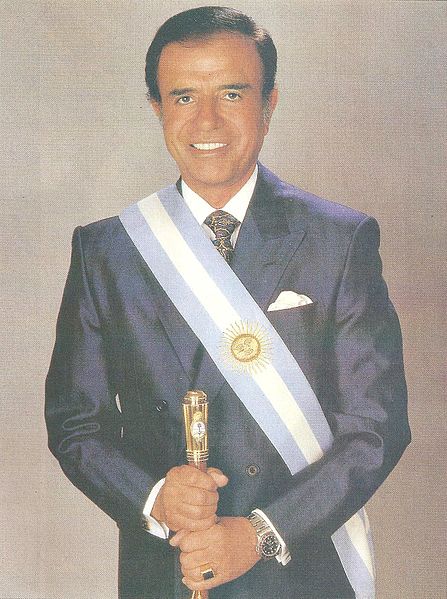
Carlos Menem
Carlos Menem (1930- ) Elected to the Presidency in 1990, Carlos Menem inherited a country with an inflation rate that exceeded 150 percent per month and an external debt that was nearly $4 billion in arrears. Though a peronist, Menem reversed traditional economic course, privatizing state-owned companies and championing a neoliberal economic doctrine. However, his decision to peg the Peso to the U.S. dollar to be an “anchor” for economic confidence caused a massive overvaluation of the peso and a subsequent trade deficit of more than $6 billion in 1994. During this time, nearly half of the country’s middle class slipped down into the lower class and unemployment more than doubled. However, despite the contractions brought by his “hard money” policies, the economy eventually grew, as the neoliberal model brought unprecedented economic growth and stability through the second half of the 1990s. Menem won two presidencies before choosing not to run for a third in 1999. Also of significance was Menem’s decision that there would be no continuing sentences or prosecutions for human-rights offenses committed in the dirty war. He offered a round of pardons in favor of former leaders of the military government.
-

Néstor Kirchner
Néstor Kirchner (1950-2010) A minor Peronist ex-governor, Kirchner earned popular support in the 2003 presidential elections by asserting his independence from the well-oiled Peronist political machine, and condemning the military’s human rights abuses by overturning the amnesty laws promulgated under Carlos Menem. As president, he restricted Argentina’s $178 billion debt, paid off loans to the IMF, and renationalized some key industries. He strengthened Argentina’s role in the regional market group, MERCOSUR, oversaw a major agricultural export boom. He decided not to run for a second term in 2007, backing his wife, then Senator Cristina Fernández de Kirchner for President.
-
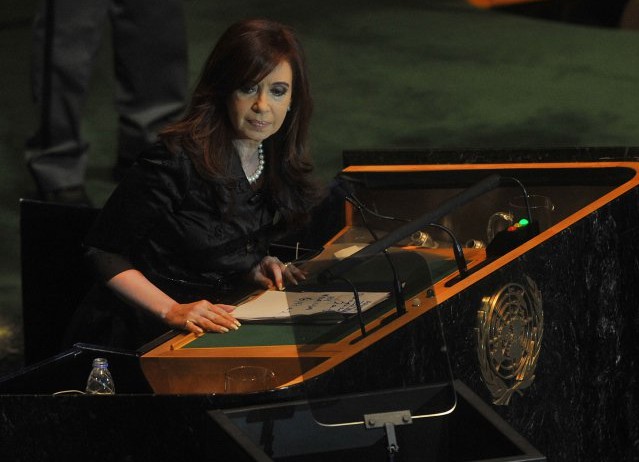
Cristina Fernández de Kirchner
Cristina Fernández de Kirchner (1953- ) Cristina Fernández de Kirchner became the first Argentine woman directly elected to the presidency in 2008, and the second to serve as president. She has revived Peronist-style populism and has advocated for a larger state role in the management of the economy. In the spring of 2012, Kirchner angered European investors after she announced that the government would be taking a majority stake in the Spanish owned oil company, YPF. However, the nationalistic move and her attention to the plight of the poor has won her widespread popular support.