
By Félix Reátegui
Official truth-seeking about violence in Peru has been followed by an intense struggle over memory, as has happened in every society that chooses to confront a violent past with the forthright recovery of memory. The most salient manifestation of this struggle is the opposition between the victims and human rights defenders, on one side, and pro-military, conservative sectors on the other side. However, the dispute over memory of violence cannot be reduced to an opposition between remembrance and oblivion. Theoretical reflection over memory states that it is a contentious practice itself. The varied process of collective remembering that has gained strength in Peru after the investigation made by the Truth and Reconciliation Commission reflects this contentiousness of memory in a variety of ways. Arguably, the most interesting struggles over memory are those that take place between the supporters and practitioners of memory.
Several locally-based, non-official, non-academic memorializing initiatives have been started after the Commission’s Final Report was released. Many others had existed before the Commission was created and some of them are still alive. They all constitute an interesting social dynamic of remembering and commemoration which both follows the master narrative laid out by the Truth Commission and contends with some particular aspects of its Final Report.
Current “struggles over memory” in Peru are an interesting instance to examine the complex links between official truth-seeking —which is mostly institutional and scholarly-based notwithstanding its political rationale— and victims’ efforts to cope with their own past, relationships that are mostly cooperative and mutually reinforcing, but that are never free of the inevitable strains that arise from hierarchical societies, where the social and symbolic capitals —the capacity to produce authoritative narratives and to bring them to the institutional realm— are so unequally distributed.
Official truth-seeking
As it often happens, it was necessary to wait until armed violence was over in order to attempt official, encompassing truth seeking as a response to the victims’ demands of truth, justice, and reparations. That was the work done by the Truth and Reconciliation Commission from 2001 to 2003. The Peruvian TRC was a state-based, official, although independent, body that was created to investigate the serious crimes and human rights abuses perpetrated during the period both by the guerrilla and by state actors. Its existence was made possible in the context of the negotiations that were carried out after the demise of the authoritarian regime of Alberto Fujimori.

President Alberto Fujimori (center) in 1999, courtesy of the Ministerio de Relaciones Exteriores de Chile
Among the many aspects of the work done by this Commission it might be interesting to focus on its attempt to craft a “master-narrative” of the period of violence in Peru. This was a key aspect of the Commission’s legal mandate: to offer an explanation for the underlying causes of violence, which situated the Commission’s task beyond the realm of forensic truth to place it in the realm of hermeneutics and of social criticism.The task was to build a narrative that would provide the widest-ranging context for the facts, one that would be authoritative and compelling enough to inaugurate a new dialogue about the past. Most of the time, authority and compelling force depend on what is called a “victims-oriented approach.” One major feature of this approach is the fact that the investigating methods rely very heavily on testimony-taking. The Peruvian Commission was able to listen to 17,000 testimonies. These direct utterances of suffering were put in dialogue with social analysis in order to convey a sense of violence as a historic process. This was an interpretation that did not replace the key factual findings that are at the core of any truth-telling exercise, namely, number of victims and the patterns of criminality that characterized the process. Some dominant aspects of the interpretation thus elaborated by the Commission include:
» Fragility of life, criminal responsibility and widespread impunity, the explanation of which leads to elaborate an argument about institutional failure and cultural determinations, such as the pervasiveness of racism in contemporary Peru.
» The“crooked-timber”of Peruvian modernization: the collapse of traditional social orders and the lack of a fully institutionalized new order and social opportunities system to replace the previous one.
» The absence and the distorted presence of State democratic authority and the concomitant fragility of citizenship.
» The irredeemable failure of some systems that are essential for institutional control of social change (governability) such as the school-system and the political parties system, both at a national and at a regional level.
Upon these interpretations and findings, the Commission made a set of recommendations aimed at bringing perpetrators to trial, making amends with victims through an ample reparations program and making institutional reforms that, through a much needed transformation of state-society relations, would prevent collective violence from resurfacing again.
Five years after the Truth Commission’s Final Report was released, these recommendations are still distant from fulfillment. Many trials have been initiated by criminal courts; however, they are mostly low-profile trials dealing with crimes committed by low-rank troops. The reparations program is not functioning yet, although an act that creates it does already exist. Institutional reforms of any kind have never reached the government agenda which means that the flaws of the State that permitted the massive abuse of human rights have not been corrected.
Nevertheless, it might be still too soon to draw conclusions about the results of truth-telling in Peru. The achievements of truth and justice used to be a matter of long-run processes. In the meantime, the workings of memory are the best opportunity for an agenda of peace with justice to gain strength. In Peru, below the current of anxiety over economic growth and the world crisis of these days, memory is the battle-field where the possibility of some important transformations will be decided in the years to come.
States of Denial
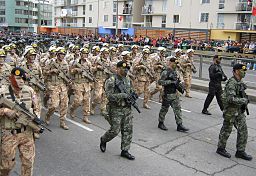
Military demonstration in Peru (2011), courtesy of User Marcomogollon
The TRC was created during a specific political context, that of political transition. Somehow, it was a “charismatic situation” where political will to make important institutional changes seemed to exist, even if it never was particularly powerful. However, when the TRC released its report many things had changed. The military had to some degree regained its influence in Peruvian political life. And the country was starting a cycle of economic prosperity that completely captured the imagination of the political elite. These and other factors conspired against a more earnest reception of the narrative laid by the TRC. Although state officers paid lip-service to the recommendations of the TRC, there was wide consensus among the elite that it would not be necessary to further look into past wrongdoings.
From 2003 onwards, a state of denial has taken place in Peruvian political life. This is related to a reluctance to hold the military accountable for their wrongdoings. But the problem should be read with a broader perspective. It is linked to the possibilities of Peruvian State of speaking the language of recognition and of guilt at the precise moment when statecraft is imagined with another language: efficiency, competitiveness, and macroeconomic discipline. Notwithstanding active and interested opposition to truth and memory, denial is in many cases a “residual or default attitude”: the vocabulary of memory and recognition does not fit in the current state language in the same way, that, for instance, the language of development does.
The Final Report of the Truth and Reconciliation Commission was submitted to the President of the Republic and to the presidents of the Congress and of the Judicial System on August, 28th 2003. The Final Report is composed by 9 volumes plus 12 annexes.
Social Memory
However, a “blooming of memory” is taking place in Peru at the same time. Victims’ organizations and memory initiatives have spread and, although they are not very strong, their presence is conspicuous in some territories. However, they are barely a plain repetition or positive sanction of what the TRC said in its final report.There is a friendly,though problematic,relationship between official truth-seeking and local, non-official memory projects that should be regarded as a promising feature of the Peruvian social process of these days. Ritual remembrance of violence through dramatic and plastic representations is common among the Andean population who was most severely stricken by violence. At the same times, peoples who were the targets of massacres by the Shining Path, or by the military, are recounting their own stories by themselves and, most importantly, for themselves, as a means of dealing with lingering conflicts and hatreds. For them, the master narrative offered by the Truth Commission is an important reference, but one to be built upon: not to be forgotten neither to be taken at face-value.
Two Final Comments
Memory is thus an ungovernable process in Peru, as it is elsewhere. But should it be? This question is related to another one that deals with the necessity of commissions that are producers of master-narratives. What is the purpose of it all? There are two possible answers to this question. One of them is related to the “blooming” of memory after a Commission has offered its broad, generalizing interpretation of the process. It has happened so in Peru, andone explanation for it may be precisely the existence of a national, authoritative conceptual framework which local, non- official, direct memory can rely on to elaborate particular narratives more confidently. The other response is more politically framed. Social diversity is desirable but it is not necessarily efficient in order to produce political and legal outcomes. The price of political efficiency is to some extent the building of some homogeneity; a common language is necessary in order to transform social outrage in public demand. The process of memory in Peru is still gaining strength five years after a national, official experience of truth-telling was performed. Its transformation into a political transforming force is still a matter of hopeful expectancy.
***
[Note: Original published in Dialogos Magazine. Providence: CLACS, Brown University. 2009.]
Félix Reátegui, sociologist, is member of the Institute for Democracyand Human Rights of the Pontificia Universidad Católica del Perú (PUCP). He worked in the Truth and Reconciliation Commission in Perú (2001-2003), where he was chief of the Editorial Committee of the Final Report. Currently, he is professor at the Social Science Department of the PUCP.