
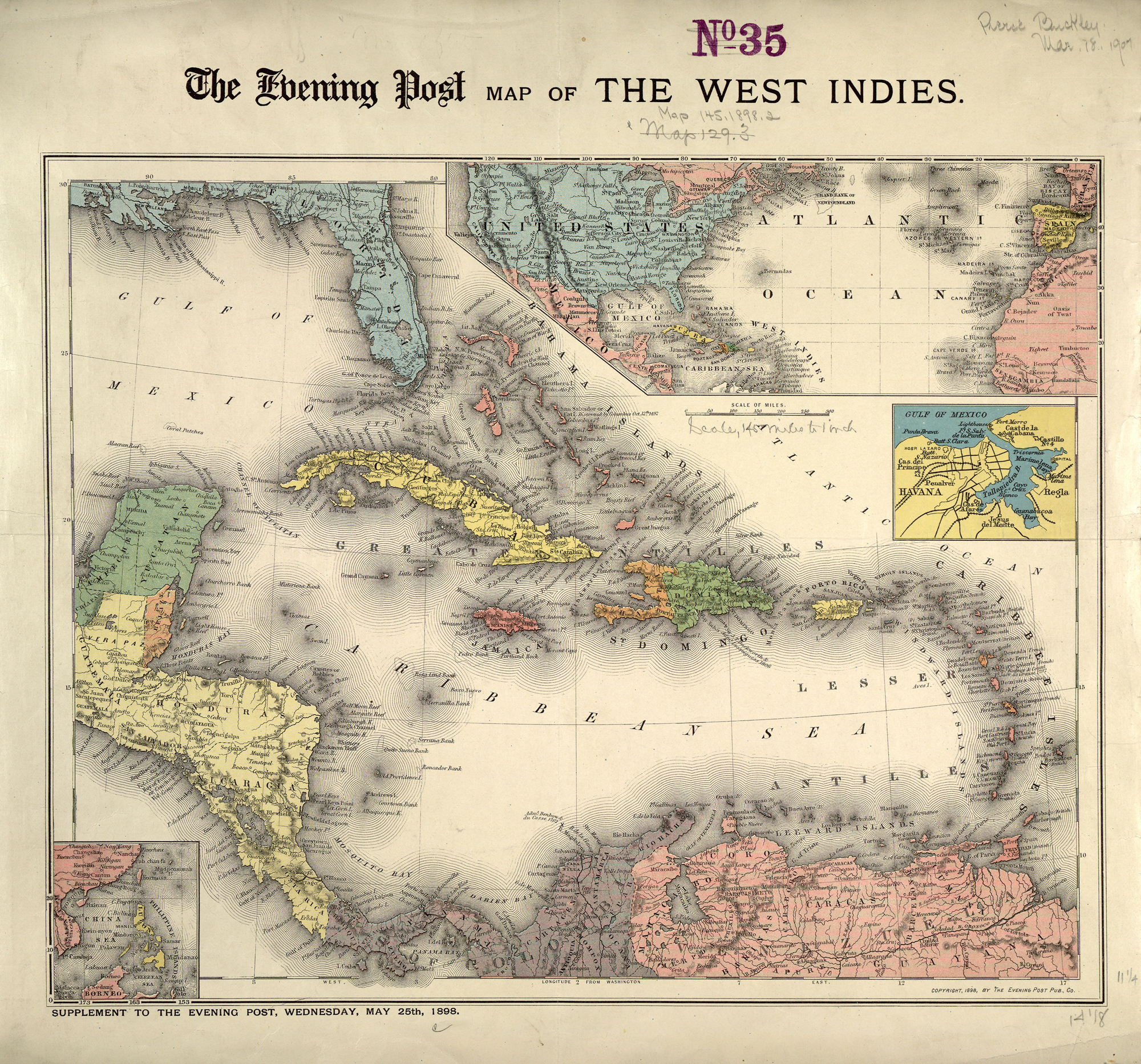
Map of Caribbean, 1898
There can be peril in proximity to the United States. Along with Mexico and Central America, islands of the Caribbean have shared this stark reality. Through trade, investment, invasion, and diplomacy, the United States exerted extraordinary influence over trends and events in this area throughout the twentieth century. Together with Central America, analysis of the Caribbean provides important perspective on challenges facing the region as a whole and on the complexity of inter-American affairs.
Islands of the Caribbean Sea tend to be small. Topographies vary from the flat plains of Barbados to the rugged coasts of Martinique and Guadeloupe. A few of the islands, like Cuba and Jamaica, have rolling hills and substantial mountain ranges. The climate is mild, rainfall is abundant, and soil is fertile. Similarly, the modern-day states of Central America line the western edge of the Caribbean basin. From Guatemala to Panama, the isthmus exhibits sharp contrasts: a spectacular mountain range, studded by volcanoes of 10,000 feet or more; some arid zones; and verdant jungles along the coasts. There are lakes in the mountainous areas but no major navigable rivers. Nor do the coasts have sufficient deep-sea harbors. As in the rest of the Caribbean basin, nature can bring calamity through violent earthquakes, torrential rains, and devastating storms.
From Colonies to Nationhood
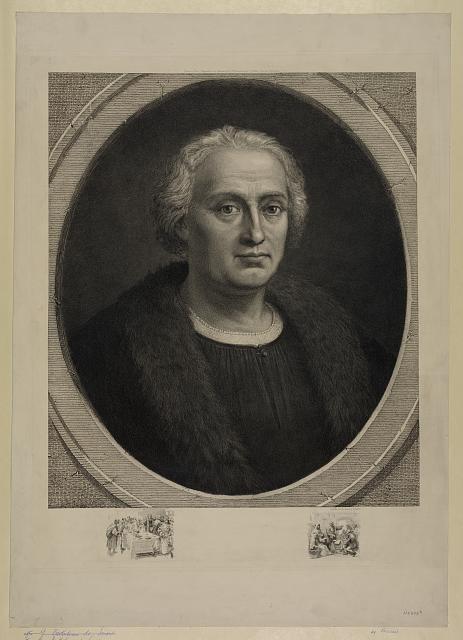
Christopher Columbus
Columbus landed on a sizable island in December 1492 and christened it La Española (Hispaniola in English). His arrival signaled the inexorable doom of the area’s native population, estimated at 750,000 persons, divided among three separate groups: Ciboney or Guanahuatebey, Taino Arawak, and Carib (from which the region gets its name). Unable to develop significant trade, the Spaniards chose to exploit the island as a source of land and labor through the encomienda system. Semifeudal institutions were imposed upon the native society. Indians were forced to work in mines and fields. Harsh labor conditions and physical contact with Spaniards led to their decimation: disease and debilitation took a staggering toll. Realizing what fate held in store, many fled to the mountains in search of safety and freedom. As in New France and New England, the native population fell victim to virtual elimination.
It was in the Caribbean where Spanish clerics first protested against abuse of the natives. In 1511 Antonio de Montesinos shocked a congregation in the island colony of Santo Domingo by denouncing maltreatment of the Indian population. Soon afterward Bartolomé de las Casas began his fervent campaign to protect the Indians from adventurers and conquerors. In response to these pleas, the crown ultimately agreed to regulate the treatment of the native population. But to protect the American natives, Las Casas also made a fateful suggestion: that Spain import African slaves as a source of necessary labor.
Seeking Independence
What is now Haiti, on the western side of the island of Hispaniola, was once one of the most prosperous overseas possessions of France. The island’s original inhabitants were almost entirely replaced by African slaves imported to work on sugar estates. During the French Revolution, Haiti’s residents, including landowners of mixed African and European descent, were granted full citizenship, a move that white estate owners resented. Resulting conflicts led to a wave of rebellions. This time the slaves wanted not only personal freedom but national independence as well.
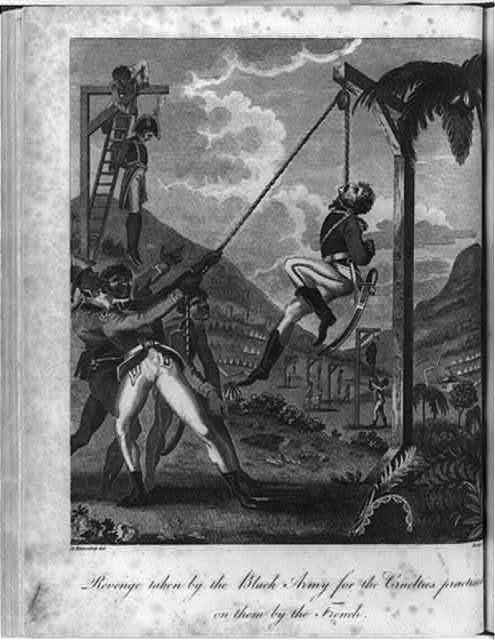
“Revenge taken by the Black Army for the cruelties practised…by the French”
Under the leadership of Pierre Dominique Toussaint L’Ouverture, the blacks of Haiti revolted in 1791 and in 1804 declared national sovereignty. This was to be the second free nation in the Americas and the first independent black country in the world. Although Toussaint led the rebellion, he was seized and sent to France, where he eventually died in an obscure dungeon. It was one of his lieutenants, Jean Jacques Dessalines, who proclaimed the nation free from colonial rule.
The wars broke up and destroyed the large sugar estates. Land was at first worked collectively under a system called the corvée, but individual aspirations in the postindependence period led to the distribution of parcels to freeholders. Thus the legacy of large oligarchic landowners, so prevalent elsewhere in Latin America, did not take root in independent Haiti. Instead, a large number of small holdings replaced the sugar estates, and production decreased drastically. Independence gave power to the blacks, who still form about 90 percent of the population, a fact that light-skinned mulattoes have resented all along. Indeed, the mulattoes became a prosperous minority, clinging to an ideal of French civilization and speaking French on a regular basis. The majority black population, by contrast, spoke a native language, Haitian, and found spiritual inspiration in vodum, an eclectic blend of Dahomian religions and Catholicism. A kind of caste system divided the mulattoes from the blacks, and conflict between the two elements formed a persisting theme in Haitian history.
These events had complicated spillover effects throughout Hispaniola. Since the late seventeenth century, colonial authority over the island had been divided between France, with Saint-Domingue (later renamed Haiti), and Spain, with Santo Domingo. This pattern began to unravel in 1795, when Spain ceded Santo Domingo to France in the Peace of Basel (thus settling one of Europe’s endless wars). This gave France titular possession of the entire island. When Haiti achieved independence in 1804, however, the eastern part of remained under French authority. And when Napoleon invaded Spain in 1808, the creoles of Santo Domingo rose up in protest against France—and, as loyal subjects of the crown, they restored Spanish rule over their colony. Powers came and powers went: this incipient phase of Dominican independence resembled a game of musical chairs.
Plots and counterplots ensued for the next dozen years. As insurgent military campaigns gained momentum in Mexico and South America, local leaders of Santo Domingo in 1821 declared the independence of what they decided to call “Spanish Haiti.” Within a matter of months, armed forces from Haiti invaded the country, seized power, and imposed a military government. As on their side of the island, Haitian authorities took radical steps—abolishing slavery, nationalizing property, and reducing the role of the church. The Haitian occupation lasted for twenty-two years, when local patriots finally ousted the invaders. This made 1844 the second date of Dominican independence—this time from Haiti, not from a European power.
Haitian forces mounted near-continuous invasions against its neighbor throughout the 1840s and 1850s. Out of exasperation and fear, one enterprising Dominican president hit upon the ideal solution: he returned his country to Spain, which resumed colonial rule from 1861 to 1865. This action provoked bitter protest in Haiti, apprehensive about Spanish power, and in the United States, outraged by such a flagrant violation of the Monroe Doctrine. Shortly after Spain was driven out, another national leader pursued yet another solution: annexation to the United States. Surely, this would protect the struggling nation from further intrusions by Haiti or anyone else. U.S. president Ulysses S. Grant strongly supported the plan, thinking it might provide a homeland for American slaves freed by the Civil War, but the proposal failed to obtain congressional approval.
The Dominican Republic thus lapsed into independence almost by default. Its citizens suffered a series of self-seeking and vainglorious rulers. Most prominent among them was Ulises Heureaux, a dictator who ruled from 1882 to 1899 in ways comparable to those of Mexico’s Porfirio Díaz. Political intrigue and economic disarray thereafter plagued the nation, which would eventually find itself under U.S. military occupation by 1916. Authentic sovereignty looked like a mirage.
Overview: Economic Growth and Social Change
As explained in Chapters 4 and 5, economic developments in Central America and the Caribbean produced a common denominator. With few exceptions, such as Costa Rica, countries of these regions forged “plantation societies” that shared a cluster of defining characteristics:
- Extensive production of export cash crops on large-scale latifundios (a.k.a. haciendas, fincas, estates, or plantations)
- Mobilization (and control) of rural labor for harvesting and related tasks
- Concentration of land ownership in very few hands
- Inadequate emphasis on subsistence farming, usually carried out on tiny minifundios
- Formation of economic and social “enclaves” where local elites and foreign owners could live and work in relative isolation from the host society at large.
Plantation societies survived in small countries which lacked the population and resources to undertake industrial development. They were economically vulnerable to overseas changes in market conditions. But because of their institutional rigidity, they were resistant to change. Beneath superficial appearances of harmony, they could give rise to volatile discontent.
Sugar (and More Sugar)
The principal crop in the Caribbean was sugar. One of the early expeditions from Spain brought sugarcane cuttings from the Canary Islands, an act that would alter the course of history. And after the Dutch brought new technologies from the Brazilian Northeast to the Caribbean in the mid-seventeenth century, the production of sugarcane exploded. It became virtually the only crop on British islands, especially Barbados and Jamaica, and it was the dominant crop in French areas, including Martinique and Saint-Domingue (i.e., Haiti). Together, colonial holdings in the Caribbean accounted for 80 to 90 percent of all the sugar consumed in eighteenth-century Europe. By the 1740s, Jamaica and Saint-Domingue were the world’s largest producers of sugar.
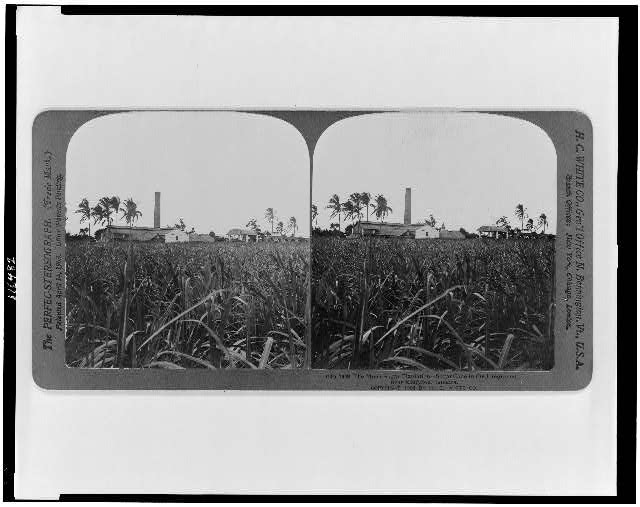
Sugar plantation in Kingston, Jamaica
As production increased, the need for labor became all the more apparent. African enslavement appeared to provide a solution. Thus began the tragic history of forced migration from the western coast of Africa. Of the 10 to 15 million people who were sent to the New World as slaves, approximately 5 to 7 million found their way to the Caribbean—where they would work on sugar plantations, alter the racial composition of the area, and, ultimately, help to establish commercial links with nineteenth-century Europe and the United States.
The loosely organized societies of the sixteenth century, dominated by whites and small-household units, gave way to a strictly organized and hierarchical society of masters and slaves by the seventeenth century. Production was firmly controlled by the mother countries. With the exception of England, each European country formed its own trading company; in addition to the casa de contratación of Spain, there were the Dutch West Indies Company and the French Compagnie des Isles d’Amérique.
A primary consequence of these developments was the creation of a rigid system of racial stratification. Virtually everywhere a three-tiered pyramid existed: whites at the top, browns in the middle, and blacks at the bottom. As whites returned to Europe and Indians disappeared, the African heritage became dominant. This pattern would have long-run effects on race relations in the region and would sharply distinguish the Caribbean from mainland areas, such as Mexico and Peru, with large and persisting indigenous populations.
Another result was the transformation of once-diversified systems of production into single-product economies, emphasizing sugar for export. Most consumption needs had to be imported—from other islands, from the mainland, or from Spain itself. Only on the smaller islands, such as Grenada, were other products (in this case, coffee) more important than sugar. Since most of the original population had died and Spanish settlers did not like to work with their hands, the demand for slaves continued through the eighteenth century.
Plantation owner’s house
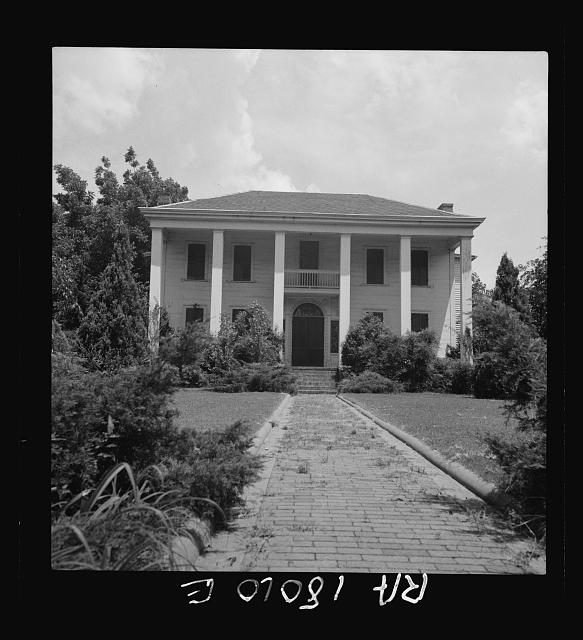
European demand for sugar permitted many of the settlers to make large fortunes, which they used to build great manorial houses and to purchase acceptance into the political and social life of the mother country. Yet French and British colonists never felt at ease on the islands. Most longed to return home, and, in fact, some went back to positions of power and prominence. If there appeared a plantation aristocracy in some parts of the Caribbean, it was not a deeply rooted one.
Spanish colonists initiated sugar production in Santo Domingo in the early sixteenth century, when they also began importing African slaves. Production grew steadily over the years and expanded in the eighteenth century. The Dominican sugar industry received a substantial boost in the mid-nineteenth century as a result of three factors: civil strife in Cuba, which led some prominent planters to transfer their operations to the Dominican Republic; warfare in Europe, which wrought devastation on the continental sugar beet industry; and the U.S. Civil War, which reduced sugarcane production in Louisiana and further reduced the competition. In the early 1880s a market crash led to a temporary decline in the harvest; it also resulted in sharp concentration of ownership because only the largest mills were able to survive.
As production recovered, labor for the backbreaking work on plantations was imported directly from neighboring Haiti. Continuation of this trend would provoke social and racial tension within Dominican society. Relations between the two countries had never been very good; the degrading treatment of Haitian workers in the Dominican Republic only made things worse. Anti-Haitian sentiment often took the ugly form of racial prejudice.
As in Cuba, American investors began showing interest in Dominican sugar around the turn of the century. U.S. military intervention from 1916 to 1924 sealed this bilateral relationship. By the end of the occupation, two American conglomerates owned eleven out of the twenty-one ingenios (mills) in the country—and five of the others were owned by U.S. citizens. Almost all Dominican sugar exports were sold on the U.S. market. Production climbed strongly through the 1920s, held steady from the 1930s through the 1940s, then soared upward in the late 1950s. After Cuba, the Dominican Republic was the second-largest producer of sugar in the Caribbean. Hardly any of the profits were reinvested in the local society. This was an enclave economy par excellence.
For Haiti as well as the Dominican Republic, reliance on the American market accentuated over time. As shown in the table below, the U.S. share of Haitian exports climbed from 14 percent in 1920 to 58 percent in 1950 and 86 percent by 2000; similarly, the U.S. share of Dominican exports rose from 79 percent in 1920 to 87 percent by 2000. (Postwar Europe consumed a very large share of Dominican sugar production in the late 1940s and early 1950s, accounting for the low proportion of U.S. exports in that era.) Ever since the early 1960s, the Dominican Republic has held the largest single allocation of the U.S. sugar import quota. The United States was also the largest single source of imports in both countries, although the European Union was making headway as the twentieth century came to an end.
Caribbean Trade with the United States, 1920–2000 (as % of total) ____ 1920 ____ ____ 1950 ____ ____2000 ____
Exports Imports Exports Imports Exports Imports
Haiti 14 81 58 72 86 62
Dominican Republic 79 42 38 73 87 59
Sources: James W. Wilkie, Statistics and National Policy (Los Angeles: UCLA Latin American Center, 1974); Economist Intelligence Unit, Country Reports, 2003.
Politics and Policy: The Dominican Republic
Santo Domingo, Dominican Republic
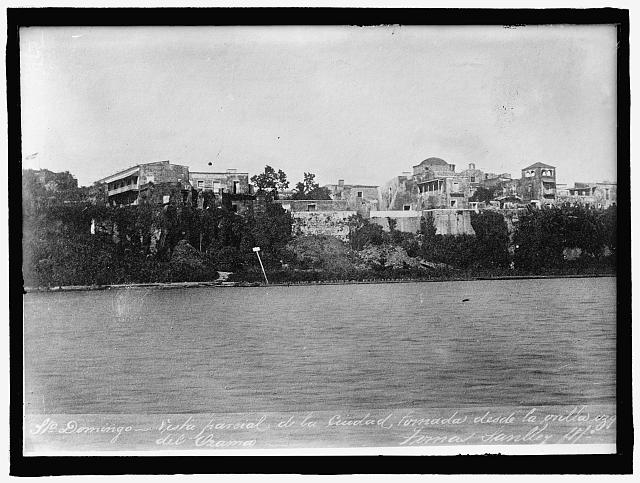
The strategic position of Hispaniola made the island important to the United States, committed by the early nineteenth century to keeping European powers from intervening in the hemisphere. Anarchy and chaos had prompted the United States to intervene at various times. From 1916 to 1924, U.S. Marines occupied the Dominican Republic (as well as neighboring Haiti). A National Guard was created to fight guerrilla bands. Among the most brilliant disciples of the American occupation force was Rafael Leonidas Trujillo, an ambitious soldier who would eventually become one of the most ruthless dictators in the hemisphere.
Thanks to the stimulus of World War I, which boosted prices for exports, economic conditions improved in the Dominican Republic during the American occupation. U.S. troops strengthened the country’s infrastructure, upgrading the educational system and imposing control on public finances. Critics nonetheless began to complain about the “dumping” of inferior U.S.-made products on the local market and about the general disdain the invaders displayed for local citizens.
An agreement between the United States and Dominican leaders in 1922 led to the formation of a provisional government. Two years later, elections gave power to Horacio Vázquez, a respected politician of long standing. Yet in 1929, Vázquez made the error that has plagued so many leaders in Latin America’s history: he tried to revise the constitution so he could run for office again.
A rebellion erupted, and Trujillo presented himself as a candidate in the 1930 elections. Wielding his power base (the National Guard), he made clear that he would win at any cost and claimed victory with 95 percent of the vote. He quickly began banishing political opponents from the scene. The future belonged to Trujillo.
As with so many dictators, Trujillo exploited the country’s resources in order to amass his own personal wealth. During the 1950s the average annual growth rate was 8 percent, an impressive performance by any standard, but benefits failed to reach the general population. Much of the nation’s income was stashed in foreign bank accounts, while peasants and workers remained woefully poor. Paradoxically, economic prosperity heightened contradictions between Trujillo and his coterie of sycophantic supporters: the more he took for himself, the more discontented his collaborators became. The most egregious offense involved his personal takeover of the sugar industry: by 1957 Trujillo controlled more than 70 percent of the nation’s production. In 1961 his former friends and cronies, not his enemies, staged a coup and masterminded his assassination.
Free and fair elections in 1962 led to the triumph of Juan Bosch, a former journalist and social reformer who sought to confiscate and redistribute Trujillo’s landownings as part of a program of agrarian reform. His efforts at improving the lot of the masses aroused discomfort among the traditional elites, who saw his innovations as dangerously “communistic.” A military coup ousted Bosch in 1963. A countermovement then sought to reinstate him as president. The resulting conflict led to a civil war between the armed forces and the pro-Bosch “constitutionalists,” mainly workers and students.
As the struggle intensified, the United States under Lyndon B. Johnson grew fearful of “another Cuba” and took over the country in April 1965. The invading force consisted of 22,000 marines, a contingent whose size amazed even American officials on the scene.
To justify its action, the U.S. government tried to engage the participation of other countries from Latin America through the OAS. Favorable responses came only from Paraguay and Brazil, both under right-wing military rulers. The Johnson administration’s attempt to form an “inter-American peacekeeping force” not only failed to legitimize the intervention, but also discredited the OAS as a whole and contributed to the subsequent debilitation of that institution.
The U.S. intervention led to the formation of an interim government and, eventually, to elections in June 1966. Victory went to Joaquín Balaguer, an ex-Trujillo official and favorite of the United States. With full blessing from Washington, the Balaguer government implemented a number of important developmental programs. Housing was built, land was distributed, and education was strengthened and improved. Austerity programs reduced severe problems with the balance of payments, and, to assist with these and other challenges, aid from the United States climbed to more than $132 million for 1968. Agricultural production rebounded and foreign investment responded. Economic growth was substantial.
The Dominican armed forces underwent moderate reform, and its most recalcitrant elements were dispatched abroad, often on fictitious diplomatic missions. Despite poverty and deprivation, the transition toward democracy continued. Elections survived minor threats in 1970 and in 1978, when the armed forces threatened to annul the results, but on both occasions the outcome was eventually allowed to stand. Balaguer’s opponents won the elections of 1978 and 1982, but he bounced back to win three subsequent times—in 1986, 1990, and 1994.
After Balaguer finally retired from public life, partisan squabbling came to characterize the political process. The elections of 1996 resulted in triumph for Leonel Fernández Reyna, an able and charismatic politician who nonetheless faced opposition majorities in both houses of the legislature—which gleefully paralyzed executive policy initiatives. Elections in 2000 led to victory for Hipólito Mejía, who presided over the collapse of one of the country’s largest banks, a scandal that discredited most of the political class. Despite resistance from within his own party, Mejía insisted on running for reelection in May 2004. After a highly charged campaign, he lost by a wide margin to Fernández Reyna, who was reelected president in 2008. Despite spurts of economic growth, the nation still faced significant social and economic problems. As part of a focus on modernization, Fernández initiated many programs, including the construction of the El Metro railway in the capital city of Santo Domingo to address serious transportation problems. that have contributed to the technological advancement of the country. He was succeeded by Danilo Medina of the Dominican Liberation Party in 2012, who defeated the Revolutionary Party’s candidate Hipólito Mejía. Medina has promised to focus investment more on social programs and education than infrastructure.
Politics and Policy: Haiti
Like other island nations of the Caribbean, Haiti fell under the long shadow of the United States in the twentieth century. As the second republic in the Americas, independent Haiti faced many challenges. Political life was plagued by instability. From 1804 to 1867 Haiti had only ten chief executives. From 1867 to 1915 there were sixteen presidents, with an average term of only three years. And from 1911 to 1915 Haiti faced one of its most chaotic periods, during which time six presidents met violent deaths.
Confronting World War I and equipped with “dollar diplomacy,” the United States occupied Haiti in 1915 and stayed until 1934. This was a full-scale military occupation. U.S. authorities abolished the army and replaced it with a national police force. A cadre of American technicians and bureaucrats took over the financial administration of the country, ensuring prompt payment of all foreign debt obligations (especially those owed to the United States). New public works were initiated and old ones were repaired, but the majority of the population regarded the foreigners with smoldering resentment.
One reason for this feeling was dismay over the loss of sovereignty. As an occupying force, the United States took over general administration but, in particular, the management of the customs houses. As a matter of fact, American financial experts would remain in Haiti until 1941—seven years after the departure of the military garrisons. Another reason was the marked preference of U.S. officials for the mulattoes, whom they brought to power in a variety of ways—including the superficial election and reelection of Sténio Vincent as president during the 1930s.

President Vincent visits President Roosevelt
In time the black population, backed by the Haitian Guard (as the police force was known), ousted another mulatto president and installed Dumarsais Estimé in 1946. He replaced mulatto officials with blacks and undertook a series of reforms designed to benefit both urban workers and agricultural producers. He discharged the country’s debt to the United States and signed an agreement with the Export-Import Bank for the development of the Artibonite Valley. In 1950 Estimé tried to amend the constitution so he could remain in power, and for this he was deposed by the army and sent into exile.
Control passed to Colonel Paul E. Magloire, a black leader who was influential within the army and popular among the nation’s masses. At his inauguration he promised to safeguard the rights guaranteed by the constitution, to continue irrigation projects and other public works, and to promote public education. In the international arena Magloire sought good relations with the United States, while the increase in export prices brought on by the Korean War helped to stimulate economic growth. Resented by ambitious rivals, he was overthrown in a coup in 1956.
After months of uncertainty, there emerged the figure of François Duvalier, who had himself elected president in September 1957. Soon after seizing power, Duvalier set out to bend the nation to his will. The army, the police, and the security forces became accountable to him alone. He created a special police force, which came to be known as the Tontons Macoutes, the most dreaded repressive force in the country. Through sheer terror he rid himself of his opponents and maneuvered elections to become president for life (président à vie). As necessary, he mobilized large crowds with insistent propagation of the official slogan: Dieu, Duvalier, et le frapeu, un et indivisible—God, Duvalier, and flag, one and indivisible.
A proponent of noirisme, a movement that looked to Africa for inspiration, Duvalier expelled mulattoes from the national bureaucracy. He gained influence over the masses by cannily associating himself with the figure of Baron Samedi, the earthly keeper of the vodum tombs. He created a sort of latter-day court, whose favorites gained riches through the dispensation of state favors. To institutionalize a system of kickbacks, Duvalier even set up an umbrella organization, the Movement for National Renovation, which collected contributions from business and high government employees for the ostensible purpose of building public facilities. Needless to say, the money was never used for such ends.
Until his death in 1971, Duvalier took the side of the United States in most international arenas, including the United Nations and the OAS. On occasion pro-U.S. votes would lead to increased aid or loans for his corrupt regime. For the most part, American governments tolerated Duvalier as a distasteful but useful if unpleasant ally in the Cold War.

Jean-Claude Duvalier
As death neared, Duvalier persuaded the National Assembly to lower the minimum age for president from forty to eighteen and proceeded to install his son as his successor and président à vie. Young Jean-Claude Duvalier, or “Baby Doc” as he was sometimes known, inherited a bitterly impoverished country. Though he may have been less brutal than his father, he retained a parasitical group of favorites—a “kleptocracy” of sorts. Government became a means of self-enrichment. Popular discontent and internecine struggles finally led to his demise in February 1986, when he boarded a U.S. Air Force plane and departed for France.
Political recovery was tentative. For decades the opposition had been suppressed, labor unions controlled, and the media corrupted. When Baby Doc left the country, there were cries for liberty and calls for dechoukaj, an “uprooting” of the Duvalier regime: tombs and statues fell, policemen felt popular wrath, and erstwhile collaborators fled the country. Elections in 1987 resulted in a bloodbath, as paramilitary forces assaulted voters and opposition candidates. A subsequent ballot resulted in the controversial election of Leslie Manigat, a well-known social scientist who lasted in office for less than a year. Yet another coup led to the ascendancy of General Prosper Avril, an ambitious young military officer who revived the Tontons Macoutes and imposed a new wave of repression. To many observers it appeared that Haiti was suffering from “Duvalier without Duvalier.”
Authentic change began in 1990. Protest demonstrations and a general strike persuaded Avril to leave the country. Under a woman interim president, Ertha Pascal-Trouillot, open elections took place in December 1990. Emerging with two-thirds of the vote was Jean-Bertrand Aristide, a Roman Catholic priest who espoused liberation theology and advocated far-reaching political and social change. In January 1991 disgruntled “Duvalierists” attempted a military coup to prevent the “communist” Aristide from taking office: the effort failed but left 74 dead and 150 injured. Later in the year, unruly elements within the military ousted him from office. The United States and other nations promptly condemned the coup, and the OAS slapped an embargo on trade with Haiti, but diplomatic negotiations for a peaceful solution to the crisis dragged on for years.
As Haitians sought to escape the oppression imposed by the new military regime of General Raoul Cédras, it was the prospect of a large-scale flood of immigrants that gave shape to U.S. policy. The Coast Guard started picking up thousands of Haitians who were attempting to reach U.S. shores on homemade rafts and took them to an encampment at the U.S. naval station at Guantánamo (in Cuba). In May 1992 President George H. W. Bush ordered the Coast Guard to return all Haitian rafters to their homeland without any screening for political amnesty. Democratic presidential candidate Bill Clinton denounced the Bush policy as “a callous response to a terrible human tragedy,” but then consented to its continuation after his election as president. By early 1994 leaders of the African American community mounted sharp criticism of Washington’s inaction, and Clinton reversed himself by announcing that U.S. authorities would process rafters at sea and grant asylum to victims of political repression. This led to yet another wave of rafters.
Despite public skepticism, Clinton began to contemplate the use of military force. In mid-September he denounced the Cédras government as “the most violent regime in our hemisphere” and stressed the dangers of inaction: “As long as Cédras rules, Haitians will continue to seek sanctuary in our nation. . . . Three hundred thousand more Haitians, 5 percent of their entire population, are in hiding in their own country. If we don’t act, they could be the next wave of refugees at our door. We will continue to face the threat of a mass exodus of refugees and its constant threat to stability in our region and control of our borders.”
As tension mounted, Clinton dispatched a high-level delegation under former president Jimmy Carter for a last-ditch effort at negotiation. At the final minute, as U.S. troops were already en route for an invasion of Haiti, Carter reached an agreement with the Cédras government. Clinton canceled the invasion but instead imposed an occupation; in less than a week there were more than 15,000 American troops on the ground. Aristide returned to office in mid-October, and the U.S. occupation gave way to an international peacekeeping force in early 1995.
Under intense international observation (and quasi-military occupation), elections took place in an orderly fashion. Aristide resisted the temptation to succeed himself, and René Preval, one of his former associates and ex–prime minister, took office in February 1996. Governing was something else again. Aided and abetted by the international community, Preval sought to impose pro-market economic reforms. Aristide suddenly moved into the opposition, refurbished his populist credentials, and assumed the leadership of the Lavalas Party. Strikes, demonstrations, and violence mounted.

Haitian Presidential Palace
The political stalemate continued through the presidential election of November 2000, which Jean-Bertrand Aristide won by an overwhelming—but contested—majority. In protest against electoral irregularities in parliamentary contests, the oppositionist Convergence Démocratique refused to recognize the legislative victory of Aristide’s Lavalas Party. Aristide nonetheless took office in February 2001. Once a hero to Haiti’s poor and underprivileged, Aristide seemed ever more distant from his people—and ever more inclined to impose his will through autocratic means. Street protests resumed, and violence continued to plague the political process.
The economy was faring no better. By 2000 the growth rate had declined to less than 1 percent. In both 2001 and 2002 economic output contracted by 21 percent. Three-quarters of the population was living in abject poverty. Less than half the adult population was able to read and write. Unemployment was running around 60 percent.
Matters came to a head in early 2004. While Aristide retained a substantial amount of popular support, opponents claimed that he had become autocratic, intolerant, and corrupt. Dissident gangs clashed with pro-Aristide groups known as chimères. Under the leadership of Guy Philippe, a former officer in the long-discredited Haitian army, armed rebels advanced through provincial cities and soon approached the capital of Port-au-Prince. Appeals by the besieged government for help from the international community, especially the United States, were to no avail. Faced with the prospect of large-scale civil war, Aristide resigned and left the country. Critics chided U.S. president George W. Bush and Secretary of State Colin Powell for failing to support a democratically elected government in the Americas.
Together with detachments from Canada and France, U.S. Marines moved in to establish a modicum of order. In 2006 René Preval was elected president with over 50 percent of the vote. After several unsuccessful attempts to appoint a prime minister, the president designated Michèle Pierre-Louis, the director of an internationally recognized educational foundation. Off to a shaky start, the government faced endemic poverty, unemployment, and social unrest. Haiti remained in desperate conditions.
In late August of 2008 Haiti was battered by tropical storms and hurricanes, leaving 331 dead and 800,000 in need of aid. The situation was worsened by high food and fuel prices. Furthermore, a 2010 earthquake killed between 45,000 and 85,000 people. Ineffective governance has stalled Haiti’s recovery. Elections were held in November of 2010 and Michel Martelly won over Mirlande Manigat. Martelly has worked to strengthen the economy and guarantee reparations for victims of the earthquake, but has also been accused of accepting bribes from corporations. The nation continues to face serious economic and social challenges.
Politics and Policy: Puerto Rico

Puerto Rico
As we have seen, U.S. administrations—Republican and Democrat alike—asserted their right to interfere directly in the domestic affairs of countries in Central America and the Caribbean for the sake of “national interests.” One island nation, however, remained under permanent American control.
Puerto Rico became part of the United States as a result of the Spanish-American War. In July 1898, in retaliation for the sinking of the U.S. vessel Maine in Cuba, American troops disembarked in Puerto Rico, initiating the country’s first act of European-style colonial expansion. The island thus became the pawn in a war between Cuban patriots and Spanish garrisons. It had not expected military occupation.
Quite the contrary. Spain had already agreed to grant Puerto Rico autonomy and to devise some sort of “home rule” for the island. The U.S. invasion changed all of this. Suddenly, Puerto Rico became a crucial factor in U.S. global strategy—not only because of its potential for investment and commerce, but also because of its geopolitical role in consolidating U.S. naval power. But there remains a basic question: Why did the United States take Puerto Rico as a colony while helping Cuba achieve independence?
The difference may well reside in the histories of the two islands. There was a long-standing armed insurrectionary movement against Spain in Cuba, an island which would have been much more difficult to occupy. Puerto Rico, however, was on the way to a negotiated settlement and could present less resistance to outside forces. Puerto Rico thus became caught in a complex struggle between major powers and Cuba’s insurgents.
Puerto Rico bore clear signs of Spanish domination. During the colonial period, the island had served as an important military garrison and commercial center, a role that intensified as the slave trade reached its peak in the 1700s. Sugar production became the predominant agricultural enterprise. There were also small farmers, jíbaros, rugged individualists who cultivated staple crops and helped maintain a diversified economy. Because of this, the slave population always remained a minority.
After the arrival of the marines, Puerto Rico developed a peculiar relationship with the United States. After 1898 residents of the island had no clear legal status of any kind. In 1917 they were granted citizenship in the United States. In 1947, nearly half a century after the invasion, Puerto Rico was permitted to attempt self-government. In 1952 the island was granted “commonwealth” status within the United States. This remains an ambiguous situation: Puerto Rico is neither a nation nor colony nor a state, but something else again.
To develop the island, to demonstrate the virtues of free-world capitalism, and to provide an inspiration for Latin America, the United States collaborated with dynamic governor Luis Muñoz Marín to undertake “Operation Bootstrap” during the 1950s and 1960s. Under this plan, the U.S. federal government would encourage investments in Puerto Rico through a series of tax holidays and other allowances. Bootstrap wrought tremendous changes in the social and economic life of Puerto Rico. Sugar estates and small farms were replaced by factories; as industrialization thrived, citizens joined the ranks of the laboring class. But the overseas investments did not provide enough jobs to absorb the growth in the working-age population, and the result was massive unemployment.

Puerto Rican immigrants in New York
One consequence was to accelerate the flow of migrants to the U.S. mainland, where 40 percent of Puerto Ricans came to reside. Fully one-half of the migrant population settled in New York City. In a sense, this trend formed two Puerto Ricos: one on the island and one on the mainland. There has been considerable movement and communication back and forth, but social tensions and cultural differences separate the two communities. In demonstration of this fact, Puerto Rican residents of New York are sometimes known as “Nuyo-ricans.”
Political life on the island has been active and orderly. The chief executive is the governor, who is elected every four years. The dominant issue has been the island’s relationship with the United States. In a 1967 plebiscite on this question, 60 percent favored the continuation and improvement of the commonwealth status, and 38 percent came out in favor of statehood. Those who favored complete independence chose to boycott the plebiscite, but this faction has been vocal and visible (in 1950, in fact, a pro-independence group made an attempt on the life of U.S. president Harry S. Truman).
The pro-statehood forces, represented by the New Progressive Party (PNP), won gubernatorial elections in 1968, 1976, and 1980. Under the leadership of Luis Ferré and Carlos Romero Barceló, this group subscribed to the belief that full statehood would provide working-class Puerto Ricans with increased access to federal welfare programs, stimulate economic growth, and remove the stigma of “second-class citizenship” associated with commonwealth status. Popular support for this movement came especially from urban areas.
The pro-commonwealth party, or Popular Democratic Party (PDP), won the elections of 1972, 1984, and 1988. Its most prominent leader was Rafael Hernández Colón, who called for a greater degree of meaningful autonomy within the commonwealth relationship. As governor, Hernández Colón actively promoted worldwide economic relations for the island and played an active role in the development of the “twin plant” concept—dividing the production process into separate parts, with initial phases to be done in some other area of the Caribbean and final assembly in Puerto Rico.
Concern steadily mounted over economic issues, and, largely as a result of a U.S. recession, Puerto Rico faced a downturn in the early 1990s. Amid this atmosphere the 1992 gubernatorial election went to the PNP’s Pedro Rosselló, who vowed to press for statehood. His first act in office was to sign a bill giving English equal status with Spanish as an official language. And in November 1993, fulfilling a campaign promise, Rosselló held a new plebiscite on the island’s status. To the surprise of many observers, the pro-commonwealth position won with 48.4 percent of the vote; statehood obtained 46.2 percent; the pro-independence stance got only 4.4 percent. Five years later—on December 13, 1998, exactly 100 years and one day after Spain officially ceded Puerto Rico to the United States—yet another plebiscite yielded a similar result: 46.5 percent for statehood, 2.5 percent for independence, 0.4 percent for “free association” or commonwealth status, and 50.2 percent for “none of the above.” The status quo won out again.
Elections of 2000 brought the pro-commonwealth PDP back to power under Sila María Calderón, the first woman ever to serve as governor. As mayor of San Salvador and then as governor, Calderón focused on urban redevelopment, prosecution of government corruption, and an end to U.S. Navy bombing exercises on the offshore island of Vieques. Her successor, Aníbal Salvador Acevedo Vilá, also of the PDP, governed under a cloud of alleged electoral fraud. In 2008 he lost a reelection bid to Luis Fortuño, a pro-statehood candidate of the PNP and card-carrying member of the U.S. Republican Party. His election gave every indication that Puerto Rico would continue its strange and ambiguous relationship with the United States in the foreseeable future.

Luis Fortuño
In November 2012, results from a referendum showed that 54% of respondents disagreed with Puerto Rico’s territorial status, and 61% favored statehood. Yet, in the same month, García Padilla, former President of the PNP and an affiliate of the U.S. Democratic Party defeated Luis Fortuño in the election for governor. As governor, he has reduced the sales tax and signed a trade agreement with Colombia in which Colombia will import Puerto Rican medicine and Puerto Rico will co-manufacture with Colombia so as to share with Colombia its tariff-free relationship with the United States. This initiative is a measure designed to strength the island’s economy by taking advantage of its close links to the United States.