
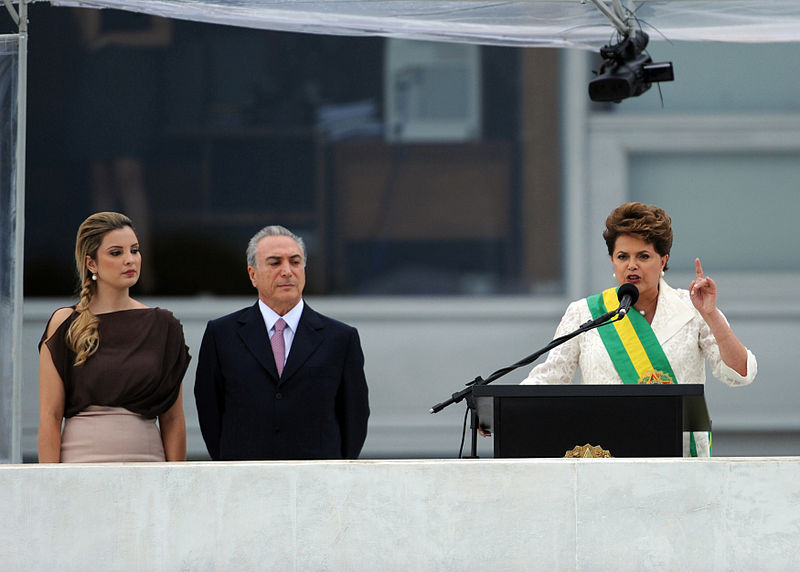
Dilma addresses a crowd at the Planalto palace.
Palace of the Planalto, May 16, 2012
Ladies and Gentlemen,
I would like to begin by quoting the deputy Ulysses Guimarães who, were he still living, would surely occupy a place of honor in this ceremony.
The noble gentleman, as we learned to refer to him, once said, “The truth does not disappear when the opinion of those who disagree is eliminated. The truth would not deserve the name if it died when censored.” The truth, in fact, does not die by being hidden. In the shadows we are all privy to the truth, but it is not just for us to remain apart from it in the light of day.
Although we know that regimes of exception survive through the prohibition of truth, we have the right to hope that, under democracy, truth, memory, and history come to the surface and become known, above all, to new and future generations.
The word “truth,” in the western tradition of the Greeks, is exactly the opposite of the word “forgetting.” It is something so wondrously strong that it does not admit resentment, nor hate, nor even pardon. And so it is, above all, the contrary of forgetting. It is memory and it is history. It is the human capacity to tell what happened.
In installing the Truth Commission we are not motivated by revenge, hate, or the desire to rewrite history in a manner different from what happened, but by the overbearing need to know [the truth] in its entirety, without hiding, without camouflage, without veto, and without prohibitions.
What we are doing here, in this moment, is celebrating the transparency of the truth of a nation that is forging its path to democracy, but which still has a meeting planned with itself. In this sense…and this fundamental sense, this is an initiative of the Brazilian State and not just a government action.
I reiterate that today we celebrate here an act of state. Therefore, I am happy to be accompanied by all the presidents that preceded me in these 28 blessed years.
Sadly, we are not accompanied by President Itamar Franco, to whom I give the homage owed to him for his dignified actions—for his dignified life of fighting for democratic liberty, as well as the zeal with which he governed Brazil, without any concession to authoritarianism.
Each of us here present—ex-presidents, ex-ministers, ministers, academics, jurists, militants for the democratic cause, relatives of the dead and disappeared and even I, a president—each of us, I repeat, is equally responsible for this historic moment of celebration.
Each of us contributed to this mark of civilization, the Truth Commission. This is the culmination of a process begun in the struggles of the Brazilian people, for democratic liberties, for amnesty, for direct elections, for the Constitution, for economic stability, for growth with social inclusion. A process built step by step, during each government elected after the dictatorship.
The Truth Commission was envisioned and carried to Congress during the administration of my fellow traveler, President Luiz Inácio Lula da Silva, whom I had the honor of serving as minister, and who I have the pride to succeed. But it also has its origin in the Law of the Special Commission on Deaths and Disappearances, approved in 1995, in the term of President Fernando Henrique Cardoso. With that opportunity, the Brazilian state recognized for the first time its responsibility for deaths and disappeared persons under its custody. For the dead and disappeared under its custody during the authoritarian regime.
However, it is only fair to say that the process that resulted in the Truth Commission began even earlier, during the mandate of President Fernando Collor, when the archives of DOPS [the Department of Social and Political Order] of São Paulo and Rio de Janeiro were opened, rendering to the public tons of secret documents, which, finally revealed, represented a breath of fresh air for those who sought information about the victims of the dictatorship.
Brazil should pay homage to the women and men who fought for the revelation of the historical truth. To those who understood and were able to convince the nation that the right to truth is as sacred as the right many families have to mourn and bury their loved owns, who were victims of violence carried out by acts of the State or the lack thereof.
This is why, this is certainly why we are all here. Our meeting, today, in such an important moment for the country, is a privilege made possible by democracy and civilized coexistence. It is a demonstration of political maturity that originates in the customs of our people and the characteristics of our country.
As much as it abhors violence and values negotiated solutions to its crises, Brazil surely hopes its representatives can unite in the service of common goals, even though they do not open their hands, though they maintain differing opinions on other issues, as is normal in democratic life.
In inviting the seven Brazilians who are here and who inaugurated the Truth Commission, I was not motivated by personal criteria or subjective appraisals. I chose a pluralistic group of citizens, men and women, recognized for their wisdom and competence. Sensible, thoughtful, concerned about justice and equality and, above all, able to understand the scale of the job they are going to carry out. The job they will do—I make a point of saying—with total liberty, without any interference from the government, but with all the support they need.
When I was fulfilling my assignment of naming the Truth Commission, I invited women and men with a history of identifying with democracy and an aversion to abuses of the state. I invited, in particular, intelligent, mature women and men with the capacity to lead the forces of Brazilian society in search of the historical truth, of the pacification and conciliation of the nation.
The country will recognize in this group, I do not doubt, Brazilians who excelled in the democratic spirit and rejection of useless confrontations and acts of revenge.
We reclaimed democracy in this manner, through irreparable struggles and human sacrifices, but also through national pacts and accords, many of them ratified in the Constitution of 1988.
Just as I respect and revere those who fought for democracy, bravely facing the illegal brutality of the state, and never stopped praising these fighters, I also recognize and validate political pacts that carry us to re-democratization.
Ladies and gentlemen,
Today the Law of Access to Information also goes into effect. Together with the Truth Commission, the new law represents a great institutional improvement for Brazil, an expression of the transparency of the State, a basic guarantee of security and protection to citizens.
Because of this law, never again will data relative to human rights violations be reserved, secret, or top secret. The two—the Truth Commission and the Law of Access to Information—are fruits of a long process of constructing democracy, lasting almost three decade, in which seven presidents of the Republic participated. When I say seven presidents it is because I am including—for the sake of justice and because the motive of our meeting is the celebration of the truth—the fundamental role played by Tancredo Neves, who managed, with patience, competence, and obstinacy, the transition from authoritarianism to the democracy we enjoy today.
It is necessary to remember here that the transition driving us toward democracy was carried out competently, ably, and zealously by President José Sarney, whom destiny and history put in Tancredo’s place.
But, even as we recognize the role that all have played, I cannot stop myself from declaring my pride, that the maturation of our democratic trajectory should coincide with my government. Through that trajectory the Brazilian state opens itself wider to the test, the supervision, and the scrutiny of society.
The Law of Access to Information guarantees the people’s right to know the acts of the government and the state by means of the best information technology.
This transparency, obligatory from today on, also functions by law as an efficient inhibitor of all the ill uses of public money and all violations of human rights. Oversight, control, and evaluation are the basis of an ethical and honest public activity.
This is the reason we have the right to build efficient institutions furnished with instruments that protect them from human imperfections.
Ladies and gentlemen,
I close with an invitation to all Brazilians, independent of the role they played and the opinions they held during the authoritarian regime. We believe Brazil cannot avoid knowing the totality of its history. We will work together so that Brazil knows and owns this totality, the totality of its history.
Ignorance of history does not pacify; on the contrary, it sustains latent wrongs and grudges. Misinformation does not help to appease, it only facilitates the traffic of intolerance. Shadows and lies cannot promote harmony. Brazil deserves the truth. New generations deserve the truth, and most of all, those who lost friends and relatives and continue suffering as if they had died anew and forever each day deserve the factual truth.
It is like saying that if there are children without parents, if there is a nation without a grave, if there are graves without bodies, never, never can history exist without a voice. Those who give voice to history are the free men and women who do are not afraid to write it. There is a phrase attributed to Galileo Galilei regarding the moment in which we are living: “The truth is the child of time, not of authority.”
I would add that force can hide the truth, tyranny can impede it from roaming freely, fear can delay it, but time will bring it to light. Today, the time has come.