
Leaders and Revolutionaries
By Emma Bainbridge
Women and Indians in Ecuador have often suffered from similar discriminatory practices employed by elite white males. Both groups were subordinated under Catholic, patriarchal, colonial society; both were denied citizenship status and voting rights until long after independence had been achieved, and both continue to face discrimination and under-representation despite nominal equality. Because indigenous women are subject to discrimination because of both gender and race, as well as class, their lot is often referred to as the “triple burden” of indigenous women (Becker, “Citizens”).
While Ecuador was the first Latin American country to grant women the vote in 1929, the move was actually used to check more radical liberal forces in Ecuadorian society, including the growing feminist movement and the Communist Party. As Becker states, “Women were associated with tradition, religion, and conservatism… The conservative political coalition which extended the vote to women did so in order to create a bulwark against what they perceived as a growing socialist threat in society” (Becker, “Citizens”). Furthermore, the stipulation in the 1929 constitution that citizens must be literate perpetuated the exclusion of most indigenous people from voting and other citizenship rights.
In 1944, an event called the May Revolution pushed women into the political arena. The Revolution involved a popular movement against President Carlos Arroyo del Rio, and various women played important roles in this rebellion. For example, Dolores Cacuango, an indigenous leader in Cayambe, organized an attack on a local army barracks; in Quito, white feminists arranged for protestors to circle the Government Palace; and following Arroyo’s resignation, white feminist Nela Martínez served as a minister of government for three days (Becker, “Citizens”). However, when José María Velasco Ibarra became president shortly thereafter, he excluded women from his government and failed to acknowledge the contribution they made to the Revolution. While the constitution drafted in 1945 incorporated many advances, including the elimination of child labor, the establishment of public education, and the recognition of workers’ right to strike, it did not grant further rights to women or Indians (Becker, “Citizens”).
In 1967, a constitution was drafted that made voting obligatory for Ecuadorian women as it already was for men (Hanratty). Another constitution in 1979 dropped the literacy requirement for citizenship rights and forbade discrimination based on race or sex. Nevertheless, women still played a very limited role in political life; in 1984 only 15% of congressional candidates were women, and only three women gained seats out of seventy-one congressional deputies (Hanratty). In 1998, however, a new law came into force which declared that 30% of congressional candidates in 2000 must be women, and that by 2008 50% of candidates must be women (“Ecuador”). A 1987 law also gave women equality with men in the areas of divorce, property rights, and inheritance rights. Thus women in Ecuador have gained tremendous legal ground in Ecuador in the last fifty years. Although, of course, law does not always translate into practice.
Dolores Cacuango (1881-1971)
Cacuango, who led attacks on army barracks during the May Revolution of 1944, was also one of the founders of the Ecuadorian Federation of Indians (FEI), which attempts to promote economic development, cultural awareness, and unity among Ecuadorian Indians (Becker, “Race, Gender, and Protest in Ecuador,” 134). Born on an hacienda in 1881 in northern Ecuador, Cacuango worked as a servant in Quito from the age of 15, and later returned to the hacienda where she was born in order to advocate for indigenous rights (Becker, “Race,” 129). Although illiterate, she helped set up the first Quechua-Spanish bilingual schools in Ecuador’s indigenous communities, organized hacienda workers in the fight for land rights and the end of the diezmos and huasicama systems, and served on the central committee of the Ecuadorian Communist Party along with white feminists such as Luisa Gómez de la Torre and Nela Martínez (Becker, “Race,” 129-130).
Tránsito Amaguaña (1909-2009)
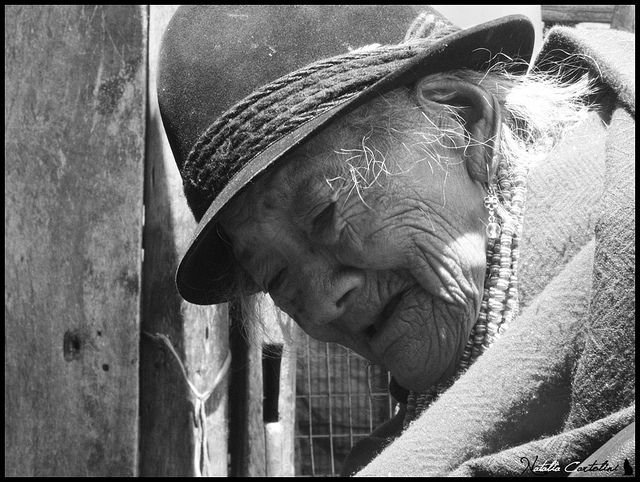
Tránsito Amaguaña, Courtesy of Natalia Cartolini
A mother by the age of 15, Tránsito Amaguaña made over 25 trips on foot to Quito to bring indigenous demands to the central government, traveled to Cuba and the Soviet Union as a representative of Ecuadorian Indians in 1962, and became heavily involved in leftist politics (Becker, “Race,” 130-131). She also helped to organize some of the first unions of agricultural workers and participated in the first strike of these workers in 1931 (“Tránsito Amaguaña”). Despite the burdens of class, race, and gender, Amaguaña became an important voice for Ecuadorian Indians both in Ecuador and in the rest of the world.
Nela Martínez (1912-2004)
Nela Martínez was the daughter of an upper-class landholding family from southern Ecuador (Becker, “Race,” 131). Born in 1912, she was an active member of the Communist Party from 1934 to 1956, and became one of its most important leaders (“Nela Martínez. Un capítulo de la historia ecuatoriana”). Along with other upper-class women in Quito, she helped found the Alianza Femenina Ecuatoriana (AFE) in 1939; this organization aimed to promote world peace and to help women become leaders in anti-government movements (Becker, “Race,” 131-132). She also assisted Dolores Cacuango in the formation of the Ecuadorian Federation of Indians (FEI), and served as a Minister of Government for three days in the aftermath of the 1944 May Revolution (Becker, “Citizens”). In 1945 she participated in the National Assembly as a representative of the working class; in this position she advocated for women’s rights and sought to end gender discrimination in political and social life (Becker, “Race,” 131). Martínez was also a skilled writer and wrote various poems and stories, as well as hundreds of articles about the condition of women in Ecuador and in support of the Cuban Revolution (“Nela Martínez”). Martínez forwarded the cause of Ecuadorian women not only through her advocacy work, but also as an example of a capable female leader.
María Luisa Gómez de la Torre (1887-1976)
More commonly known as “Lucha” (Becker, “Race” 132). Born in Quito, she, like Martínez, was involved in the Communist Party, Alianza Femenina Ecuatoriana (AFE), and the Ecaudorian Federation of Indians (FEI); she also helped found the Ecuadorian Socialist Party in 1926 (Becker, “Race,” 132). However, she is best known as a teacher; she became the first woman to teach at the prestigious all-male school Colegio Mejía in Quito, and also worked at the school Diez de Agosto, which served girls from poor families (“Maria Luisa Gomez De La Torre”). Like other female leaders during this time period, she helped to break down centuries-old gender boundaries.