
Coca and Identity in Peru
By Sabine Adrian
In Peru coca is mostly grown in the eastern Andes, especially in the regions of the Huallaga and Apurimac valleys (C. M. Allen 37) at altitudes of up to 3,000 meters above sea level (Mac Gregor 104). Coca cultivation and chewing was practiced long before the arrival of Europeans to the American continent, but took on new significance after the Spanish conquest since it was used by indigenous workers to endure brutal working conditions. Out of the clash of these peoples, coca became a symbol of indigenous identity (Allen “Hold Life Has” 220).
Anti-coca prohibitionist sentiment first arose in the 16th century. Urban elites claimed that coca chewing was a destructive addiction and was the cause of social and economic problems – a view that was internationally accepted until the late 20th century when it was overturned by empirical investigations (Gagliano 169 & Allen “To Be Quechua” 158). Moreover church leaders felt that coca represented opposition to evangelization since it was used and associated with non-Christian religious practices (Gagliano 166). The prohibitionist movement’s influence rose in response to the dramatic rise in demand for cocaine in the mid-1970s. Growing demand resulted in a coca-production boom despite the increased vigor of the prohibitionist movement (Mac Gregor 110 & Gagliano 169).
Presently, the coca bush is an appealing cash crop for unemployed rural dwellers since it matures quickly, has a long productive lifespan and requires low capital investment and production costs (Allen, C. M. 37, 50). Subsistence family farms also commonly intersperse their crops with coca to ensure a source of steady cash, especially after the decline of coffee prices in 2001 (Allen, C. M. 37-38 & Mac Gregor 105). The dispersed character of rural cultivation makes coca eradication very difficult for prohibitionists.
The U.S. government’s “war on drugs” has focused on reducing coca cultivation in cocaine-producing countries like Peru, as opposed to laying more responsibility on domestic drug consumers and dealers (Allen, C.M. 50 and Mac Gregor 128). It has attempted to reduce supply via crop substitution and eradication (Allen, C.M. 50). These strategies, in which many resources have been invested, have largely failed to raise the price or reduce the availability of cocaine (Allen, C. M. 109). Coca production has only increased, and the movement of drugs from South and Central America to the United States continues to flow while prohibition policies damage producer nations.

A Fairchild C-123K Provider supplied by the U.S. State Department to Peru as part of the War on Drugs, courtesy of the U.S. Air Force
Costs of the drug trade in Peru include environmental degradation, increased number of drug consumers, corruption and economic distortion (Mac Gregor 117-119). But US policy and the “war on drugs” also strongly affect traditional chewers. Narcotics control has severely limited Andean people’s access to coca by taxation and restricted its legal transportation (Allen “Hold Life Has” 224). Moreover, law enforcement in a society trapped by its illegal economy and influenced by social bias gives preferential treatment to middle-class leaders and elite members of the international cocaine network, perpetuating deep social divisions in Peru (Morales 127).
A large Amerindian population of 45% (“South America” web) means that indigenous issues are necessarily national issues. The cultural identity of this sector of the population must at least be a significant and meaningful part of national identity at large. Many Amazonian languages, including Spanish-Quechua and Aymara, are widely spoken throughout Peru, revealing strong and widespread associations with indigenous culture.
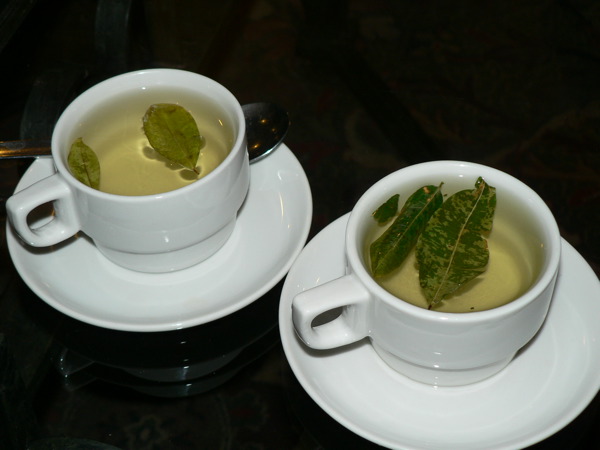
Mate de coca, a tea made from the leaves of the coca plant and a popular drink in Peru, courtesy of of user Aniko
Peru’s national identity encompasses perhaps as many different facets as its geographic diversity of jungles, highlands, deserts and beaches. Indigenous Andean culture is just one of the multi-layered mixes of identities found in Peru today. The practice of chewing coca maintains strong cultural meaning for many indigenous communities in the Andes but is probably less important in the daily routine of urban-dwellers along the coast. Nonetheless, coca issues continue to play an integral role in the country – whether in terms of social or religious practices, government prohibition policies or economics. Indeed coca holds a very important place in Peruvian national identity.