
By Justina Hwang
Between 1849 and 1874, more than 100,000 coolies arrived in Peru as a result of Ley China, which allowed for the importation of an indentured work force of Chinese laborers in order to meet Peruvian need for labor after the slaves were emancipated in 1854.[1] In 1876, the census in Peru registered 49,956 Chinese (slightly underestimated) out of a population of 2,699,160.[2] However, between 1849 and 1876, nearly half of the Chinese brought to Peru, ages 9 to 40, died from exhaustion, suicide, or ill treatment; of the deceased, few were women, given that women made up less than 1% of the Chinese population recorded before 1860.[3] By 1876, nearly 12,000 Chinese were living in Lima, representing 10% of the urban population at the time.[4]

Chinese Laborers in Peru circa 1900
Most Chinese workers labored in the sugar and cotton industries, where plantation agriculture expanded significantly in the nineteenth century as a result of the guano boom that invigorated the Peruvian economy. Peruvian planters benefited from high world sugar prices, which lasted until the 1880s, and high demand for cotton, which increased during the U.S. Civil War. The only obstacle to continuing growth for the sugar and cotton industries was a dearth of labor. Due to Great Britain’s termination of the slave trade to Peru in 1810 and the declining number of slaves, between 1892 and 1854, the number of slaves fell from 40,337 to 25,505.[5] In order to alleviate the problem, Congress passed an immigration law subsidizing the importation of contract laborers. Between 1839 and 1851, 450,000 pesos were paid to subsidize immigration at the rate of 30 pesos per immigrant to anyone who imported at least fifty workers between the ages of 10 and 40.[6] China was a good source for laborers at the time because political unrest and a relatively weak government that could not enforce order reduced millions to refugee status and made them vulnerable to labor contractors and merchants eager to profit. A typical coolie contract could last from four to eight years, often longer, depending on the hacienda owner. Unscrupulous owners could extend a coolie’s contract if they managed to increase his debt by claiming absence during work hours or charging extra for goods and services rendered.
Chinese laborers in Peru mined guano, helped build railroads, and toiled on cotton and sugarcane plantations until the end of the coolie trade in 1874. This new policy helped to bring about the decline of the Peruvian economy in the 1870s and 1880s.[7] The end of the coolie trade was a result of Chinese governmental stability (it now had the ability to execute labor contractors and blockade Macao to cut off the supply of labor) and British refusal to allow the coolie trade to continue.[8]
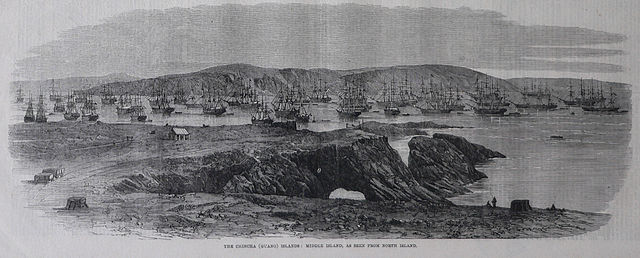
Chincha Islands, where large deposits of guano were located, courtesy of Manuel González Olaechea y Franco and The Illustrated London News
On plantations, the coolies faced limited mobility via debt peonage and tightly controlled lives via corporal punishment. On plantations, many coolies resisted total domination by planters through tactics very similar to those of African slaves and indentured servants, sometimes going against Chinese contractors that acted as enforcers.[9] Coolies would steal, run away, pretend to be sick, strike, and hold back or disrupt production in order to frustrate owners in the hope of gaining concessions that would better their living conditions.
In general, the Peruvian government was unconcerned about the everyday abuses of the coolies and even created legislation to help the planters. All Chinese were required by law to carry a letter from their employer stating that they had completed their work contracts and were required to register with local authorities and purchase a “boleto de su ocupación.”[10] Even though a special Chinese Commission, made up of Chinese and Peruvian officials, was formed in 1887 to inspect the living conditions of Chinese subjects in Peru, the Commissioners too were unconcerned about the general welfare of the coolies, caring only about “gross injustices, such as corporal punishment, illegal imprisonment in plantation jails, contract violations, and wages that fell below the subsistence level.”[11] While both planters and the Peruvian government recognized the need for Chinese labor, even that acknowledgement was not an incentive to treat them well; instead, racist views about unworthiness of the Chinese race prevailed. Runaways, who often fled to escape terrible living and working conditions, were pursued by subprefects, governors, and police, and punished by having to work off the costs of their recovery. Eventually, a majority of the coolies finished their contracts and chose to continue working on the plantations. According to Michael Gonzales, without Chinese workers, “Peruvian planters could never have survived the crisis of the 1870s and 1880s and emerged as wealthy businessmen and political leaders in the 1890s.”[12]
Some coolies also migrated to the cities after successful completion of their contract. In cities such as Lima, some Chinese men were employed as domestic servants or artisans; they had more freedom to form households with native Peruvians, resulting in children of mixed race beginning in the 1850s.[13] While the coolies were called raza amarilla, china, chinos de la Gran China, chinos del imperio celeste, Celestes, or Nación asiática, in respectful terms, and los amarillos or Macacos in popular but less polite terms, their mixed-race offspring, who began emerging in 1870, would not be given any particular name or racial category until the twentieth century.[14] As historian Isabelle Lausent-Herrera points out, the lack of racial classification by authorities, a practice that extended as far back as the corporate society of the early colonial era, signified that the Chinese-Peruvians had no real place in Peruvian society.
By the late nineteenth and early twentieth centuries, however, the Chinese were beginning to carve a place for themselves in Peru. In the late 1880s, a few Chinese became planters themselves, while others became established merchants. Wing On Chiang & Cia. of Piura sold opium to planters, and a major wholesaler in Pisco was a Chinese man named José Elías.[15] These men, however, were exceptions to the rule as most Chinese established small stores, restaurants, vegetable stands, or worked as artisans.[16]In the late nineteenth century, urban Chinese formed native place associations and established hierarchies within their communities in the cities and integrated themselves into Peruvian society by converting to Catholicism. While the Chinese community experienced its share of tensions from within and without the community during the twentieth century, the Chinese have largely survived and flourished in Peru.
[1] Isabelle Lausent-Herrera, “Tusans (tusheng) and the Changing Chinese Community in Peru,” Journal of Chinese Overseas 5 (2009): 116.
[2] Ibid 116.
[3] Ibid, 116.
[4] Ibid, 116.
[5] Michael J. Gonzales, “Chinese Plantation Workers and Social Conflict in Peru in the Late Nineteenth Century,” Journal of Latin American Studies, Vol. 21, No. 3 (Oct., 1989): 390.
[6] Ibid 390.
[7] Ibid, 386.
[8] Gonzales, 391.
[9] Gonzales, 387.
[10] Ibid, 392.
[11] Ibid, 393.
[12] Ibid, 387.
[13] Lausent-Herrera, 117.
[14] Ibid, 118.
[15] Gonzales, 423.
[16] Ibid, 423.